 Cat Trivia Games
iOS App
Donskoy Cat Breed
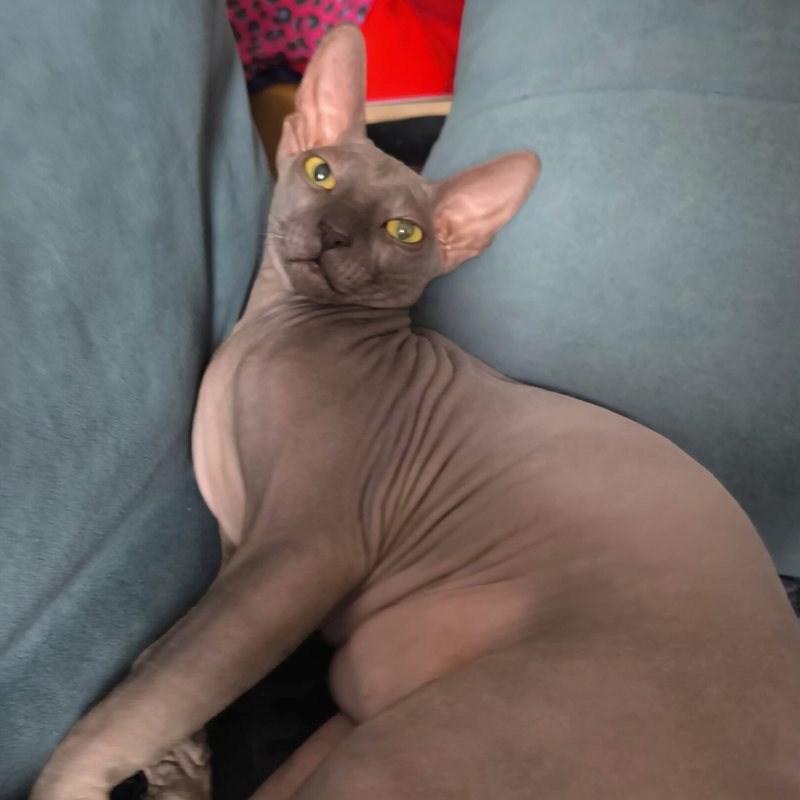

The Donskoy, also called the Don Sphynx, is a Russian breed with a distinctive coat-loss trait. Coat types vary, and some retain hair. Many are described as sociable and curious, while their skin and temperature needs require attention beyond ordinary brushing.
Quick facts
- Origin: Rostov-on-Don, Russia, 1987
- Coat: four types, from born bald to brush cats that keep much of a wiry coat
- Genetics: a dominant hair-loss trait; the gene has not been identified
- Life expectancy: 12 to 15 or more years (TICA)
- Registry: a TICA championship breed; not listed by CFA (checked October 2026)
Temperament and daily life
Donskoys are usually very social cats. TICA describes a breed whose social skills extend to other animals, says it should not be without a companion pet, and notes that many can be trained to follow voice commands. Most enjoy company and play, so climbing space, food puzzles and regular interaction suit them. Introductions and the individual cat's temperament matter with children and other pets.
Grooming and care
Little or no hair changes the care routine; it does not remove it. Skin oil that a coat would absorb builds up on the skin, so hairless cats can feel greasy, mark furniture and collect oil in their nail beds, and the skin may be prone to yeast infections. Regular bathing is part of their care, but frequent baths can dry the skin, so ask your veterinarian about a skin-care routine for your cat.
Warmth and sun matter too. A hairless cat feels the cold, so give it warm resting places, and keep it indoors, out of strong sun, since bare skin burns. If sunscreen comes up, International Cat Care advises using only a product made for pets and labeled as safe for cats.
Health and welfare considerations
Hairlessness itself is the main welfare question. International Cat Care's position, in its profile of the Don Sphynx, was that the breed is derived from a mutation that inevitably compromises the health of the cat, and that it would not advocate breeding any more. Its current guidance lists hairless cats among the traits that should not be continued through further breeding.
Beyond the skin and temperature needs above, published breed-specific health information is limited, and that does not establish that the breed is free of inherited disease. Ask a breeder which health checks the parents have had, and have your veterinarian check the skin, ears and nails at routine visits.
History
In 1987, in Rostov-on-Don, Elena Kovaleva, a professor at the city's pedagogical institute, rescued a kitten that went on to lose her hair. The cat, Varvara, was treated without success, and when she later had kittens, some lost their hair the same way. Breeder Irina Nemikina developed the line into a new breed, first known as the Don Sphynx.
TICA changed the breed's name to Donskoy in 2005, accepted it as a Preliminary New Breed in 2006, and listed it among its championship breeds by 2018. The Cat Fanciers' Association does not list it (checked October 2026).
Appearance
The Donskoy is a medium-sized cat, and males are significantly larger than females. TICA describes four coat types. Rubber bald cats are born bald and stay that way. Flocked cats look hairless, with a very short coat that can disappear. Velour cats are born with a bald spot on the head and a coat that fades during the first year or so, often leaving some hair on the face, legs and tail. Brush cats lose only part of their coat and are often wiry all over, with bald areas. Some grow a fine winter coat on the chest and tail tip.
Before choosing a Donskoy
A Donskoy is an affectionate companion with an involved care routine: regular skin care, warm places to rest and protection from sun and cold. International Cat Care advises against continuing to breed hairless cats, so if you are drawn to one, consider an adult that already needs a home. Meeting the individual cat tells you more about its temperament than the breed description.
Donskoy FAQ
Is a Donskoy the same as a Sphynx? No. The two breeds have separate histories, the Sphynx from a mutation found in 1966 and the Donskoy from a cat found in Russia in 1987, and different genetics. The Sphynx's hairlessness comes from a recessive variant of the KRT71 gene, while the Donskoy carries a semi-dominant hairless mutation whose cause has not been identified.
Are Donskoy cats hypoallergenic? No breed can be assumed safe for someone with a cat allergy, and having little or no hair does not change that. Spend time with the individual cat before committing.
Sources
- The International Cat Association: Donskoy, the Donskoy breed introduction, and board minutes from the 2005 annual, 2006 semi-annual and 2018 annual meetings (archived copies)
- Abitbol M. et al. (2015), PLOS ONE: Sphynx KRT71 and the Donskoy and Peterbald hairless mutation
- International Cat Care: Don Sphynx (2018, archived copy), inherited disorders in cats and should I use sunscreen on my cat?
- PetMD: hairless cat breeds
- Cat Fanciers' Association: breeds (checked October 2026)
Quick quiz: 3 questions about the Donskoy cat
What type of coat is most likely to result in a Donskoy that remains bald for life?
Answer: Rubber Bald. Per TICA's breed profile, 'The Rubber Bald is born bald and remains that way throughout its life,' making it the coat type most reliably linked to lifelong hairlessness. Source
What is a common skin trait found on Donskoy cats?
Answer: Wrinkled skin around the face and neck. Donskoy skin is notably wrinkled, especially around the face and neck. A hallmark of the breed's bare-skin look, unrelated to fat, calluses, or skin temperature. Source
Which of the following is a correct description of the Flock Coat type in Donskoy cats?
Answer: Feels like suede and looks hairless, may go fully bald. Per TICA's official standard, the Flock coat 'appears hairless' with the texture of a soft chamois from the start, and can progress to complete baldness. A different pattern from Velour (wavy coat that thins) or Brush (wiry coat that keeps patches). Source