 Cat Trivia Games
iOS App
Scottish Fold Cat Breed
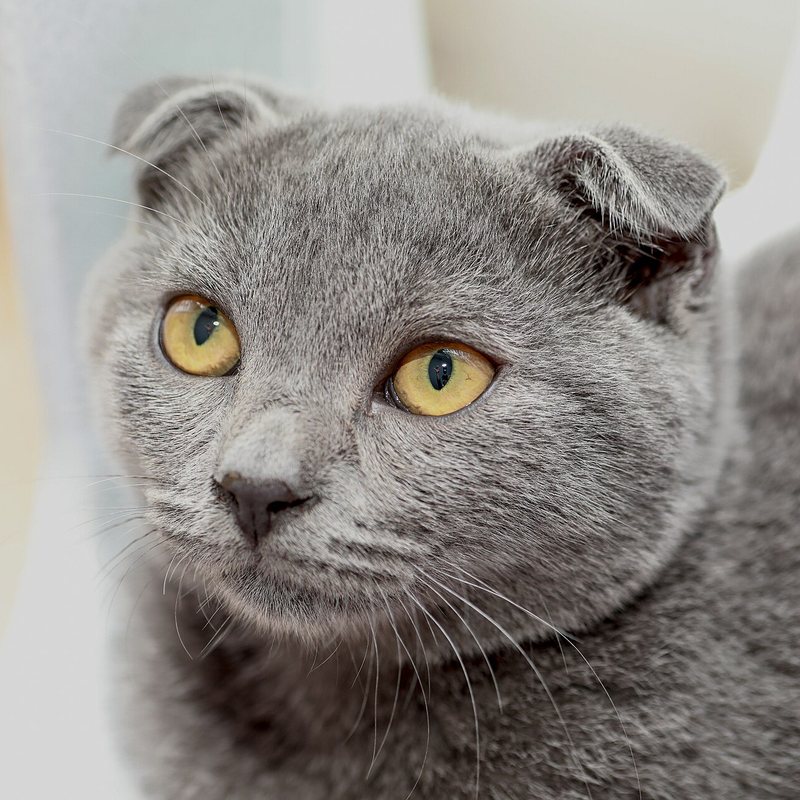

The Scottish Fold is known for ears that fold forward. The trait is linked to a mutation affecting cartilage, which raises serious welfare concerns beyond appearance. Anyone caring for a Fold should understand the associated joint disease and work with a veterinarian on comfort and mobility.
Quick facts
- Origin: a white farm cat named Susie, found in the Tayside region of Scotland in 1961
- Ears: begin to fold at three to four weeks of age, caused by a dominant variant of a cartilage gene, TRPV4
- Welfare: every cat with folded ears develops osteochondrodysplasia, a disorder of cartilage and bone (UFAW)
- Size and lifespan: medium-sized, 7 to 10 pounds, with a life expectancy of 11 to 14 or more years (TICA)
- Registries: recognized by CFA and TICA; Britain's GCCF stopped registering the breed by 1974, and FIFe bans it
Health and welfare considerations
The variant that folds the ear cartilage also affects cartilage and bone development throughout the body. The result is osteochondrodysplasia, which the Universities Federation for Animal Welfare (UFAW) says develops in all cats with folded ears. Cats with two copies of the variant are severely affected, with deformed limbs, a thick and inflexible tail and crippling arthritis early in life. In cats with one copy, which is enough to fold the ears, the arthritis tends to progress more slowly, but its course varies: UFAW describes it as very mild in some cats and as significant, painful joint disease in others, sometimes from as young as six months.
Signs can be subtle. International Cat Care lists reluctance to move, walking stiffly, not curling up comfortably, limping and difficulty jumping, and says pain may also show as hiding, a smaller appetite, accidents outside the litter tray or grooming less. A slower, quieter cat is not necessarily a calm one. Tell your veterinarian about stiffness, reluctance to jump or changes in movement. Do not force a painful joint or tail. X-rays help show how far the disease has progressed.
The disease has no cure, but that does not mean nothing can be done. A veterinarian can help manage pain with medication and suggest changes at home to make daily life more comfortable. UFAW notes that long-term pain relief can itself have side effects, which is one reason the plan belongs with your veterinarian, and that surgery on affected joints and, in one reported case, radiation therapy have been used to ease pain.
Breeding a folded cat only to a straight-eared cat, which CFA says responsible breeders do to minimize arthritic and bone problems, avoids kittens with two copies of the variant. It does not protect the folded kittens of those litters, all of which still carry one copy and develop the disease to some degree. International Cat Care considers it unethical to continue breeding cats with a mutation known to cause significant painful disease, and UFAW states that stopping breeding from folded-eared cats would eliminate the condition within a generation.
PetMD also lists hypertrophic cardiomyopathy and polycystic kidney disease (PKD) for the breed. UC Davis includes the Scottish Fold and Scottish Straight among the breeds for its PKD1 DNA test, which covers that one variant; a genetic test cannot show how seriously a cat is affected, and Cornell notes that ultrasound gives the definitive diagnosis.
Temperament and daily life
CFA describes Scottish Folds as "comfortable, charming homebodies who enjoy but do not crave human interaction": quiet but not placid, sometimes reserved with strangers and other cats, usually patient with children, and not suited to being left alone for long periods. Many like to follow their people from room to room and will play fetch or learn simple tricks. Individual cats vary, and joint pain can change how much a cat wants to play, climb or be handled.
Gentle play on the floor suits a cat whose joints may be sore. Low beds or steps up to favorite spots, ramps, rugs on slippery floors, raised food and water bowls and a litter tray with low sides all make daily life easier. Keeping the cat at a healthy weight also spares its joints.
Grooming and care
The shorthaired coat needs a weekly combing, and longhaired Folds need combing more often to prevent tangles and mats. Both shed year-round, more heavily in spring and fall. Check the ears as part of routine care and have any smell, discharge or head shaking checked by your veterinarian. A cat with stiff joints may find it harder to groom itself, which is another change worth mentioning at a checkup.
History
In 1961 a shepherd, William Ross, noticed a copper-eyed white cat named Susie with folded ears on a farm in the Tayside region of Scotland. Susie had only one litter, and her daughter Snooks became the foundation queen. Bred first to a domestic male and then to a British Shorthair, Snooks produced folded-ear kittens with both, and in America the breed was later outcrossed to American and British Shorthairs.
The breed's registry history divided early. Britain's Governing Council of the Cat Fancy recognized it for a few years but had excluded it by 1974 because of the limb and tail deformities seen in the breed, and FIFe bans it. CFA granted championship status to shorthaired Folds in 1978 and to longhaired Folds in 1992, and accepted straight-eared cats in 2022. In 2016 researchers identified the cause of the folded ears and the bone disease as a variant in the TRPV4 gene (EveryCat Health Foundation).
Appearance
"Round" is the word CFA uses most: a round head, large round eyes and a medium-sized, well-padded body. The folded ears have rounded tips and fit the head like a cap, and the CFA standard prefers a small, tightly folded ear. Its standard disqualifies a tail that lacks flexibility because of abnormally thick vertebrae. Folds come in shorthair and longhair and in almost any color and pattern.
Before choosing a Scottish Fold
UFAW and International Cat Care both treat the fold itself as the welfare problem, and International Cat Care calls continued breeding for it unethical, so the most useful step is not to create demand for more folded kittens. If you already care for a Fold, or are adopting one that needs a home, plan for regular veterinary checks, pain management when it is needed and a home arranged so the cat does not have to jump. No health certificate or breeder checklist removes the joint disease that comes with folded ears.
Scottish Fold FAQ
Do folded ears affect a Scottish Fold's hearing? No. CFA notes that the folded ears have no effect on the cat's hearing. The welfare concern is the effect of the same mutation on cartilage and bone elsewhere in the body.
Is a straight-eared Scottish cat free of the fold disease? UFAW says straight-eared kittens from a folded and a straight-eared parent do not have the fold variant or the disease. Ears only begin to fold at three to four weeks, so a very young kitten's ears are not the whole answer; a DNA test for the variant is available from labs such as UC Davis. Straight ears say nothing about other inherited conditions, and temperament still varies from cat to cat.
Sources
- Universities Federation for Animal Welfare (UFAW): Scottish Fold osteochondrodysplasia
- International Cat Care: Scottish Fold osteochondrodysplasia
- Cat Fanciers' Association (CFA): Scottish Fold and its breed standard
- The International Cat Association (TICA): Scottish Fold
- PetMD: Scottish Fold
- EveryCat Health Foundation: genetics and osteochondrodysplasia in Scottish Fold cats (TRPV4)
- UC Davis Veterinary Genetics Laboratory: PKD1 test and list of cat DNA tests
- Cornell Feline Health Center: polycystic kidney disease
One question about the Scottish Fold cat
What kind of body shape does the Scottish Fold typically have?
Answer: Rounded and medium-sized. Scottish Folds are medium-sized, well-padded cats with a round head, round eyes and a rounded body, giving them their signature soft, circular look. Source