 Cat Trivia Games
iOS App
Maine Coon vs Norwegian Forest Cat: How to Tell Them Apart
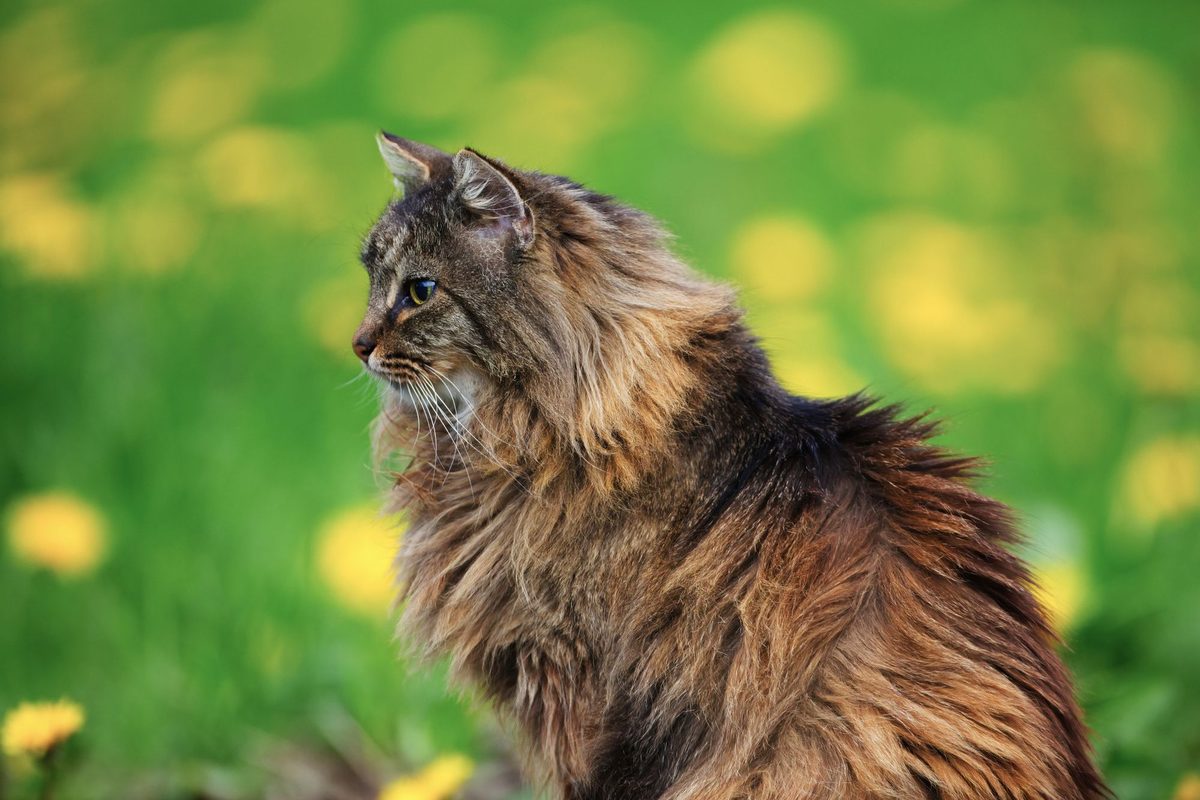
Look at the head from the side, then from the front. In the breed standards, a Maine Coon has a visibly square muzzle and a nose line with a slight dip, and a Norwegian Forest Cat has a triangular head with a profile that runs straight from brow to nose tip. Ear set and coat texture back those up. Eye shape, tail and weight are weaker clues, because the registries disagree or the two breeds overlap.
The head gives the fastest answer
CFA's Maine Coon standard asks for a muzzle that is "visibly square" and blunt ended in profile, a chin deep enough to make a square, 90-degree angle, and a profile with a slight concavity.1 Its Norwegian Forest Cat standard asks for a head shaped like an equilateral triangle, measured from the outer base of each ear to the point of the chin, and a nose profile that is straight from the brow ridge to the tip of the nose.2
Each standard also rules out the other breed's head. CFA says a Maine Coon profile that is straight from brow line to nose tip "is not acceptable",1 and it disqualifies a Norwegian Forest Cat with a square muzzle or a long rectangular body.2 TICA penalizes a Maine Coon for a straight profile, a narrow or triangular muzzle, or a woolly or cottony coat.3
Ears are the next check. A Maine Coon's are set about one ear's width apart.1 A Norwegian Forest Cat's sit as much on the side of the head as on top, so their outer edges continue the line of the head down to the chin.2
Maine Coon and Norwegian Forest Cat side by side
Standards and recognition dates here are as of November 2026. For each breed on its own, see the Maine Coon and Norwegian Forest Cat guides.
| Trait | Maine Coon | Norwegian Forest Cat | Source |
|---|---|---|---|
| Origin | New England, United States; documented to the 1850s (CFA), first recorded in 1861 (TICA) | Norway; exact origins not clear | CFA,12 TICA3 |
| Head and profile | Slightly longer than wide; slight concave curve in profile; a straight profile is not acceptable | Equilateral triangle; straight from brow ridge to nose tip, with no break | CFA12 |
| Muzzle and chin | Visibly square, blunt-ended muzzle; strong chin in line with the upper lip and nose | Muzzle follows the straight line toward the base of the ear, without pronounced whisker pads; firm chin, gently rounded in profile | CFA12 |
| Ears | Large, well tufted, wide at the base, tapering to appear pointed; about one ear's width apart | Medium to large, set as much on the side of the head as on top; tips rounded (CFA) or pointed (FIFe) | CFA,12 FIFe4 |
| Eyes | Large, opened oval, slightly oblique (CFA); full and round (GCCF) | Large and almond shaped (CFA); large and oval (FIFe) | CFA,12 GCCF,5 FIFe4 |
| Body and legs | Long body with a rectangular look; legs of medium length | Body moderate in length (CFA) or long (FIFe); hind legs longer than front legs, so the rump is higher than the shoulders | CFA,12 FIFe4 |
| Coat | Heavy and shaggy; shorter on the shoulders, longer on the stomach and britches; silky, falling smoothly | Double coat: dense undercoat under long, glossy, water-resistant guard hairs; three-part bib and full britches | CFA12 |
| Tail | Long, wide at the base and tapering, with long, flowing fur | Long and bushy; desirable length equal to the body from base of tail to base of neck | CFA12 |
| Weight | Mature males can reach or exceed 20 lb, females usually smaller (CFA); 10 to 20 lb (GCCF) | Males 12 to 16 lb, females 9 to 12 lb (CFA); 9 to 16 lb (GCCF) | CFA,12 GCCF56 |
| Full growth | Up to three years (CFA), up to four (GCCF), four to five (TICA) | About five years (CFA); four to five (GCCF) | CFA,12 GCCF,56 TICA3 |
| Temperament in the registry's words | "Gentle, easy going yet active" (CFA); "Sweet natured, playful & friendly" (GCCF) | "Active and sweet" (CFA); "Gentle & friendly" (GCCF) | CFA,12 GCCF56 |
| Inherited conditions CFA names | Hypertrophic cardiomyopathy and hip dysplasia | Hypertrophic cardiomyopathy and glycogen storage disease | CFA12 |
| Recognition | CFA championship 1976; TICA championship 1979; FIFe 1982; GCCF championship 1993 | FIFe 1977 (FIFe) or 1976 (GCCF); CFA championship 1993; GCCF championship 1997 | CFA,12 TICA,3 FIFe,74 GCCF56 |
Three checks you can do at home
Each check compares a cat with the written standards. Wait until the cat is relaxed and just look.
- Profile from the side. At the cat's eye level, follow the line from the brow to the nose tip. A slight dip fits the Maine Coon standard, an unbroken straight line the Norwegian Forest Cat's.
- Muzzle from the front. A blunt, boxy muzzle over a deep chin fits the Maine Coon. A face that narrows in straight lines from the ears to the chin fits the Norwegian Forest Cat.
- Coat feel. A Maine Coon coat is silky and falls smoothly.1 A Norwegian Forest Cat has a dense, woolly undercoat beneath long, glossy guard hairs that repel water.24
A match on all three shows which standard a cat resembles, not its ancestry. A cat without registration papers is a domestic longhair, CFA's name for a longhaired cat of unknown heritage.8 For a longer checklist, try the Is my cat a Maine Coon quiz.
Which one is bigger?
By the registries' figures, the Maine Coon, though the ranges overlap. CFA says a mature male Maine Coon can reach or exceed 20 pounds, and gives Norwegian Forest Cat males 12 to 16.12 GCCF lists 10 to 20 pounds for the Maine Coon and 9 to 16 for the Norwegian Forest Cat.56 A 14-pound cat fits either breed.
"The largest of all pedigreed cats" is CFA's phrase for the Maine Coon, and it comes without a measurement. CFA's standard asks for a "medium to large" cat and says quality should never be sacrificed for size.1 FIFe classes both breeds as large.74
Where each breed comes from
The Maine Coon's roots are in New England, where CFA says shorthaired ship cats landed with early settlers. A brown tabby named Cosey was chosen Best Cat at the first U.S. cat show, in 1895.1
The Norwegian Forest Cat's exact origins are not clear, CFA says. Norse myth has two gigantic "Skogkatts" pulling the goddess Freya's chariot. The breed was almost lost through interbreeding with shorthaired strays until, in the mid-1970s, a Norwegian breed club began a breeding program from selected non-pedigreed cats. The first breeding pair reached the United States in 1979.2
Two dates differ by source. FIFe's standard gives 1977 for its recognition of the breed, and GCCF says FIFe first registered it in 1976.46 CFA says King Olaf named it the official cat of Norway in the 1970s, and GCCF says the 1950s.26
Temperament, as the registries describe it
Both breeds are described as friendly cats that keep some independence. CFA's Maine Coon is sociable and loyal, wants a moderate amount of human interaction, and chirps and trills more often than it meows.1 CFA's Norwegian Forest Cat is not clingy, sits on a lap when it decides to, and likes high places.2 GCCF calls Maine Coons high energy and says Forest Cats can be reserved with strangers.56
These are tendencies. Meet the individual cat, and take introductions to children and other pets slowly.
Grooming and care
On CFA's advice, the Maine Coon needs the comb more often. Breeders recommend two or three times a week for a Maine Coon, and CFA says the Norwegian Forest Cat's double coat does not need a lot of maintenance beyond regular combing.12 Spring is the heavy season for both: GCCF says Maine Coons can shed quite heavily then,5 and CFA says the Forest Cat needs more attention as its winter coat gives way to a lighter one.2 A tight mat close to the skin is a job for a veterinarian or qualified groomer.
Health: what the primary sources name
The shared concern is hypertrophic cardiomyopathy (HCM), a thickening of the heart muscle. The Cornell Feline Health Center lists both among the breeds in which HCM is more prevalent, and says it is diagnosed by echocardiography.9 A 2024 review advises routine genetic testing for only two HCM variants: A31P in the Maine Coon and R818W in the Ragdoll.10 A negative result for one HCM-associated variant does not rule out every cause of HCM.
Hip dysplasia is rare in cats compared with dogs, and Cornell says it seems to be more prevalent in certain breeds, such as Maine Coons.11
In the Norwegian Forest Cat, glycogen storage disease type IV (GSD IV) is an inherited disorder, passed on as an autosomal recessive trait.6 In the 2007 study that identified the mutation, most affected kittens died at or soon after birth, and survivors looked normal until about five months of age, when progressive neuromuscular degeneration began. Its screening of 402 privately owned Norwegian Forest Cats found 58 carriers and 4 affected cats, a sample that is not a current rate.12 A DNA test is available,6 and CFA says breeders now routinely test for both conditions.2
None of this predicts one cat's health. Ask a breeder which tests and heart scans the parents had. A cat breathing with difficulty or with an open mouth needs a veterinarian right away.9
Frequently asked questions
Is a Maine Coon bigger than a Norwegian Forest Cat?
Usually, on the registries' figures, but age matters. CFA gives a Maine Coon up to three years to reach full growth and a Norwegian Forest Cat about five, so a young cat of either breed may not be full size.12
Are Maine Coons and Norwegian Forest Cats related?
None of the registries I checked documents a shared ancestry. FIFe lists cats imported by Vikings among the stories told about the Maine Coon's origin,13 and CFA says Viking explorers may have brought Forest Cats to the east coast of North America in the late 900s.2 Neither presents it as a record.
How well do you know cat breeds?
Play a round of questions on breeds, behavior, biology and history. Cat Trivia is free to play in your browser, with no account.
Play Cat TriviaUp next
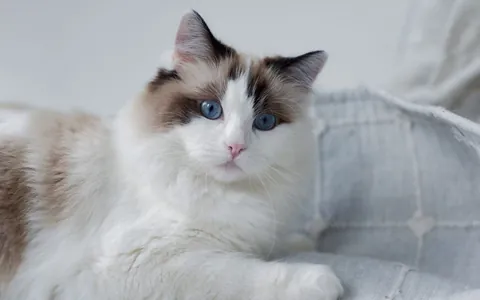 Cat FactsRagdoll vs Maine Coon: Eyes, Coat, Size and Temperament ComparedThe same side by side check, with the Ragdoll in place of the Norwegian Forest Cat.
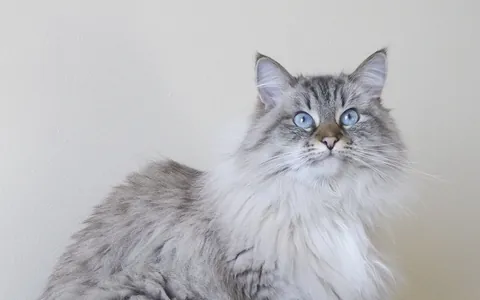 Cat BreedsSiberianA third longhaired breed, covered in its own guide.
Breed photos: mostly Wikimedia Commons contributors under free licenses, cropped. Every photographer and license is on the photo credits page.
Christopher writes and runs Cat Trivia Games. The sources for this article are listed below, and how the site is made and corrected is on the editorial policy page. More about the author.
References
- Cat Fanciers' Association. Maine Coon Cat: breed profile and breed standard. back
- Cat Fanciers' Association. Norwegian Forest Cat: breed profile and breed standard. back
- The International Cat Association (TICA). Maine Coon Breed Group standard (revised May 1, 2025). back
- Fédération Internationale Féline (FIFe). Norwegian Forest Cat breed standard. back
- Governing Council of the Cat Fancy (GCCF). Maine Coon. back
- Governing Council of the Cat Fancy (GCCF). Norwegian Forest Cat. back
- Fédération Internationale Féline (FIFe). Maine Coon breed standard. back
- Cat Fanciers' Association. Finding the purr-fect pedigreed kitten. back
- Cornell Feline Health Center. Hypertrophic cardiomyopathy. back
- Boeykens F, et al. Classification of feline hypertrophic cardiomyopathy-associated gene variants according to the American College of Medical Genetics and Genomics guidelines. Frontiers in Veterinary Science, 2024. back
- Cornell Feline Health Center. Hip dysplasia. back
- Fyfe JC, et al. A complex rearrangement in GBE1 causes both perinatal hypoglycemic collapse and late-juvenile-onset neuromuscular degeneration in glycogen storage disease type IV of Norwegian forest cats. Molecular Genetics and Metabolism, 2007. back
- Fédération Internationale Féline (FIFe). Maine Coon breed profile. back
This is general information, not veterinary advice. Written by Christopher Fox under our editorial policy.