 Cat Trivia Games
iOS App
HOME / BREEDS / NORWEGIAN FOREST CAT
Norwegian Forest Cat Breed
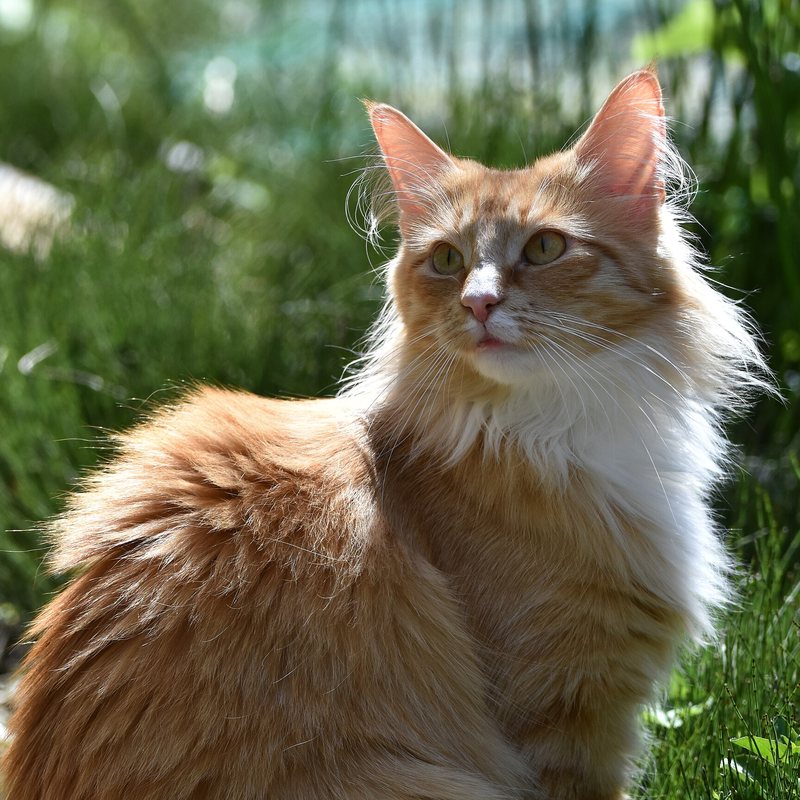

The Norwegian Forest Cat is a large, sturdy cat with a thick coat and a strong interest in climbing. Many enjoy spending time near their people without always wanting to sit on a lap. Their coat needs regular attention, especially during seasonal shedding.
Quick facts
- Weight: males 12 to 16 pounds and females 9 to 12 (CFA); TICA gives 12 to 18 and 8 to 12
- Maturity: slow; up to five years to reach full growth (CFA)
- Life expectancy: 13 or more years (TICA)
- Coat: a dense undercoat under long, glossy, water-resistant guard hairs
- Recognition: FIFe since 1977, TICA championship since 1984 and CFA championship since 1993
Temperament and daily life
CFA describes the breed as independent and intelligent, and as moderately active, sensitive, friendly and adaptable. Many enjoy being near their people without always wanting to sit on a lap, and many like high places, sometimes choosing the top of the kitchen cabinets as a favorite spot. A tall, sturdy cat tree and shelves the cat is allowed to use give it somewhere better to climb. How a particular cat gets on with children and other pets depends on its temperament and on careful introductions.
Grooming and care
The coat changes with the seasons: it can be fuller in winter, when the dense undercoat is fully developed, and the heavy seasonal shed is when it needs the most help. Longhaired indoor cats can need grooming sessions every few days to prevent tangles. Pay extra attention to the armpits and the area between the hind legs, where knots form most easily. Tease a mat apart with your fingers and never cut it out with scissors; a tight mat close to the skin is a job for a veterinarian or qualified groomer. Ask your veterinarian to check body condition at routine visits, since body shape is hard to judge under a thick coat.
Health considerations
Glycogen storage disease type IV (GSD IV) is an inherited, recessive condition identified in Norwegian Forest Cats. According to UC Davis, most affected kittens die at or soon after birth; in rare cases a kitten appears normal until about five months of age and then develops fever, muscle tremors and muscle wasting, and eventually dies. A DNA test exists for the GSD IV defect identified in the breed, so breeding cats can be tested for it.
Hypertrophic cardiomyopathy (HCM), a thickening of the heart muscle, is the second concern: the Norwegian Forest Cat is among the breeds in which HCM is more common. Unlike GSD IV, HCM in this breed has no DNA test in routine use; a 2024 review recommends routine genetic testing only for one variant each in the Maine Coon and the Ragdoll, so screening relies on cardiac evaluation, usually an echocardiogram. Both conditions have occurred in the breed, and breeders now routinely test for them. Pyruvate kinase deficiency, an inherited form of anemia, is also reported in the breed, and a DNA test for it covers the Norwegian Forest Cat.
History
TICA calls the Norwegian Forest Cat a natural breed, and Norse myth tells of two giant "skogkatts" drawing the goddess Freya's chariot. Plans to develop the breed began in the 1930s but were interrupted by the Second World War. In the mid-1970s, members of Norway's first breed club began a breeding program based on carefully selected non-pedigreed cats, and FIFe recognized the breed in 1977. The first breeding pair arrived in the United States in 1979. TICA says it was the first North American registry to grant the breed championship status, in 1984, and CFA followed in 1993.
Appearance
CFA's standard describes a large, sturdy cat with a distinctive double coat: a dense undercoat covered by long, glossy, water-resistant guard hairs, a bib made of a short collar, side "mutton chops" and a frontal ruff, and full britches on the hind legs. The head forms an equilateral triangle with a straight profile from the brow ridge to the tip of the nose, and the eyes are large and almond-shaped. Heavily furnished ears, paws with heavy tufting between the toes and a long, bushy tail complete the look.
Before choosing a Norwegian Forest Cat
Plan for regular grooming, with extra time during seasonal sheds, for climbing space, and for routine veterinary care. Ask a breeder about the parents' GSD IV test results and heart screening, and remember that the breed matures slowly, so a young cat is not yet its adult size. A visit with the individual cat will tell you more about its temperament than any breed profile.
Norwegian Forest Cat FAQ
How can you tell a Norwegian Forest Cat from a Maine Coon? Look at the head. CFA's standard for the Norwegian Forest Cat calls for an equilateral triangle with a straight profile from the brow ridge to the nose, while its Maine Coon standard calls for a rectangular head with a square muzzle and a gently concave profile.
Do Norwegian Forest Cats live well with children? Some live comfortably with children. Supervise interactions and provide places where the cat can rest undisturbed.
Are Norwegian Forest Cats hypoallergenic? No breed can be assumed safe for someone with a cat allergy. Spend time with the individual cat before committing.
Sources
- Cat Fanciers' Association: Norwegian Forest Cat
- The International Cat Association: Norwegian Forest
- FIFe: Norwegian Forest Cat standard
- UC Davis Veterinary Genetics Laboratory: glycogen storage disease type IV and pyruvate kinase deficiency
- Cornell Feline Health Center: hypertrophic cardiomyopathy
- Boeykens F. et al. (2024), Classification of feline hypertrophic cardiomyopathy-associated gene variants according to the American College of Medical Genetics and Genomics guidelines. Frontiers in Veterinary Science
- ASPCA: cat grooming tips and International Cat Care: grooming your cat
One question about the Norwegian Forest Cat
Besides the Ragdoll, which two breeds were specifically linked to their own distinct FGF5 mutations in the original study?
Answer: Norwegian Forest Cat and Maine Coon. Alongside a widespread mutation shared by most long-haired breeds, researchers traced separate breed-specific mutations to Ragdolls, Norwegian Forest Cats, and Maine Coons. Source