 Cat Trivia Games
iOS App
Ragdoll vs Maine Coon: Eyes, Coat, Size and Temperament Compared
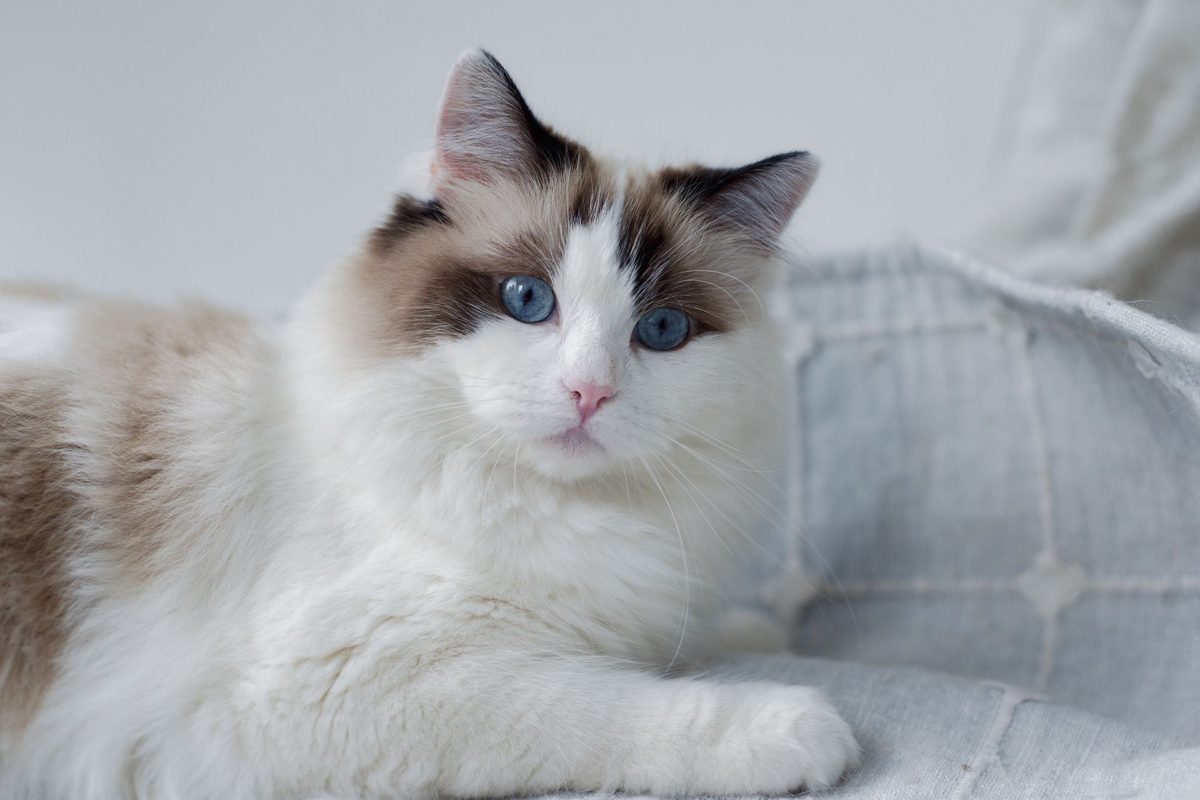
To tell them apart, check the coat pattern and the eyes. Every Ragdoll is pointed, with a body lighter than its face, ears, legs and tail, and blue eyes. CFA and GCCF rule the pointed pattern out for Maine Coons, which have large tufted ears, a shaggy coat and, under CFA's standard, green, gold, green-gold or copper eyes unless the cat is white or has white. Weight barely separates them, and Ragdolls are often described as calmer.
The quickest tells: color pattern and eyes
Every Ragdoll carries the colorpoint gene, and in mitted, bicolor and van Ragdolls white partly covers the points. CFA disqualifies a Ragdoll with eyes of any color other than blue.1
Maine Coon rules run the other way. CFA disqualifies Maine Coons showing evidence of hybridization that results in chocolate, lavender or the Himalayan (pointed) pattern,2 and GCCF accepts "most colours, except chocolate, lilac & colourpointed".3 CFA allows blue or odd eyes only in white cats and cats with white.2 Looks cannot prove ancestry, but a longhaired cat with dark points and blue eyes fits neither registry's Maine Coon.
Ears and coat are the next clues. Maine Coons have large, well-tufted ears and a heavy, shaggy coat.2 Ragdolls have medium ears with rounded tips and minimal woolly undercoat, and CFA penalizes a thick undercoat that stands off from the body.1
Size is a weaker clue than its reputation
CFA calls the Maine Coon "the largest of all pedigreed cats" without giving a measurement, then gives both breeds the same weight line: it is not unusual for a mature male to reach or exceed 20 pounds, and females are usually smaller.21 GCCF lists 10 to 20 pounds for both.34
More detailed figures disagree. GCCF gives neutered Ragdoll males 12 to 20 pounds and females around 8 to 15,4 and PetMD gives Maine Coon males up to 25 and females 10 to 14.5 Both take three to four years to reach full size, so a one-year-old may still be growing.123
Length records favor the Maine Coon, though each is one cat. Guinness World Records verified a Maine Coon called Stewie (Mymains Stewart Gilligan) at 123 cm (48.5 in) in 2010, the longest domestic cat ever, and in 2019 added another, Barivel, measured at 120 cm (3 ft 11 in) in 2018 when he was two. Guinness no longer recognizes weight as a measurement for domesticated animals.6
Ragdoll and Maine Coon side by side
Show rules in this table are as of October 2026. For care and history, see the full Ragdoll and Maine Coon guides.
| Feature | Ragdoll | Maine Coon |
|---|---|---|
| Color pattern | Always pointed1 | Pointed pattern ruled out (CFA, GCCF)23 |
| Eye color | Vivid blue only (CFA)1 | Green, gold, green-gold or copper; blue or odd eyes only with white in the coat (CFA)2 |
| Colors | Seal, blue, chocolate, lilac, red and cream points, as solid, lynx or tortie (CFA)1 | Solid, tabby, bicolor, parti-color, shaded and smoke classes; chocolate and lavender disqualified (CFA)2 |
| Patterns | CFA: colorpoint, mitted, bicolor and van;1 GCCF: colourpointed, mitted and bi-colour4 | Tabby patterns classic, mackerel and ticked; vans shown in the with-white classes (CFA)2 |
| Head | Large, broad modified wedge with equal sides and a flat plane between the ears1 | Slightly longer than wide, square muzzle, slightly concave profile2 |
| Ears | Medium, wide set, rounded tips, tilted forward1 | Large, well tufted, wide at the base, tapering to appear pointed2 |
| Coat | Moderately long, abundant guard hairs, minimal woolly undercoat1 | Heavy and shaggy, shorter on the shoulders, longer on the stomach and britches2 |
| Weight (GCCF) | 10 to 20 lb4 | 10 to 20 lb3 |
| Full size | About four years (CFA)1 | Up to three years (CFA), up to four (GCCF)23 |
| Combing (CFA) | At least once or twice a week1 | Two or three times a week2 |
| Breed HCM variant tested (MYBPC3 gene) | R818W, first named R820W7 | A31P7 |
| UK life expectancy at birth (2024 study) | 10.31 years (95% CI 8.86 to 11.76)8 | 9.71 years (95% CI 8.42 to 11.00)8 |
| Origin | Riverside, California, 1960s1 | New England, documented to the 1850s2 |
| CFA championship status | 20001 | 19762 |
| CFA popularity list, 2026 | 2nd9 | 1st9 |
Quick quiz: how well do you know cat breeds?
Which Russian city is the Peterbald breed associated with and named after?
Answer: St. Petersburg. The breed was developed in St. Petersburg, and 'Peterbald' combines that city's name with the word 'bald'. Source
Which activity do Balinese cats typically enjoy?
Answer: Climbing to high perches. Balinese are agile, energetic cats that like to climb and survey their surroundings from above, so towers, shelves, and tall scratchers suit them well. Source
Which activity is a Cornish Rex most likely to enjoy?
Answer: Chasing toys and playing fetch. Cornish Rex cats keep their kitten-like energy into adulthood and will chase and retrieve thrown toys like a dog rather than spend the day resting. Source
Temperament: the Ragdoll tends to be calmer
CFA's Ragdoll is docile, placid and affectionate, "loving without being demanding", and not talkative beyond a soft mew of greeting.1 Its Maine Coon is gentle, easy going yet active and fairly independent, needs moderate human interaction, and chirps, trills and occasionally meows.2 GCCF calls Maine Coons high energy.3
In a 2019 University of Helsinki study of owner questionnaires on 5,726 Finnish cats, Ragdolls were among the least active breeds and in the least aggressive, least extroverted and least fearful cluster. Maine Coons grouped with most other breeds but were among the most likely to show wool sucking.10
The study also found a genetic link between activity level and seeking contact with people in both breeds, and the authors suggest that breeding for calm, inactive Ragdolls may unintentionally favor cats that seek little contact.10 Individual cats vary, so meet the cat and take introductions to children and other pets slowly.
Grooming, heart health and lifespan
Both coats need regular combing, the Maine Coon's more often. CFA says the Ragdoll's lack of a thick undercoat means less shedding and matting,1 and GCCF says Maine Coons can shed quite heavily in spring.3 A tight mat close to the skin is a job for a veterinarian or qualified groomer.
Both breeds appear on the Cornell Feline Health Center's list of breeds in which hypertrophic cardiomyopathy (HCM), a thickening of the heart muscle, is more prevalent.11 Each has its own HCM-linked variant in the MYBPC3 gene: in a 2024 study's samples, A31P had an allele frequency of 5.68% in 14,025 Maine Coons and R818W 2.42% in 4,754 Ragdolls. None of 5,181 Maine Coons carried R818W, and one of 2,979 Ragdolls carried a single copy of A31P. The authors recommend routine testing for each variant only in its own breed.7
Cornell says HCM's cause is not clearly identified: mutations in several heart genes turn up in some affected cats, and not every cat with one develops the disease.11 A negative result for one HCM-associated variant does not rule out every cause of HCM. CFA credits testing, by x-ray for hip dysplasia and by saliva tests and echocardiograms for HCM, with helping Maine Coon breeders manage health concerns.2
Life expectancy is close. A 2024 UK study of 7,936 cats that died under primary veterinary care gives 10.31 years at birth for Ragdolls and 9.71 for Maine Coons, each from 69 deaths, against 11.74 for all cats in the study.8 The confidence intervals overlap widely, and a breed average says little about one cat.
Both breed names rest on shaky stories
The Ragdoll name traces to Ann Baker's claim that her foundation cat, Josephine, was so placid she went limp when held. CFA says this is not typical of most of today's Ragdolls.1 On GCCF's breed page, the late judge Alan Edwards calls the floppiness "pure hype" and the claim of a low pain threshold "positively dangerous". The page adds that Baker trademarked the name and set up her own registry, and that breakaway breeders later wrote the standard the major registries use.4
The "Coon" comes from a theory, prompted by the bushy, ringed tails of brown tabbies, that cats had mated with raccoons. CFA notes the pairing is genetically impossible and lists other legends, from Marie Antoinette's Turkish Angoras to a sea captain named Coon. It traces the breed to the 1850s, and a brown tabby named Cosey won Best Cat at the first U.S. cat show, in 1895.2
Frequently asked questions
Are Ragdoll kittens born white?
Yes. GCCF says all Ragdoll kittens are born white, and the point color starts to show a few days after birth and may darken into adulthood.4 CFA gives two years for full coat color in its breed profile and about three in its standard.1
Can a Ragdoll or a Maine Coon have extra toes?
Not in a CFA show ring. The Maine Coon standard calls for five toes in front and four behind and disqualifies an incorrect number,2 and the Ragdoll standard disqualifies extra toes.1
Which breed is more popular?
In CFA's 2026 list, based on the previous year's data, the Maine Coon ranked first for the second year in a row and the Ragdoll second.9 CFA's Ragdoll profile still calls the breed the most popular breed in the world by CFA registration statistics, so check the year on any ranking.1
Up next
 Photo quizGuess the Cat BreedName the breed from a photo.
 Cat BreedsBirmanAnother pointed, blue-eyed breed, with white gloves on its paws.
 Cat FactsMaine Coon vs Norwegian Forest Cat: How to Tell Them ApartTwo big longhaired breeds, and the head shapes that separate them.
Breed photos: mostly Wikimedia Commons contributors under free licenses, cropped. Every photographer and license is on the photo credits page.
Christopher writes and runs Cat Trivia Games. The sources for this article are listed below, and how the site is made and corrected is on the editorial policy page. More about the author.
References
- Cat Fanciers' Association. Ragdoll: breed profile and breed standard. back
- Cat Fanciers' Association. Maine Coon Cat: breed profile and breed standard. back
- Governing Council of the Cat Fancy (GCCF). Maine Coon. back
- Governing Council of the Cat Fancy (GCCF). Ragdoll. back
- PetMD, Janelle Leeson. Maine Coon (updated May 30, 2025). back
- Guinness World Records. A history of big cats as another Maine Coon becomes the world's longest feline (February 7, 2019). back
- Boeykens F, et al. Classification of feline hypertrophic cardiomyopathy-associated gene variants according to the American College of Medical Genetics and Genomics guidelines. Frontiers in Veterinary Science, 2024. back
- Teng KT, Brodbelt DC, Church DB, O'Neill DG. Life tables of annual life expectancy and risk factors for mortality in cats in the UK. Journal of Feline Medicine and Surgery, 2024. back
- Cat Fanciers' Association. Most popular breeds for 2026 (April 22, 2026). back
- Salonen M, Vapalahti K, Tiira K, Mäki-Tanila A, Lohi H. Breed differences of heritable behaviour traits in cats. Scientific Reports, 2019. back
- Cornell Feline Health Center. Hypertrophic cardiomyopathy. back
This is general information, not veterinary advice. Written by Christopher Fox under our editorial policy.