 Cat Trivia Games
iOS App
Ragdoll Cat Breed
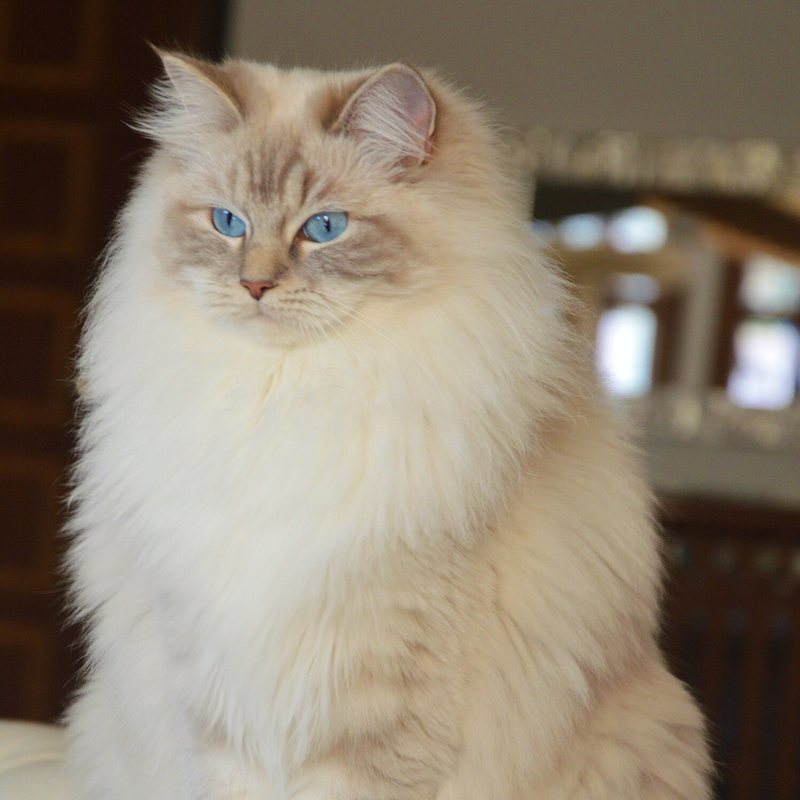

The Ragdoll is a large, semi-longhaired cat known for blue eyes and a pointed coat. Many are affectionate and relaxed around their people. Some enjoy being held, but the breed's name is not a promise that every cat will go limp in your arms.
Quick facts
- Weight: 15 to 20 pounds for males and 10 to 15 for females (TICA)
- Life expectancy: many live into their mid or high teens (TICA); PetMD says up to 17 years
- Maturity: slow; CFA says full size and weight at about four years
- Coat: semi-long and silky, always pointed, with blue eyes
- Popularity: second on CFA's 2026 list of its most registered breeds
Temperament and daily life
CFA describes Ragdolls as docile, placid and affectionate, loving without being demanding, and not talkative. Some enjoy being picked up and relax in your arms, while others do not; support the hindquarters whenever you lift a cat this size. How well a Ragdoll copes with time alone depends on the individual cat, the length of the absence and the environment, so consider the cat's needs alongside your routine. Introductions and the individual cat's temperament matter with children and other pets.
Keep a Ragdoll indoors or give it safe outdoor access, such as an enclosed catio or supervised time on a harness, as you would for any cat that could meet traffic, dogs or other dangers outside.
Grooming and care
The semi-long coat has no dense undercoat, which means less shedding and matting than many longhaired coats. Regular combing once or twice a week with a steel comb keeps it in order, and some owners keep a coarse and a fine comb for the purpose. Measure meals and keep an eye on body condition with your veterinarian, since extra weight on a large frame adds strain to the joints. A large cat also needs a litter box big enough to turn around in.
Health considerations
Hypertrophic cardiomyopathy (HCM), a thickening of the heart muscle, is the best-documented concern. The Ragdoll is among the breeds in which HCM is more common, and a DNA test detects one variant associated with HCM in the breed, in the MYBPC3 gene, known as R820W (or R818W in newer naming). A 2024 review recommends routine genetic testing for it in Ragdolls (Boeykens and colleagues, 2024), and UC Davis notes that its test detects only that variant. A negative genetic result is therefore not a lifetime all-clear: cardiac evaluation, usually an echocardiogram, looks for the disease itself. TICA advises choosing a breeder who tests all breeding cats for the variant.
PetMD also lists bladder stones, obesity and allergies among the breed's health issues. Bladder stones can block the urethra, and a cat straining or unable to pass urine needs a veterinarian right away; urethral obstruction is a true medical emergency, and male cats are at greater risk.
History
The breed was developed in the 1960s by Ann Baker, a breeder in Riverside, California, from a foundation cat named Josephine, a white domestic longhair carrying the colorpoint gene. TICA accepted the Ragdoll for championship competition in June 1979, when TICA itself began. CFA accepted it for registration in 1993 and advanced it to championship status in 2000.
Appearance
Ragdolls are large, slow-maturing cats with a semi-long, silky coat, blue eyes and darker points on the face, ears, legs and tail. Registries describe the patterns and colors differently: CFA recognizes colorpoint, mitted, bicolor and van patterns in six point colors (seal, blue, chocolate, lilac, red and cream), while TICA lists three patterns (colorpoint, mitted and bicolor) and eight colors, adding cinnamon and fawn. CFA's breed profile says full coat color develops at about two years, and its standard says about three.
Before choosing a Ragdoll
A Ragdoll may suit a household with time for regular combing and play, room for a large cat, and a plan for safe outdoor time. Ask a breeder about the parents' HCM test results and heart screening, and meet the individual cat to see how it responds to handling.
Ragdoll FAQ
Do all Ragdolls go limp when picked up? No. Many relax when held and some do not, and the trait varies from cat to cat. Sudden limpness or weakness in any cat is a reason to see a veterinarian, whatever the breed's name suggests.
Does a negative HCM test mean a Ragdoll will not get heart disease? No. The test covers one variant, and HCM can have other causes. Ask your veterinarian whether heart screening, usually an echocardiogram, is advisable for your cat.
Are Ragdolls hypoallergenic? No breed can be assumed safe for someone with a cat allergy. Spend time with the individual cat before committing.
Sources
- Cat Fanciers' Association: Ragdoll and most popular breeds for 2026
- The International Cat Association: Ragdoll
- UC Davis Veterinary Genetics Laboratory: HCM (Ragdoll)
- Boeykens F. et al. (2024), Classification of feline hypertrophic cardiomyopathy-associated gene variants according to the American College of Medical Genetics and Genomics guidelines. Frontiers in Veterinary Science
- PetMD: Ragdoll
- Cornell Feline Health Center: hypertrophic cardiomyopathy and feline lower urinary tract disease
Quick quiz: 3 questions about the Ragdoll cat
Which breeder developed the Ragdoll cat in California during the 1960s?
Answer: Ann Baker. Ann Baker began the Ragdoll in Riverside, California in the 1960s, starting from a placid white longhair named Josephine that carried the colorpoint gene. Mill, Horner, and Conroy founded the Bengal, Bombay, and Tonkinese instead. Source
In what year was the Ragdoll breed first accepted for Cat Fanciers' Association registration?
Answer: 1993. The Ragdoll was accepted for CFA registration in 1993 and later advanced to full championship status in 2000. Source
What affectionate nickname do people often give the Ragdoll for its temperament?
Answer: Puppy cat. Ragdolls follow their owners from room to room, can learn to fetch, and often go limp when held, so their dog-like devotion earns them the nickname 'puppy cat.' Source