 Cat Trivia Games
iOS App
New Cat Studies in October 2026: Oxytocin, Petting Bites and Cat Mummies
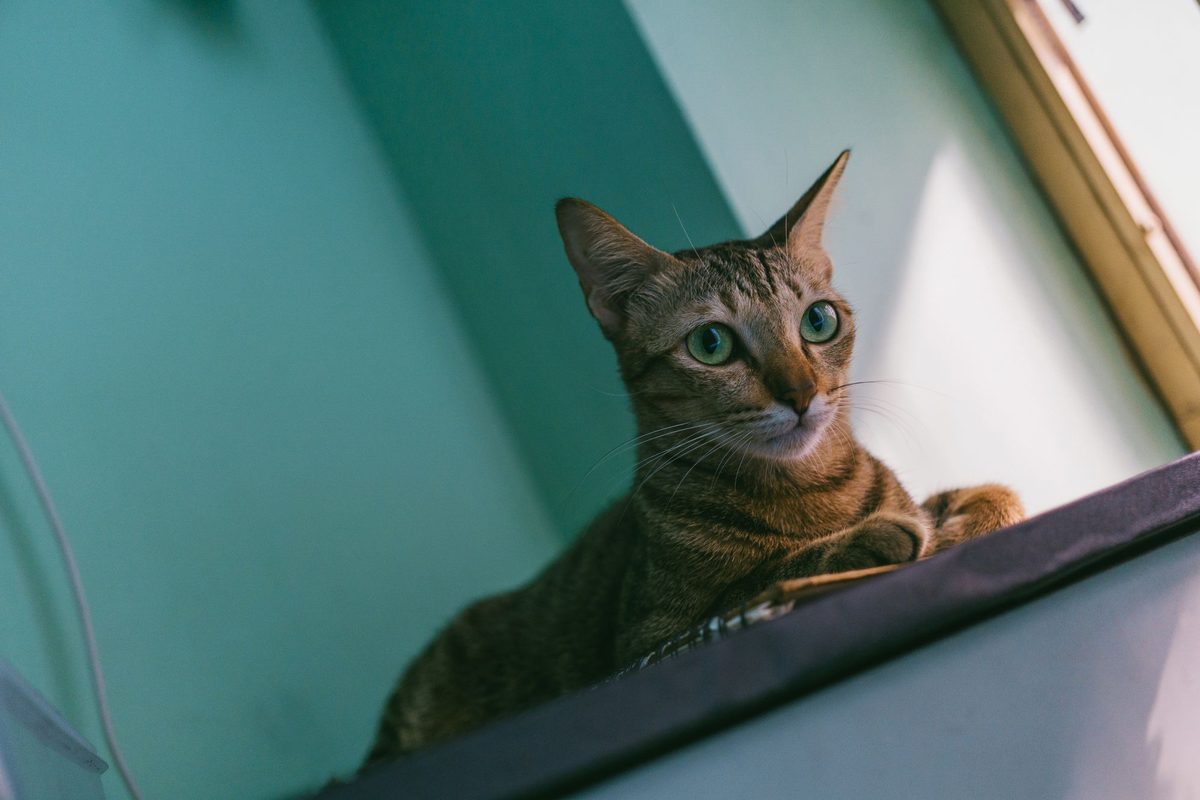
Cat studies published in October 2026 found that cat and owner oxytocin levels went together, that owners who scolded after past bites were more likely to report a bite or scratch, and that Egyptian mummy cats show signs of captivity. Others covered sleep, grooming, Kauai's seabird-eating cats, Borneo's flat-headed cat and Hungarian wildcats. Each summary ends with the study's main limit.
Cat and owner oxytocin levels went together
Source: iScience, published online October 14, 2026. 29 cats and 19 owners. DOI 10.1016/j.isci.2026.117934
Owners with more oxytocin, a hormone linked to social bonding, tended to have cats with more oxytocin. Over one month, the team measured oxytocin and the stress hormone cortisol in 19 owners and 29 cats, collected owner mood ratings and logged how close each cat stayed with Bluetooth beacons.1
Cats with higher oxytocin had owners with lower cortisol and less negative mood, and more time close together went with higher owner vigor, a sense of energy. Owner and cat cortisol showed little association.1
These are correlations, so the study cannot say who influences whom, and the authors add that the shared household may explain part of the link.1 More detail: what the cat and owner oxytocin study found.
Owners who scolded after past bites were likelier to report bites or scratches
Source: Applied Animal Behaviour Science, published online October 5, 2026. 66 owners in the petting log; the abstract gives no survey total. DOI 10.1016/j.applanim.2026.107209
Sixty-six owners logged three petting sessions in one day, and an online survey asked about each cat's lifetime reactions to petting. In the logs, 82.7% to 90.6% of cats reportedly enjoyed being petted. In the survey, 32.2% of owners said they had been scratched or bitten during petting.2
Owners who had used verbal corrections such as "No!" after earlier incidents had about 14 times the odds of being scratched or bitten, and owners who stopped petting had about 7 times the odds. Explorative enrichment, such as boxes and tunnels, went with lower odds. No factor was significantly linked to responses on the logged day.2
The margins of error are wide, and all the data came from owners. The authors say causation is unclear: owners may reinforce or provoke these reactions, or respond this way to cats already prone to aggression.2 More detail: why cats bite during petting.
Over half of 131 Egyptian mummy cat skulls show abnormalities, mostly dental
Source: Journal of Archaeological Science, published online October 26, 2026. 131 skulls of small cats. DOI 10.1016/j.jas.2026.106733
The skulls come from cat mummies found at Beni Hassan, Egypt, and acquired by Vienna's Natural History Museum in the 1880s. A few are jungle cats (Felis chaus), a separate wild species. The rest vary so much in size that African wildcats and possibly hybrids may be among them.3
Besides dental problems, the skulls show healed fractures, puncture marks and deformations possibly linked to infections or metabolic disorders. All but one of the jungle cats show such changes. To the authors, this suggests all the cats were kept together under similar captive conditions. Stable isotopes suggest the jungle cats probably did not breed in captivity.3
Compared with X-ray studies of wrapped mummies, this collection leans toward adults and nearly grown cats, so it may not represent every mummified cat.3 More detail: what the mummy skulls reveal.
A cat in the room at night went with small changes in heart rate and sleep
Source: Nature and Science of Sleep, published October 24, 2026. 11,733 adults, 3,911 of them in the cat group; cats were not counted. DOI 10.2147/NSS.S636142
The team analyzed 1,649,083 days of WHOOP fitness tracker data from 11,733 adults, who reported each morning whether a cat had been in the room while they slept, and compared each person's nights with and without a dog, cat or child.4
On nights with a cat in the room, people in the cat group had a resting heart rate about 0.9 beats per minute lower and about 7 more minutes of sleep. They also had slightly more disturbances, a slightly smaller share of deep and REM sleep, and a little more activity the next day.4
Co-sleeping was self-reported, and the app question could not tell a cat on the bed from one elsewhere in the room. WHOOP funded the study, and two of the three authors work for the company.4
Cats groom in no fixed order
Source: Journal of the Experimental Analysis of Behavior, published online October 1, 2026. 17 cats, 40 grooming sequences. DOI 10.1002/jeab.70146
Rodents tend to groom in a predictable order, so the team filmed 17 shelter cats to see whether cats do too. Individual cats varied a lot in which body areas they groomed and in what order. They did tend to move to a neighboring area, and the authors link that to closeness and efficient movement.5
Oral grooming, licking and nibbling with the mouth, took the largest share of time; face washing with a wet paw and scratching were less frequent.5
The analyses used 35 to 40 grooming sequences from 7 to 10 cats at one shelter. Timid cats that stopped grooming when watched could not be filmed, so the sample leans toward relaxed cats.5
On Kauai, older free-roaming cats were more likely to have eaten at-risk seabirds
Source: Biological Invasions, published online October 7, 2026. Gut contents of 113 upland cats. DOI 10.1007/s10530-026-03937-w
Cats account for 35.6% of predation events on two Kauai seabirds, the endangered Hawaiian petrel (ʻuaʻu) and the threatened Newell's shearwater (ʻaʻo). The island has lost 78% of its ʻuaʻu and 94% of its ʻaʻo in recent decades. Gut contents came from 113 free-ranging cats in remote upland areas.6
The odds that a cat had eaten these seabirds rose with its age (odds ratio 1.414). Cats caught in the colonies were generally younger and more often male than cats elsewhere and may have come from other areas.6
The age link is an association, and the authors suggest seabird eating could be learned. In their model, age alone predicted it in cats older than 5.8 years, a cutoff they call exploratory, not demonstrated.6
Borneo camera traps found the rare flat-headed cat mostly in nibong palm habitat
Source: Ecology and Evolution, published online October 14, 2026. 148 camera traps; individual cats were not counted. DOI 10.1002/ece3.74248
The flat-headed cat (Prionailurus planiceps) is a small, semi-aquatic wild cat, listed as endangered by the IUCN and one of the least-detected cats in Southeast Asia. From August 2021 to May 2024, the team ran 148 camera traps in the proposed Lundu Mangrove Protected Forest in Sarawak, Malaysia. An initial survey found none, but a November 2021 photo led to a targeted search.7
The cameras recorded two still images and 57 videos, including an adult female with a kitten. Of the independent detections, 49 came from nibong palm habitat, nine from buta-buta habitat and one from nipah swamp. The cats often foraged in shallow puddles, mostly from evening to late morning.7
Detections are sightings, not a head count. Adjusted for camera effort, the detection rate was higher in buta-buta (0.087 per 100 camera nights) than in nibong (0.056). Many cameras were moved to nibong puddles after the first record, and the authors note that puddle use may affect detection rates.7
About 1 in 7 Hungarian cats sampled in the field fell between wildcat and house cat
Source: Animals, published October 9, 2026. 118 field-collected cats plus 30 domestic cats for comparison. DOI 10.3390/ani16203166
European wildcats (Felis silvestris) are threatened partly by interbreeding with domestic cats. The team tested 118 suspected wildcats from seven parts of Hungary, mostly found dead on roads, and 30 domestic cats at 14 DNA markers called microsatellites, plus mitochondrial DNA.8
In the main analysis, 84 cats grouped with wildcats, 18 with domestic cats and 16 (13.6%) fell in between. The authors stress that the combined non-wildcat share of 28.8% is not a hybridization rate, and a three-group model shrank the in-between group to 10.8
In simulations, the method caught first- and second-generation hybrids but placed most second-generation and all third-generation backcrosses (hybrids bred back to one parent type) in a parent group. The authors call for genome-wide tests before management decisions rely on labeling individual cats as hybrids.8
Quick quiz: how well do you know cat biology?
What is the primary role of the peripheral nervous system in cats?
Answer: Relays signals. The peripheral nervous system's spinal and cranial nerves carry sensory information to the brain and motor commands back out, forming the communication link between the central nervous system and the rest of the body. Source
What is the relationship between claw scratching and interdigital gland secretion in cats?
Answer: Scratching pressure activates secretion release through paw pads. When cats scratch surfaces, their claw movements apply pressure to the paw pads, which activates the interdigital sebaceous glands and causes them to deposit their pheromone-containing secretions. This creates a combined visual and chemical message that marks territory more effectively than either method alone. Source
What is the scientific term for a species, like the cat, in which mating itself triggers the release of an egg?
Answer: Induced ovulator. Cats are 'induced ovulators,' meaning ovulation is triggered by the physical stimulus of mating rather than happening on its own each cycle. Source
Frequently asked questions
How are studies picked for these roundups?
They come from peer-reviewed journals found through the OpenAlex research index, limited here to October 2026 papers about pet and wild cats. Each summary follows the paper's abstract, with details from the full paper where it is free to read.
How solid are these findings?
Most were small or observational. An association can come from a third factor, such as a shared home, and a result from one island or forest may not hold elsewhere. Look for the same result from other teams using different cats and methods.
Up next
Christopher writes and runs Cat Trivia Games. The sources for this article are listed below, and how the site is made and corrected is on the editorial policy page. More about the author.
References
- Takagi S, Tsubomura T, Nagasawa M, Kikusui T. Cats and humans show correlated affiliative physiological states. iScience, article 117934, October 2026. back
- O'Hanley K, Pearl DL, Klinck M, Niel L. The petting diaries: Investigating owner-cat petting styles, responses and preferences. Applied Animal Behaviour Science 305:107209, 2026. back
- Van Neer W, De Cupere B, Ottoni C. Keeping cats for mummification in ancient Egypt: osteological evidence from Beni Hassan. Journal of Archaeological Science 196:106733, 2026. back
- Montoye AHK, Curran DJ, Grosicki GJ. Who's Been Sleeping in My Bedroom? Associations Between Co-Sleeping with Dogs, Cats, or Children and Sleep and Cardiorespiratory Physiology Among WHOOP Users. Nature and Science of Sleep 18, published October 24, 2026. Funding and author disclosures are in the paper. back
- Hock A, Schmidt M. Decoding diversity: Are there patterns in the organization of grooming movements in domestic cats? Journal of the Experimental Analysis of Behavior 126(3):e70146, 2026. back
- Gheida SN, Dutcher A, Pias K, Martin JM, Short RA. Seabird consumption on Kauaʻi: age-dependent risk from free-ranging cats (Felis catus) based on gut content analysis. Biological Invasions 28, article 229, 2026. back
- Ampeng A, Mohammad H, Sait H, et al. Habitat Preference and Spatiotemporal Habitat Use of the Endangered Flat-Headed Cat in the Proposed Lundu Mangrove Protected Forest, Sarawak, Malaysia. Ecology and Evolution 16(10):e74248, 2026. back
- Fehér P, Frank K, Ninausz N, et al. Microsatellite and Mitochondrial DNA Reveal Spatial Genetic Variation and Domestic Cat Admixture in Hungarian European Wildcats. Animals 16(20):3166, 2026. back
This is general information, not veterinary advice. Written by Christopher Fox under our editorial policy.