 Cat Trivia Games
iOS App
Javanese Cat Breed
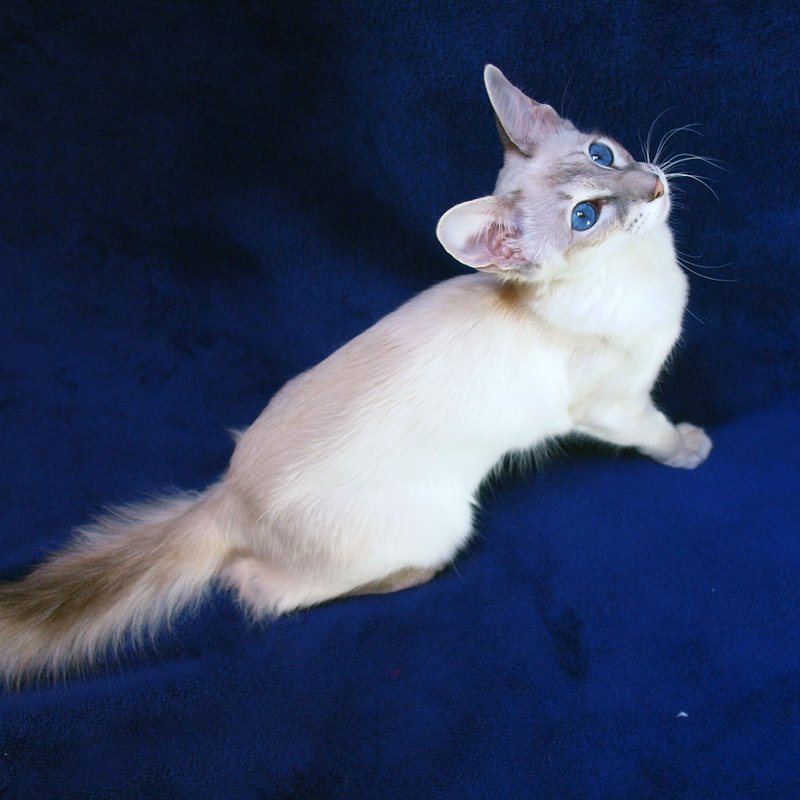

Javanese is a name used for certain longhaired pointed cats within the Siamese and Balinese family. Its meaning depends on the registry. These cats are often described as active and vocal, with silky coats and a strong interest in their people.
Quick facts
- In CFA: the Javanese division of the Balinese since May 1, 2008, for colors beyond seal, chocolate, blue and lilac point
- In TICA: no Javanese breed; all these colors are registered as Balinese
- Weight: 5 to 8 pounds for females and 8 to 12 for males (TICA, for the Balinese)
- Coat: single, silky and medium-long, with no downy undercoat
- Health screening to ask about: the PRA (rdAc) DNA test
Temperament and daily life
These are usually busy, people-focused cats. PetMD's Javanese profile describes a cat that is loyal to a fault and follows its family members everywhere, with a high degree of intelligence that makes it easy to train. Many are vocal and want to be involved in whatever is going on. Training can provide useful mental activity, and climbing space, window perches, food puzzles and daily play give an active cat somewhere to put its energy. Introductions and the individual cat's temperament matter with children and other pets.
Grooming and care
The coat is easier than its length suggests. With a single coat and no downy undercoat, these cats are not prone to mats, and combing or brushing several times a month controls shedding. Some coats look greasy from time to time, and a bath can help. Check the plumed tail for debris, and give teeth, nails and ears the same routine care as any cat's.
Health considerations
Progressive retinal atrophy (PRA) is a degeneration of the retina. A recessive variant in the CEP290 gene, called rdAc, causes a form in which most affected cats become blind at about three to five years of age, and UC Davis lists the Javanese, Balinese, Siamese and Colorpoint Shorthair among the breeds to test (PRA rdAc test). The test covers only that variant. CFA's list of genetic disorders also names the Javanese among breeds in which a protruding sternum has been seen. Ask a breeder what the parents were tested for, and go over the results with your veterinarian.
History
Longhaired pointed cats of Siamese type were accepted by the Cat Fanciers' Association as Balinese, for championship competition in 1970, but only in the four traditional Siamese colors: seal, chocolate, blue and lilac point. Breeders of longhaired cats in other point colors asked to register them too, and in 1979 lynx points, tortie points and other non-traditional colors were accepted under the name Javanese. According to CFA's history of the breed, the board would register the cats but not as Balinese, so the breeders chose a new name from a map of Asia; the name does not mean the cats came from Java.
In 2008, CFA breeders voted to merge the two into a single breed with separate divisions, and the Javanese became a division of the Balinese effective May 1, 2008. CFA's registration rules also allowed a transition period, permitting certain Balinese to be bred to Javanese for cats born through December 31, 2010. TICA never had a separate Javanese breed: it registers lynx, tortie, red and cream points as Balinese. The name still appears in other registries and in everyday use, so a cat called Javanese may be papered as a Balinese.
Appearance
The body type is the Siamese one, softened slightly by the longer coat: long, fine-boned and elegant, with a long, tapering wedge-shaped head, large ears that continue the line of the wedge, and vivid blue almond eyes. The silky coat lies close to the body and flows into a plumed tail, and a definite downy undercoat disqualifies a cat in CFA's standard. The Javanese division covers red, cream, tortie, lynx and other non-traditional points. Many pointed cats darken with age, so a young cat's coloring can change. TICA notes that these cats may not fully develop until 18 to 24 months of age.
Before choosing a Javanese
A Javanese may suit a household where someone is around for company, conversation and play most days. Ask a breeder which registry the cat is papered with, since the name differs between registries, and which DNA tests the parents had. Meeting the individual cat tells you more about its voice and energy than the breed name.
Javanese FAQ
What is the difference between a Javanese and a Balinese? Color, and the registry. In CFA, the Balinese division covers seal, chocolate, blue and lilac points, and the Javanese division covers the other point colors, within one breed. In TICA, all of them are Balinese.
Are Javanese cats hypoallergenic? No breed can be assumed safe for someone with a cat allergy, and a single coat with no undercoat does not change that. Spend time with the individual cat before committing.
Sources
- Cat Fanciers' Association: Balinese, including the Javanese division, the Javanese breed article, the Balinese and Javanese registration rules and genetic disorders
- The International Cat Association: Balinese
- PetMD: Javanese
- UC Davis Veterinary Genetics Laboratory: PRA rdAc test
Try a mixed breed question
Which breeder developed the Ragdoll cat in California during the 1960s?
Answer: Ann Baker. Ann Baker began the Ragdoll in Riverside, California in the 1960s, starting from a placid white longhair named Josephine that carried the colorpoint gene. Mill, Horner, and Conroy founded the Bengal, Bombay, and Tonkinese instead. Source