 Cat Trivia Games
iOS App
HOME / BREEDS / BRITISH LONGHAIR
British Longhair Cat Breed
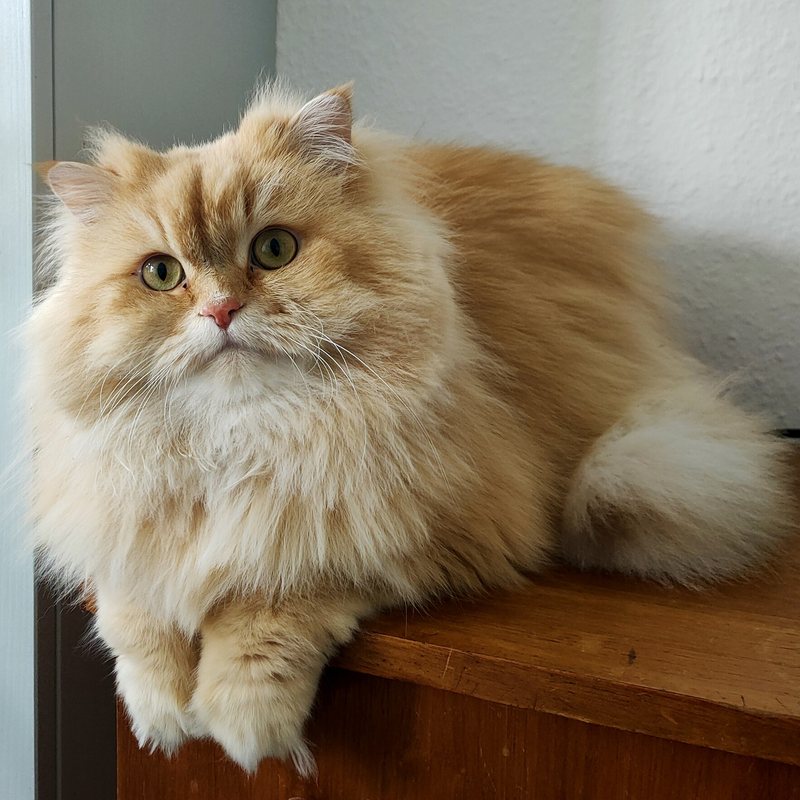

The British Longhair has the rounded features and sturdy build associated with British Shorthairs, plus a dense, longer coat. Many are quiet companions who enjoy sitting nearby. The main practical difference is grooming: that coat needs regular attention to prevent tangles.
Quick facts
- Weight: about 8 to 11 pounds for females and 10 to 16 for males, per TICA
- Life expectancy: 12 to 20 years, depending on background and circumstances, per TICA
- Coat: long, dense and plush, standing out from the body
- Grooming: TICA says a daily combing prevents tangles
- Recognition: TICA championship since May 2009; CFA has no separate British Longhair as of 2026
Temperament and daily life
The British Longhair is often described as the British Shorthair with a longer coat and all the same characteristics: slightly reserved, dignified and affectionate, and a four-feet-on-the-floor breed that likes to be handled with gentle firmness and supported when carried. Many prefer to sit near their people rather than on them.
Many are calm and content with short bursts of play, so regular play sessions and food puzzles help keep a quiet cat active and at a healthy weight. Introductions to children and other pets should go at the cat's pace, and children should learn to support the cat's body if they pick it up.
Grooming and care
The coat is the main job. It takes more work than the shorthair's, and a daily combing prevents any tangles. Comb gently through the whole coat, including the belly, legs and the longer fur around the hind end, which can also collect litter. If a mat is tight, painful, or close to the skin, ask a veterinarian or qualified groomer for help, because matted hair can be painful and lead to underlying skin problems.
Measured meals and regular play help a calm cat stay at a healthy weight. The ASPCA's enrichment guide has ideas for food puzzles and play.
Health considerations
Published health information on the British Longhair on its own is limited, and the available sources group it with the British Shorthair. The British Shorthair is among the breeds in which hypertrophic cardiomyopathy (HCM) is more prevalent, and a 2024 review of feline HCM variants, which studied British Shorthairs and Longhairs together, notes a reported breed predisposition but recommends routine genetic testing only for specific variants in Maine Coons and Ragdolls. HCM is diagnosed by echocardiography, so ask a breeder how the parents' hearts were checked.
For polycystic kidney disease (PKD), the British Longhair is among the Persian-derived breeds covered by the PKD1 test. A negative result means the cat does not carry that heritable PKD1 variant, but a genetic test does not show how seriously a cat is affected, and ultrasound gives a definitive diagnosis.
History
The long coat traces to crosses with the Persian made between 1914 and 1918, which introduced the longhair gene into British lines. Shorthaired kittens stayed in the British Shorthair program and longhaired ones went into Persian breeding programs. The breeds are closely related, and registries differ in how they classify the longhaired variety: TICA granted the British Longhair championship status effective May 2009, while the Cat Fanciers' Association's breed list has no separate British Longhair (checked October 2026).
Appearance
The body is stocky, semi-cobby and muscular, and the coat dense, rich and plush, with the longhair adding length so that the coat stands out from the body. In most colors the eyes are large, round and deep gold through copper, and pointed cats have blue eyes.
Before choosing a British Longhair
A British Longhair may suit a calm home with time for daily combing. Many prefer to keep their feet on the floor and sit nearby rather than be carried. Ask a breeder about heart and kidney screening, and what those results do and do not cover.
British Longhair FAQ
How long does a British Longhair take to grow up? Expect a slow-maturing cat. CFA says the British Shorthair does not reach its full size until about three years of age, and TICA describes the British Longhair as having the same characteristics apart from the coat.
Are British Longhairs hypoallergenic? No breed can be assumed safe for someone with a cat allergy, and a long, dense coat does not change that. Spend time with the individual cat before committing.
Sources
- The International Cat Association: British Longhair
- Cat Fanciers' Association: British Shorthair
- Cornell Feline Health Center: hypertrophic cardiomyopathy and polycystic kidney disease
- Frontiers in Veterinary Science (2024): review of feline HCM genetic variants
- UC Davis Veterinary Genetics Laboratory: PKD1 test
- ASPCA: cat grooming tips and feline DIY enrichment
Try a mixed breed question
Which Russian city is the Peterbald breed associated with and named after?
Answer: St. Petersburg. The breed was developed in St. Petersburg, and 'Peterbald' combines that city's name with the word 'bald'. Source