 Cat Trivia Games
iOS App
Cornish Rex Cat Breed
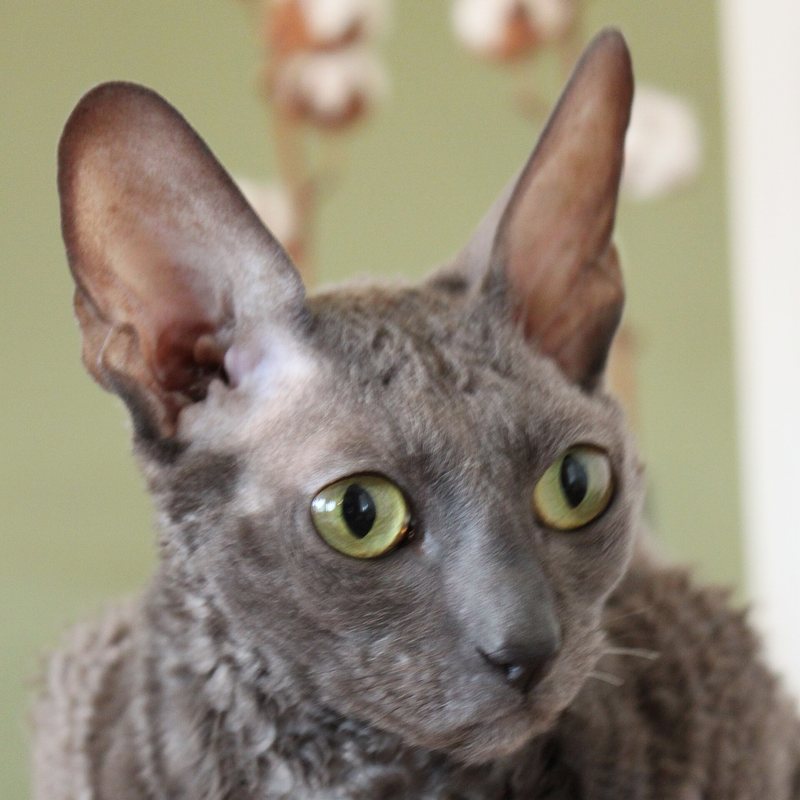

The Cornish Rex has a fine, wavy coat, large ears, and a slender, arched body. The breed developed from a curly-coated kitten born in Cornwall. Many are active and sociable, so daily play and interaction are an important part of living with one.
Quick facts
- Weight: on average 5 to 7 pounds for females and 8 to 10 for males (TICA)
- Life expectancy: estimates differ, from 9 to 13 or more years (TICA) to 11 to 15 (PetMD)
- Coat: short, close-lying waves with no guard hairs, in all colors and patterns
- Activity: high, often with a kitten-like playfulness that lasts into adulthood
- Grooming: little brushing; ears and skin need regular checks
Temperament and daily life
Most Cornish Rex cats are busy, social and acrobatic, and many keep a kitten's enthusiasm well into adulthood. They are often called "Velcro kitties" because they like to stay in physical contact with their people, and they tend to want to be in the middle of whatever is happening. Fetch is a common game.
Long stretches alone tend not to suit them, and the breed's registry profile suggests a companion when everyone in the household works long hours. Many get along with other pets, but introductions and the individual cat's temperament matter. Training and enrichment can help, but expect an active cat: a tall cat tree, shelves the cat is allowed on, puzzle feeders and regular play sessions all give that energy somewhere to go. Behavior changes can have environmental, social, or medical causes, so a new problem is worth discussing with your veterinarian.
Grooming and care
The coat needs little work, and regular combing is not needed. The ears and toes can get greasy, so check them often and ask your veterinarian how often they need cleaning, since that depends on the cat. Nails and teeth need the same regular care as any cat's.
Warmth matters more than it does for most cats. With so little coat, they get cold more easily and look for heat vents, sunny spots, warm laps and the space under the blankets, so give them warm places to rest. The short coat also leaves the skin open to problems such as sunburn, which is a good reason to keep a Cornish Rex indoors. The breed tends to overeat, so measured portions and regular weight checks with your veterinarian help.
Health considerations
The breed may be prone to hypertrophic cardiomyopathy (HCM) and patellar luxation, a kneecap that slips out of place and can make walking difficult. PetMD also lists progressive retinal atrophy (PRA), a deterioration of the retina that leads to blindness, among its main health concerns. HCM thickens the walls of the heart. Cornell's Feline Health Center calls it the most common heart disease of cats and says it is diagnosed by echocardiography, an ultrasound of the heart.
International Cat Care also lists the Cornish Rex among the Burmese-related breeds affected by periodic hypokalaemia, an inherited form of low blood potassium that causes episodes of muscle weakness, usually first seen in kittens between two and six months old. A gene test is available for breeding cats.
Ask a breeder what heart screening the parents have had and what those results can and cannot show. Review the available health information before deciding, and ask your veterinarian which checks make sense for your cat as it ages.
History
The breed began on Bodmin Moor in Cornwall, England, on July 21, 1950, when a tortoiseshell cat named Serena, owned by Nina Ennismore, had a litter that included a curly-coated male called Kallibunker. On a geneticist's advice he was bred back to his mother, and that litter included two more curly-coated kittens. With so few cats to work from, breeders outcrossed to domestic cats and to breeds including Siamese, Russian Blues, American Shorthairs, British Shorthairs and Havana Browns. Cornish Rex cats reached California in the late 1950s, and the Cat Fanciers' Association accepted the breed for registration in 1962 and for championship competition two years later.
About ten years after Kallibunker, a curly-coated male named Kirlee turned up in neighboring Devon. When he was mated to Cornish Rex queens, none of the kittens had curly coats, so the two curls had to come from different genes, and Kirlee became the founder of the Devon Rex. Research has since traced the Cornish Rex coat to a mutation in a gene called LPAR6, while the Devon Rex coat is associated with the KRT71 keratin gene (Gandolfi and colleagues, 2013).
Appearance
Most cats have three kinds of hair: guard hairs, awn hairs and a soft down layer. The Cornish Rex has only the down layer, with no guard hairs, and the hair lies close in tight rows of curl called marcel waves. The coat carries 40 points in the CFA breed standard. Even the whiskers are curled and shortened.
Under the coat is a slender, fine-boned cat that is hard-bodied and muscular, with a natural arch to the back, a tucked-up waist, long legs and a long tapering tail. The head is egg-shaped, with high cheekbones, tall ears and oval eyes. The breed comes in all colors and patterns, and these cats often feel warm to the touch.
Before choosing a Cornish Rex
A Cornish Rex may suit a home where someone is around for play and company most days, with climbing space and warm places to rest. Plan for ear and skin checks, an indoor life and regular veterinary care, and ask about heart screening in the parents. Meeting the individual cat tells you more about its energy and temperament than any breed description.
Cornish Rex FAQ
Are Cornish Rex cats hypoallergenic? No breed can be assumed safe for someone with a cat allergy, and a coat without guard hairs does not change that. Spend time with the individual cat before committing.
Do Cornish Rex cats shed? Not much. The short coat sheds little, although having so little hair also means these cats feel the cold more often.
Is the Cornish Rex related to the German Rex? Their coats appear to share a cause. The 2013 study that identified the Cornish Rex mutation in LPAR6 found the same variant in German Rex cats.
Sources
- Cat Fanciers' Association: Cornish Rex, the rex breeds and Devon Rex history
- The International Cat Association: Cornish Rex
- PetMD: Cornish Rex
- Gandolfi B. et al. (2013), To the root of the curl: a signature of a recent selective sweep identifies a mutation that defines the Cornish Rex cat breed. PLOS ONE
- Cornell Feline Health Center: hypertrophic cardiomyopathy
- International Cat Care: hypokalaemia in cats
Quick quiz: 2 questions about the Cornish Rex cat
Early breeders crossed the Devon's founding cat with Cornish Rex cats, assuming they shared the same curly gene. What did the kittens reveal?
Answer: Every kitten had a straight coat, from a separate gene. The crosses produced straight-coated kittens, proving the Devon's curl came from a completely different mutation than the Cornish Rex's, and confirming the Devon as its own breed. Source
Which activity is a Cornish Rex most likely to enjoy?
Answer: Chasing toys and playing fetch. Cornish Rex cats keep their kitten-like energy into adulthood and will chase and retrieve thrown toys like a dog rather than spend the day resting. Source