 Cat Trivia Games
iOS App
Devon Rex Cat Breed
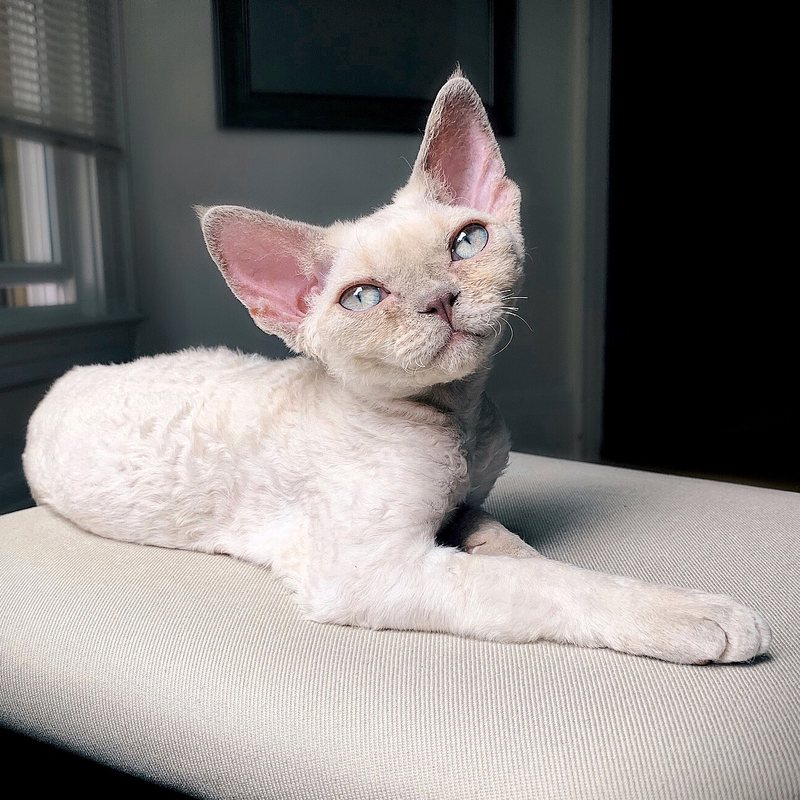

Devon Rex cats have large, low-set ears, expressive eyes, and a soft, curly coat that varies in thickness. Many are playful and seek close contact with their people. Their fine coat and skin may need a different grooming routine from a typical shorthaired cat.
Quick facts
- Weight: about 6 to 9 pounds, with males sometimes larger (CFA)
- Life expectancy: estimates differ, from 9 to 15 years (PetMD) to 14 to 17 or more (TICA)
- Coat: short, loose waves with sparse guard hairs; thickness varies from cat to cat; all colors
- Activity: high, with strong jumping and climbing
- Health screening to ask about: blood type, the CMS DNA test and heart scans of the parents
Temperament and daily life
Devons are usually very people-focused. The Cat Fanciers' Association describes them as deeply attached to their owners and says they dislike being left alone for long periods. If you sit down, a Devon often wants to be in your lap, and many are strong jumpers that explore high shelves and the tops of doors. Many are not especially talkative, although some chirp to draw your attention to something, and a Devon often enjoys frequent interaction.
Daily play, climbing space and puzzle toys give an active, curious cat something to do, and many like to learn tricks or fetch a thrown toy. A Devon that spends long days alone with nothing to do may find its own entertainment, so if the home is empty for long hours, plan how the cat's day will be broken up, whether that is a midday visit or, for some cats, a compatible companion. Introductions and the individual cat's temperament matter with children and other pets.
Grooming and care
The coat is fine and fragile, and heavy grooming can break the hair, so a gentle hand works better than firm brushing. Some Devons have greasy or waxy skin, and the large ears and the nail beds can collect oily buildup. How often that needs cleaning, and whether occasional baths help, depends on the cat, so ask your veterinarian about a routine. Kittens often lose much of their coat at around three months, and the adult coat comes in over the following six months or so.
Devons feel warm to the touch because the thin coat insulates less, not because they run hotter: their body temperature is the same as other cats'. They look for warm places, so give them cozy spots to rest and keep them indoors.
Health considerations
Several inherited conditions are documented in the breed, and some have DNA tests. Each test covers only its own variant, so ask a breeder which tests the parents had and go over the results with your veterinarian.
- Blood type. Type B blood is common in Devons. If a type B queen is bred to a type A or AB tom, her kittens can develop neonatal isoerythrolysis, which can be fatal, so breeders blood-type cats before mating them.
- Congenital myasthenic syndrome (CMS). This inherited muscle condition, first described as "spasticity", causes weakness that can start at about three weeks of age and can be fatal. It is recessive, and a DNA test identifies the COLQ variant behind it.
- Periodic hypokalaemia. International Cat Care lists the Devon Rex among the Burmese-related breeds affected by this inherited form of low blood potassium, which causes episodes of muscle weakness, usually first seen in kittens between two and six months old. A gene test is available for breeding cats.
- Patellar luxation. A kneecap that slips out of place. The Devon Rex was one of the first breeds diagnosed with it.
- Hypertrophic cardiomyopathy (HCM). PetMD lists HCM among the breed's health concerns, along with hip dysplasia and polycystic kidney disease. UC Davis offers HCM DNA tests only for Maine Coons and Ragdolls, so heart screening in Devons relies on scanning the parents. Cornell's Feline Health Center explains that HCM is diagnosed by echocardiography, an ultrasound of the heart.
History
The breed began with one curly-coated male kitten, Kirlee, in Buckfastleigh, Devon, England, in 1959 or 1960 (accounts differ). His mother was a stray taken in by Beryl Cox, and his father was believed to be a curly-coated feral tom living around an abandoned tin mine nearby. The Cornish Rex had appeared in neighboring Cornwall about ten years earlier, so breeders assumed Kirlee carried the same gene. When he was mated to Cornish Rex queens, none of the kittens had curly coats, and the two coats became known as Gene I rex (Cornish) and Gene II rex (Devon). Every Devon Rex traces back to Kirlee, who died in 1970.
Kirlee's descendants were outcrossed to other breeds over the years, which is one reason the breed comes in so many colors and patterns. A North American breeding program began in 1968, and CFA accepted the Devon Rex as a separate breed in 1979 and for championship competition in 1983. Research has since traced the Devon coat to a mutation in the keratin gene KRT71, while the Cornish Rex coat comes from a mutation in a different gene, LPAR6 (Gandolfi and colleagues, 2013).
Appearance
The head is a modified wedge with large eyes, a short muzzle, prominent cheekbones and huge ears set low on the sides of the head, which gives the breed the "elfin look" described in its breed standard. The body has a medium-fine frame.
The coat sets the Devon apart from the Cornish Rex. Devons have a few guard hairs, very sparse, short and curled, which gives an open wave that varies in density, texture and length and can be fragile. Coats range from a tousled mop of curls to a thin, suede-like covering, and some cats have nearly bare patches. The coat often changes over a cat's life, and the whiskers and eyebrows are short and crinkled.
Before choosing a Devon Rex
A Devon Rex may suit a household where someone is around for company and play most days, with warm resting places and room to climb. Consider whether you can provide the ongoing care and veterinary support the individual cat needs, including skin and ear care and any follow-up on its health tests. Meeting the cat tells you more about its energy and temperament than the breed name.
Devon Rex FAQ
Are Devon Rex cats hypoallergenic? No breed can be assumed safe for someone with a cat allergy. Devons shed very little, but they still produce the allergens that cats make, so spend time with the individual cat before committing.
How can you tell a Devon Rex from a Cornish Rex? Look at the head and the coat. A Devon has a modified wedge-shaped head with very low-set ears and a looser, more uneven wave, while a Cornish Rex has an egg-shaped head, ears set high and tight, even marcel waves.
Is the Devon Rex related to the Sphynx? In coat genetics, yes. The Devon's curl and the Sphynx's near-hairlessness come from two different mutations in the same gene, KRT71, and the Sphynx variant is dominant over the Devon one.
Sources
- Cat Fanciers' Association: Devon Rex, Devon Rex history and genetic disorders
- The International Cat Association: Devon Rex
- PetMD: Devon Rex and bringing home a rex cat
- UC Davis Veterinary Genetics Laboratory: Sphynx and Devon Rex coats, congenital myasthenic syndrome, AB blood group and the list of cat DNA tests
- International Cat Care: hypokalaemia in cats
- Cornell Feline Health Center: hypertrophic cardiomyopathy
- Gandolfi B. et al. (2013), To the root of the curl. PLOS ONE
Quick quiz: 2 questions about the Devon Rex cat
What is one of the most recognizable features of the Devon Rex?
Answer: Large ears and curly coat. The Devon Rex is known for its oversized, low-set ears paired with a soft, wavy (rexed) coat, an instantly identifiable combination. Source
How often does a Devon Rex typically need a bath?
Answer: Occasionally, to remove skin oil. Because the Devon Rex lacks most guard hairs, the skin oils a normal coat would absorb can build up and make the skin feel greasy, so an occasional bath helps. Over-bathing is avoided, though, since their fragile curls break easily. Source