 Cat Trivia Games
iOS App
Cymric Cat Breed
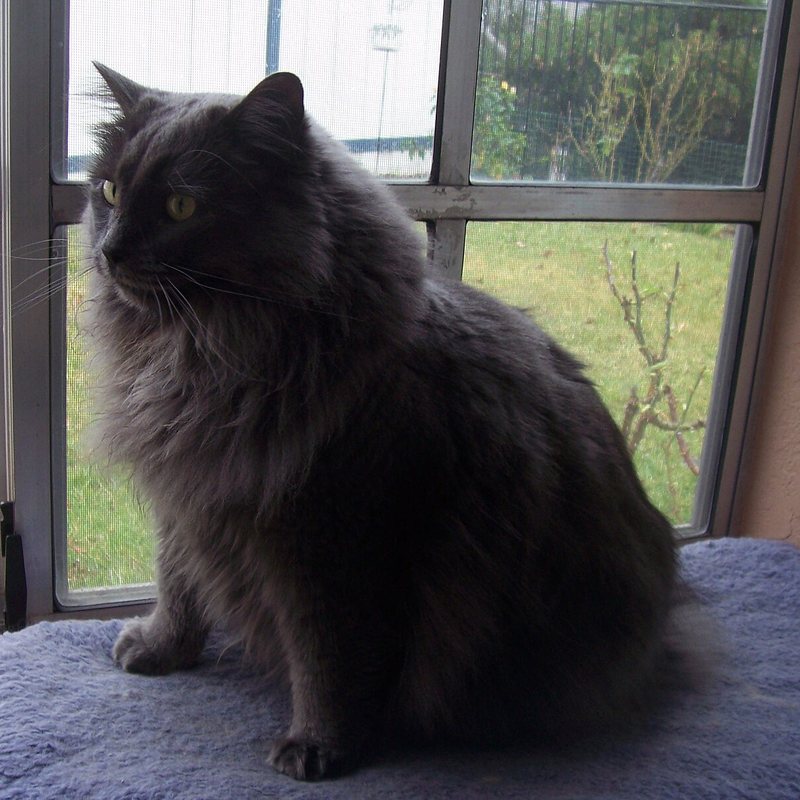

The Cymric is the longhaired form of the Manx, with a rounded build and a dense coat. Tail length varies, including fully tailed cats. The breed's spinal-health concerns are important, so this guide explains them first, alongside appearance and temperament.
Quick facts
- Registry name: Cymric in TICA; the longhair division of the Manx in CFA
- Weight: 8 to 10 pounds for females and 10 to 12 for males (TICA)
- Life expectancy: estimates differ, from about 10 to 14 years (PetMD, for the Manx) to 16 or more (TICA)
- Tail: anything from none at all to a full-length tail
- Maturity: slow; TICA says about five years to reach full maturity
Health and welfare considerations
The gene that shortens the tail also affects the spine. Manx syndrome is an array of problems affecting the hind legs, bladder and colon of tailless cats, and spina bifida is part of it. UFAW notes that it can cause partial paralysis, incontinence and painful infections, that some cats show no signs while others have major welfare problems, and that completely tailless "rumpy" cats are most often affected. Signs may be present at birth or appear in the weeks to months afterward. There is usually no effective treatment, although surgery occasionally helps. All Manx-type cats carry one copy of the gene, because kittens with two copies die early in development.
Because the problems are usually found before four months of age, some breeders wait to place kittens, and CFA describes regular use of tailed cats in breeding programs. Neither practice guarantees that a kitten is free of spinal problems. Ask a breeder for documented breeding and veterinary information about the kitten and its parents, and have the kitten examined by a veterinarian before you bring it home, as UFAW recommends for all Manx kittens.
Welfare organizations have taken a position on the breed itself. International Cat Care names the breeding of Manx cats as an obvious example of a breed whose defining trait is based on a mutation that harms the cat's health, and UFAW notes that breeding Manx cats keeps these welfare problems going. Cats with mobility or continence needs deserve the same care and respect as any other cat, and a veterinarian can advise on the support an individual cat needs.
Other conditions are reported in the Manx. Corneal dystrophy, a clouding of the cornea, can show when kittens are about four months old, and cats with short stub tails are prone to early-onset arthritis in the tail.
Temperament and daily life
Cymrics are usually companionable cats with a relatively quiet voice, often a trill rather than a meow. TICA notes that many retrieve and sometimes bury their toys, that they prefer not to be alone for long periods, and that they get on with children and other pets when properly introduced. Some take time to become comfortable with visitors. Daily play and company suit them, and introductions and the individual cat's temperament matter.
Handle the hindquarters with care. In a tailless cat, the nerve endings at the end of the spine are still present but unprotected, and pressure there can hurt, so support the back end whenever you pick the cat up.
Grooming and care
The coat is not prone to matting, but it sheds and needs regular attention. A wide-toothed comb works well, with particular care under the legs and on the sides of the face, where mats tend to start; weekly combing is the usual recommendation. Check the fur around the rear end, which can get soiled on a longhaired cat, and ask a groomer or your veterinarian for help if it needs trimming. Most Cymrics do not need regular bathing.
History
The Manx was known on the Isle of Man two to three hundred years ago, according to a history cited by the Cat Fanciers' Association, and many of the island's Manx were long-coated. Where and when the tailless mutation first appeared is uncertain. TICA recognized both the Manx and the Cymric for championship competition in June 1979. CFA first recognized the longhair Manx in the 1989 to 1990 show season under the name Cymric and, since May 1994, has shown it as the longhair division of the Manx. TICA registers the longhair as the Cymric, with a separate listing for tailed Cymrics, while CFA treats it as a Manx.
Appearance
The Cymric shares the Manx standard apart from the coat: a rounded head, round eyes, a compact body and hind legs that are longer than the front. The longhair coat is dense and medium in length. Tails range from completely absent to full length, and tailed kittens are born in Manx and Cymric litters.
Before choosing a Cymric
Learn about Manx syndrome before you choose a Cymric, and ask for the kitten's veterinary examination and the parents' records rather than relying on age or a breeding rule. Plan for weekly combing, careful handling of the hindquarters and regular veterinary checks. If you are adopting an adult with mobility or continence needs, ask the shelter and your veterinarian what daily care involves.
Cymric FAQ
Is a Cymric the same as a Manx? In CFA, yes: it is shown as the longhair division of the Manx. TICA registers it under the separate name Cymric, with an identical standard apart from coat length.
Why are some Cymric kittens tailed? Tail length varies, and tailed cats are regularly used in breeding programs, so tailed kittens are born in the breed. A tailed Cymric is still a Cymric; TICA has a separate Cymric Tailed listing.
Sources
- UFAW: Manx syndrome
- Cat Fanciers' Association: Manx and the Manx breed article
- The International Cat Association: Cymric
- International Cat Care: inherited disorders in cats
- PetMD: Manx
One question about the Cymric cat
The long-haired variety of the Manx is known by which name?
Answer: Cymric. The long-haired Manx is called the Cymric. Some registries treat it as a separate breed, but it carries the same taillessness gene and double coat, just with medium-to-long fur, 'breeches,' and ear and toe tufts. Source