 Cat Trivia Games
iOS App
German Rex Cat Breed
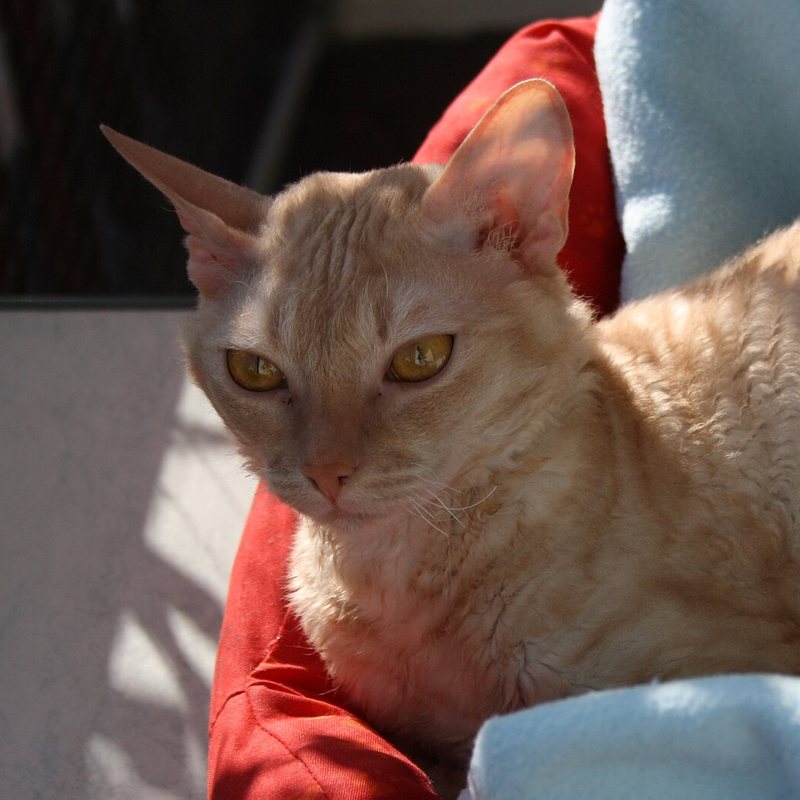

The German Rex is a rare curly-coated breed associated with Germany. Its soft, wavy coat and relatively moderate body shape distinguish it from some other Rex breeds. Because the population is small, its history and registry status are less fully documented than those of the better-known Rex breeds.
Quick facts
- Origin: a curly-coated cat noticed in a Berlin hospital garden in 1951 (FIFe)
- Coat: short, wavy all over and very silky, without guard hair
- Build: medium-sized, with rather fine legs and a rounded head
- Recognition: FIFe since 1982; not on TICA's or CFA's breed lists (checked October 2026)
- Size and lifespan: no reliable breed-specific figures are published
Temperament and daily life
German Rex cats are usually described as friendly, lively, playful and intelligent, and as cats that bond quickly with their people. Some learn to play fetch or do tricks, and many also enjoy settling down to be petted after a play session. A sociable, curious cat needs company and things to do, so regular play, climbing space and puzzle toys help. Introductions and the individual cat's temperament matter with children and other pets.
Grooming and care
The coat needs little grooming: a weekly brush with a soft bristle brush or a fine comb is enough to smooth it. Rex hair is fragile, and heavy grooming can break it, so keep the touch light. With so little hair to absorb skin oil, some German Rex cats get greasy and may need baths; how often depends on the cat, so ask your veterinarian. Check the ears and eyes as part of routine care, and give the cat warm places to rest, since a thin coat insulates less.
Health considerations
Published breed-specific health information is limited. That does not establish that German Rex cats are free of inherited disease. The breed is still represented by a small number of pedigreed cats, so ask a breeder how closely related the parents are and which health checks they have had, and rely on your veterinarian's advice for the individual cat.
History
In the summer of 1951, Rose Scheuer-Karpin, a doctor in Berlin, noticed a black curly-coated cat in a hospital garden. The hospital staff told her they had known the cat since 1947. That cat, named Lämmchen ("little lamb"), became the maternal ancestor of all German Rex cats. Accounts of the earliest years differ: some place her first appearance between 1946 and 1948, in the grounds of the Hufeland Hospital in East Berlin, and they agree that breeders took the curly coat seriously only from 1951, after the Cornish Rex had been found in England. In 1957 Lämmchen was bred to one of her sons, continuing the curly-coated line.
Genetic testing points to a closer link with the Cornish Rex than the separate origin story suggests. A 2013 study that identified the Cornish Rex mutation, in a gene called LPAR6, found the same mutation in the German Rex cats it tested: two copies in curly-coated cats and one copy in straight-coated ones. The authors concluded that the German Rex carries the mutation that defines the Cornish Rex and described it as a breed with few individuals, developed from Cornish Rex (Gandolfi and colleagues, 2013).
FIFe has recognized the German Rex since 1982. The breed does not appear on the current breed lists of TICA or the Cat Fanciers' Association (checked October 2026).
Appearance
The German Rex is a medium-sized cat with rather fine legs of medium length. The head is rounded, with well-developed cheeks, medium-large ears and medium-sized eyes. The coat can vary in density, but the FIFe description calls for one that is short, wavy all over and very silky; without guard hair, it feels like soft velvet. Like most Cornish Rex cats, most German Rex cats have bent and twisted whiskers.
Before choosing a German Rex
The breed is rare, so finding a German Rex can take patience. Plan for daily company and play, a light grooming routine and regular veterinary care, and ask a breeder about the parents' relatedness and health. Meeting the individual cat tells you more about its temperament than the breed description.
German Rex FAQ
How is the German Rex different from the Cornish Rex? Mainly in build. The German Rex is a medium-sized cat with a rounded head and well-developed cheeks, while the Cornish Rex has an egg-shaped head, tall ears and a slender, racy body with an arched back.
Are German Rex cats hypoallergenic? No breed can be assumed safe for someone with a cat allergy, and a coat without guard hair does not change that. Spend time with the individual cat before committing.
Sources
- Fédération Internationale Féline (FIFe): German Rex
- PetMD: German Rex and bringing home a rex cat
- Gandolfi B. et al. (2013), To the root of the curl: a signature of a recent selective sweep identifies a mutation that defines the Cornish Rex cat breed. PLOS ONE
- The International Cat Association: browse all breeds and Cat Fanciers' Association: breeds (both checked October 2026)
Try a mixed breed question
What kind of ears does the LaPerm typically have?
Answer: Medium-large with lynx-like tufts. LaPerm ears are set wide on a wedge-shaped head and are typically medium to large, often finished with lynx-like tufts at the tips - unlike the folded ears of a Scottish Fold or the backward curl of an American Curl. Source