 Cat Trivia Games
iOS App
Peterbald Cat Breed
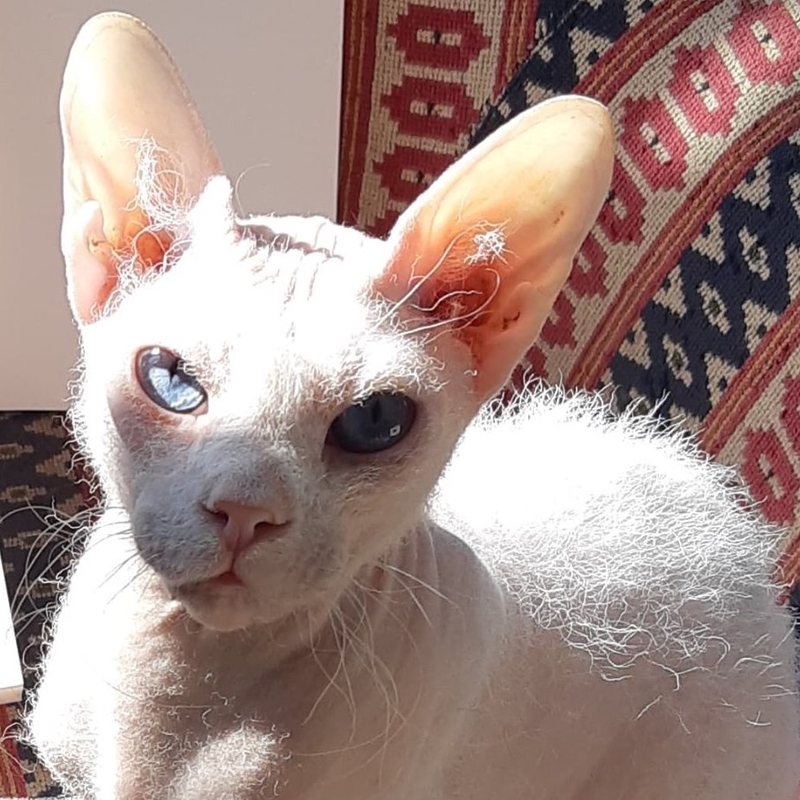

The Peterbald is a slender Russian breed with large ears and coat types ranging from hairless to fully coated. Many are described as affectionate, active and vocal. Their care needs vary with their coat and skin, so less fur does not necessarily mean less work.
Quick facts
- Origin: Russia, where the first Peterbalds were born in January 1994
- Coat: naked, chamois, flock, brush or straight; the coat usually settles by about three years of age (TICA standard)
- Weight: 5 to 7 pounds for females and 7 to 10 for males (TICA)
- Life expectancy: 12 to 15 or more years (TICA)
- Recognition: TICA championship since 2005 and FIFe since 2012; not on CFA's breed list (checked October 2026)
Temperament and daily life
TICA describes Peterbalds as very loving, social and affectionate, and as often vocal. Many follow their people around and like to play fetch. Plan for company, daily play and places to climb, and expect individual cats to differ in how talkative and active they are. Introductions and the individual cat's temperament matter with children and other pets.
Grooming and care
Care depends on the coat. A straight-coated Peterbald needs ordinary coat care, while naked and nearly hairless cats need skin care instead: oil that a coat would absorb builds up on bare skin, and the ears and nail folds collect wax and oil, so these areas need regular cleaning. Ask your veterinarian about skin care suited to your cat's coat type. Too-frequent bathing can also cause problems.
A thin or absent coat holds less heat, so offer warm, draft-free resting places that the cat can choose to use or leave, and ask your veterinarian if you are unsure about temperature. Keep the cat indoors and limit time in strong sun; if sunscreen comes up, use only a product made for pets and labelled as safe for cats, and ask your veterinary team about it.
Health considerations
Sources differ on the breed's health. TICA's breed page says no health issues have been reported, so it makes no screening suggestions. Others point to one inherited eye condition: progressive retinal atrophy of the rdAc type, an inherited loss of vision. UC Davis lists the Peterbald among the breeds for which its DNA test is appropriate, FIFe's breeding rules require Peterbalds to be tested before mating, and a 2022 survey of more than 11,000 cats found the variant at its highest frequency in the Peterbald, 26.5 percent (Anderson and colleagues, 2022). Ask a breeder for the parents' results, bearing in mind that the test covers only that one variant. Beyond this, published breed-specific health information is limited.
History and genetics
The first Peterbalds were born in Russia in January 1994 from a cross between an Oriental Shorthair named Radma vom Jagerhof and a Donskoy named Afinoguen Myth, and the new breed was developed in St Petersburg (TICA). FIFe credits the experimental cross to Olga Mironova and says the first two litters produced four hairless kittens. TICA accepted the Peterbald for championship competition in 2005, and FIFe has recognized it since 2012. TICA's standard permits outcrosses to the whole Siamese Breed Group (Siamese, Balinese, Oriental Shorthair and Oriental Longhair) and to the Donskoy, while FIFe's current rules permit Balinese, Oriental Longhair, Oriental Shorthair and Siamese outcrosses.
The hairlessness came from the Donskoy side. A 2015 study describes the Donskoy and Peterbald as carrying a semi-dominant hairless mutation whose molecular cause is still unknown, unlike the Sphynx, which has two copies of a recessive variant of a gene called KRT71 (Abitbol and colleagues, 2015). The 2022 survey also found the Sphynx variant absent in the Peterbalds it tested. Straight-coated Peterbalds do not carry the hair-loss gene at all.
Appearance
The Peterbald is svelte and elegant, with long, tapering lines, a slim, muscular body and a long, whip-like tail. The head is long and narrow with a straight profile, almond-shaped eyes and large ears. The coat types run from naked, with warm, almost elastic skin, through chamois, which feels like suede or peach fuzz, and flock, a velvety coat without guard hairs, to brush, a sparse, wiry coat, and straight, a normal coat. Cats born with hair, except straight coats, can lose it over time, and the straight coat is not eligible for the show ring in TICA.
Before choosing a Peterbald
Plan for daily company and play, skin, ear and nail care suited to the coat, and warm places to rest, and ask a breeder for the parents' PRA test results. A kitten's coat can change as it matures, so meeting the individual cat, and the adults in its family if you can, tells you more than a description.
Peterbald FAQ
Is a Peterbald the same as a Sphynx? No. The Peterbald was developed in Russia from Donskoy and Oriental Shorthair cats, and genetic testing has found that Peterbalds do not carry the Sphynx's hairlessness variant. The build differs too: the Peterbald is long and slender, like an Oriental.
Do Peterbalds need baths? Many hairless and nearly hairless cats need regular baths or wipe-downs because skin oil builds up. Ask your veterinarian how often for your cat's coat type, since too-frequent bathing can also cause problems.
Are Peterbalds hypoallergenic? No breed can be assumed safe for someone with a cat allergy, and having little or no hair does not change that. Spend time with the individual cat before committing.
Sources
- The International Cat Association: Peterbald and the Peterbald breed standard
- Fédération Internationale Féline (FIFe): Peterbald
- UC Davis Veterinary Genetics Laboratory: PRA (rdAc)
- Anderson H. et al. (2022), Genetic epidemiology of blood type, disease and trait variants, and genome-wide genetic diversity in over 11,000 domestic cats. PLOS Genetics
- Abitbol M. et al. (2015), A deletion in FOXN1 is associated with a syndrome characterized by congenital hypotrichosis and short life expectancy in Birman cats. PLOS ONE (background on hairless breeds)
- PetMD: hairless cat breeds and International Cat Care: should I use sunscreen on my cat?
One question about the Peterbald cat
Which Russian city is the Peterbald breed associated with and named after?
Answer: St. Petersburg. The breed was developed in St. Petersburg, and 'Peterbald' combines that city's name with the word 'bald'. Source