 Cat Trivia Games
iOS App
Dwelf Cat Breed
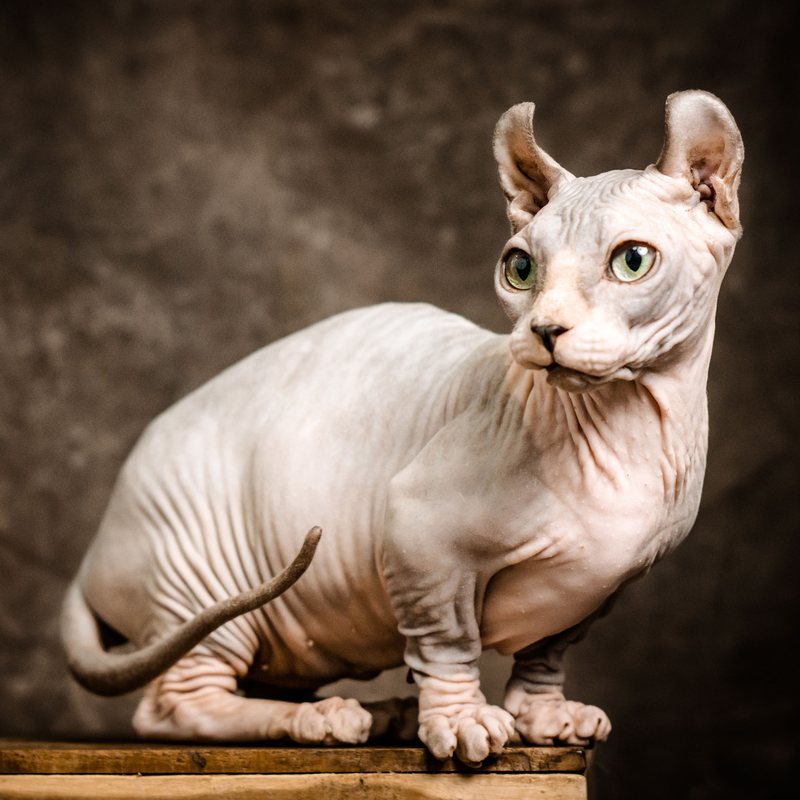
The Dwelf combines short legs, a sparse coat, and backward-curving ears. These traits create specific care needs and have prompted welfare concerns from veterinary organizations. This guide explains those concerns clearly, along with practical care for cats already living with families.
Quick facts
- Parent breeds: Munchkin (short legs), Sphynx (hairlessness) and American Curl (curled ears)
- Legs: short, from the Munchkin mutation, which affects bone and cartilage growth
- Coat: little or no hair
- Registry status: not on TICA's or CFA's breed lists (checked October 2026)
- Size and lifespan: no reliable breed-specific figures are published
Health and welfare considerations
The Cat Group, a collection of professional organizations dedicated to feline welfare that includes International Cat Care, published a position statement on Bully and Dwelf cats in 2024, updated in 2025. It says these cats suffer from physical deformities, including hairlessness and distorted limbs, that the limb deformities are painful and restrict mobility, and that breeding for deformity is unethical. It urges breeders to stop breeding them, says they should not be promoted or shown, and asks the public not to buy them under any circumstances.
The short legs come from the Munchkin mutation. The limb bones fail to grow normally, and UFAW notes that affected cats are predisposed to painful osteoarthritis, that some kittens die before birth, and that such cats should not be used for breeding. PetMD's Munchkin profile also describes lordosis, an inward curve of the lower spine, and pectus excavatum, a chest deformity.
Less is known about the curled ears. International Cat Care said it did not have enough information to know whether the curl affects cartilage elsewhere, noted breeders' reports that the ears are fragile and easily damaged when handled, and mentioned anecdotal reports of narrowed ear canals (archived Dwelf profile). The Sphynx, one parent breed, is on Cornell's list of breeds in which hypertrophic cardiomyopathy is more prevalent. That is not a measured Dwelf risk, but heart checks are worth discussing with your veterinarian.
Temperament and daily life
Owners often describe sociable behavior, but evidence for a consistent breed-wide temperament is limited, and meeting the individual cat tells you more. A Dwelf's home should work at ground level: ramps, low steps, low-sided litter boxes and low resting places are easier on short legs than tall cat trees, and play on the floor suits a cat that cannot jump well.
Grooming and care
Little hair changes the grooming routine; it does not remove it. Skin oil that a coat would absorb builds up, so hairless cats need regular bathing, but frequent baths can dry the skin, and PetMD's guide to hairless cats advises asking your veterinarian about a skincare routine. Ears and nails also collect wax and oil, and the curled ears need gentle handling.
Provide warm resting places and keep the cat indoors, out of strong sun. If sunscreen comes up, International Cat Care advises using only a product made for pets and labeled as safe for cats. Short legs can also make it harder to groom some areas, so check the places the cat cannot reach.
History
The Dwelf is a recent cross that combines the short legs of the Munchkin, the hairlessness of the Sphynx and the curled ears of the American Curl, as International Cat Care's profile described it. No reliable date for its first breeding is published. It is not on the breed lists of TICA or the Cat Fanciers' Association, and the Munchkin parent is itself not recognized by CFA.
Appearance
A Dwelf has the short legs of a Munchkin, the sparse coat of a Sphynx and ears that curl backward like an American Curl's. The bare or nearly bare skin shows the color and pattern the cat would otherwise carry in its coat, and it is exposed to cold and sun.
Before choosing a Dwelf
The Cat Group asks breeders to stop producing Dwelf cats and asks the public not to buy them, and International Cat Care advises against continuing traits that compromise welfare. If you already care for a Dwelf, or are thinking of adopting one that needs a home, plan for skin care, warmth, sun protection, ramps or low steps, and regular veterinary checks of the joints, spine and ears. No checklist removes the welfare concerns that come with the cat's structure.
Dwelf FAQ
Can Dwelf cats jump? Not as well as cats with typical legs. Some can manage low furniture, but arthritis or spinal problems can limit them further, so ramps and low steps help.
Are Dwelf cats hypoallergenic? No breed can be assumed safe for someone with a cat allergy, and having little hair does not change that. Spend time with the individual cat before committing.
Sources
- The Cat Group: position statement on Bully and Dwelf cats (2024, updated 2025)
- International Cat Care: Dwelf (archived copy), inherited disorders in cats and should I use sunscreen on my cat?
- UFAW: Munchkin limb deformity
- PetMD: Munchkin and hairless cat breeds
- Cornell Feline Health Center: hypertrophic cardiomyopathy
- The International Cat Association: browse all breeds and Cat Fanciers' Association: breeds (both checked October 2026)
Try a mixed breed question
According to the CFA, how are the Chartreux's erect, medium-sized ears set on its head?
Answer: High on the head. The CFA describes erect, medium-sized ears set high on a broad, rounded head that tapers to a narrow muzzle. The whisker pads give the face a hint of a smile. Source