 Cat Trivia Games
iOS App
HOME / BREEDS / EUROPEAN BURMESE
European Burmese Cat Breed
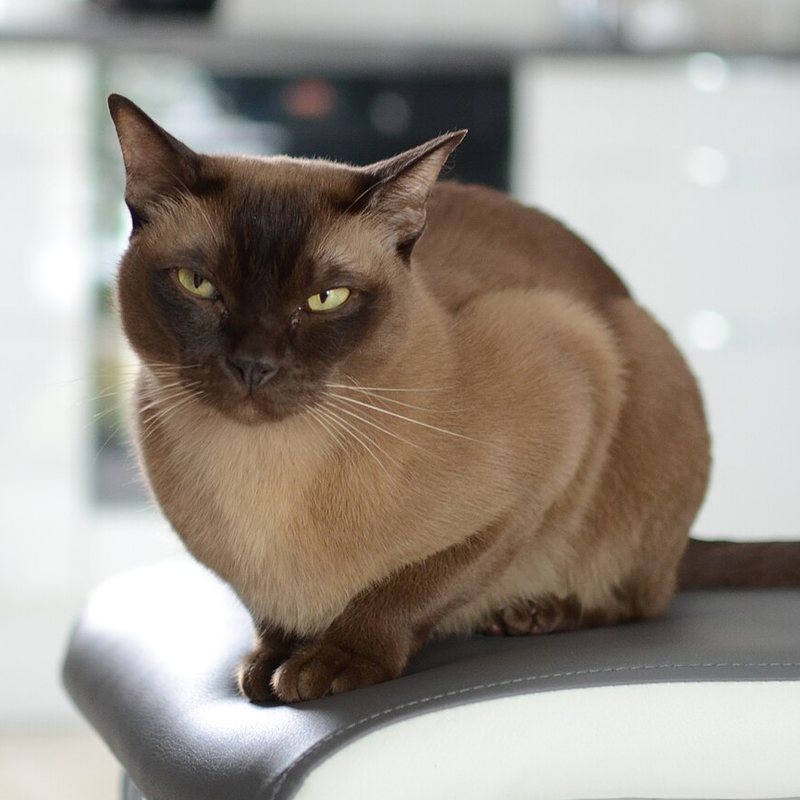

European Burmese cats are compact, muscular companions with short, glossy coats. They are often described as sociable and playful. Compared with the American Burmese, registry standards generally describe a different head shape and a wider color range.
Quick facts
- Build: medium-sized and muscular, heavier than it looks
- Coat: short, close-lying and glossy, in ten colors (CFA)
- Eyes: yellow-gold to deep amber (CFA); GCCF allows chartreuse to amber
- Grooming: occasional brushing with a rubber brush
- Health screening to ask about: the hypokalaemia DNA test
Temperament and daily life
CFA describes the breed as curious and playful. Its profile calls European Burmese highly intelligent cats that thrive on human companionship, likely to follow you from room to room, join in with whatever you are doing and even welcome visitors at the door. Many enjoy frequent interaction through the day, so a home where someone is around often, with toys, food puzzles and somewhere to climb, suits them well. Introductions and the individual cat's temperament matter with children and other pets.
Grooming and care
This is one of the easier coats to care for. Occasional brushing with a rubber brush controls the small amount of shedding, and the cats keep themselves clean, so regular bathing is not needed. Give them warm places to rest, and for outdoor time, use a secure space such as an enclosed catio or a harness and lead under supervision.
Health considerations
In some countries, Burmese cats appear to have a higher risk of developing diabetes than other breeds, but this may not be true in the United States, according to Cornell's Feline Health Center. The evidence comes from studies of Burmese in Australia, England and Sweden, places where the European type of Burmese developed or spread. Britain's GCCF notes a slight tendency to diabetes that rises with age and body weight, so measured portions and regular weight checks help. Weight loss despite a good appetite, and increased thirst and urination, are signs to mention to your veterinarian.
Hypokalaemia is an inherited condition of Burmese and related breeds in which low blood potassium causes episodes of muscle weakness, usually first seen in kittens between two and six months old. A DNA test for the WNK4 variant lists the European Burmese among the breeds it applies to, and the GCCF strongly recommends testing all Burmese used for breeding. Ask whether the parents were tested. A clear result covers only that variant.
History
The European Burmese and the Burmese share one ancestor: Wong Mau, a small brown cat introduced to the Western world in 1930 by Dr. Joseph Thompson. Her solid brown kittens founded the Burmese breed in the United States, and from 1949, American-bred Burmese were exported to England, where the European type began to develop. Brown cats were recognized for championship competition in England in 1952. Blue followed, then red and cream, and finally chocolate and lilac, which made four tortoiseshell colors possible and completed a palette of ten.
The breed spread through Europe, Africa, Australia and New Zealand before returning to the United States, where the Cat Fanciers' Association accepted it for registration in 1993 and for championship competition in 2002.
Appearance
The two breeds now look different. CFA describes the Burmese as compact, cobby and round, and the European Burmese as more moderate, with gently rounded contours and a medium-length body. In the European Burmese standard, both oriental elongation and excessive cobbiness are incorrect. The top of the head is slightly rounded, with wide cheekbones tapering to a short, blunt wedge, a visible nose stop and a strong chin, close to the GCCF's description of a short, wide wedge with a rounded top of head.
The coat is short, close-lying and glossy, with underparts slightly paler than the back. CFA accepts ten colors: brown, blue, chocolate, lilac, red and cream, plus brown tortie, chocolate tortie, blue-cream and lilac-cream. The Burmese is shown in four.
Before choosing a European Burmese
A European Burmese may suit a home where someone is around for much of the day and enjoys a cat that wants to be involved. Plan for play, measured meals and regular weight checks, and ask a breeder whether the parents were tested for hypokalaemia. Meeting the individual cat tells you more about its temperament than the breed description.
European Burmese FAQ
Why is it called the European Burmese in the United States? To separate it from the American type. The European type developed in England and spread through Europe and beyond before CFA accepted it in 1993 as a breed of its own, alongside the Burmese.
Are European Burmese cats hypoallergenic? No breed can be assumed safe for someone with a cat allergy, and a short coat with little shedding does not change that. Spend time with the individual cat before committing.
Sources
- Cat Fanciers' Association: European Burmese and the European Burmese standard
- Governing Council of the Cat Fancy (GCCF): Burmese
- Cornell Feline Health Center: feline diabetes
- Diabetes studies: Australian Veterinary Journal (1997), Journal of Veterinary Internal Medicine (2016, England) and Journal of Veterinary Internal Medicine (2015, Sweden)
- International Cat Care: hypokalaemia in cats
- UC Davis Veterinary Genetics Laboratory: Burmese hypokalemia test
Try a mixed breed question
A quiz-goer assumes every hairless cat carries the Sphynx's recessive coat mutation. In the Ukrainian Levkoy, where does the hairlessness actually come from, and how is it inherited?
Answer: From its Donskoy ancestry, as a dominant trait. The Levkoy was built from the Donskoy (Don Sphynx) crossed with the Scottish Fold, not from the Sphynx. The Donskoy's hairlessness is governed by a dominant gene, so any cat inheriting it is born bald or loses its coat while growing. That is the opposite of the true Sphynx, whose baldness is recessive. Same look, different genetics. Source