 Cat Trivia Games
iOS App
Tonkinese Cat Breed
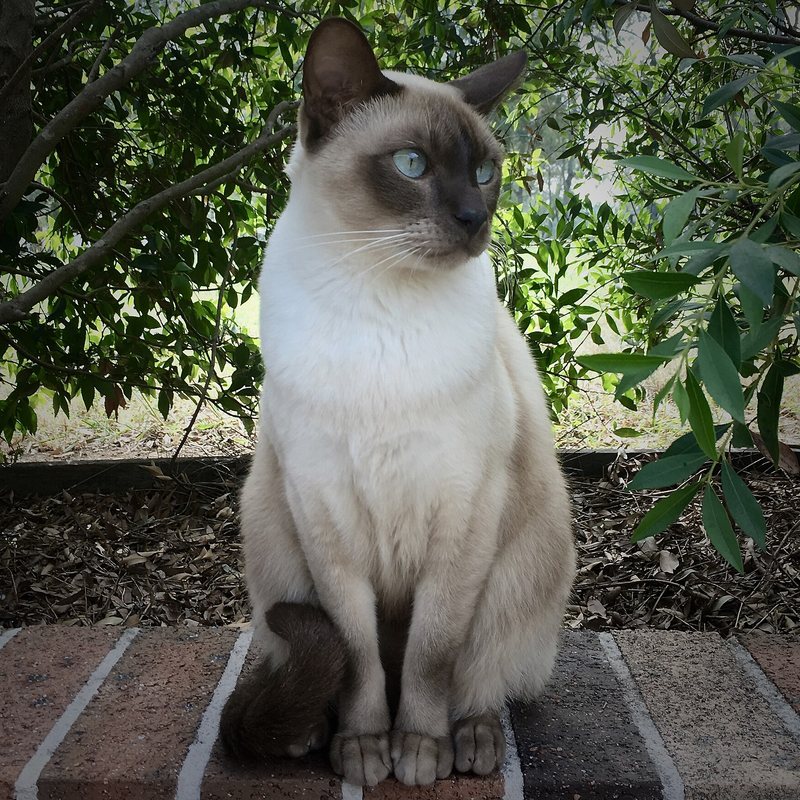

The Tonkinese shares ancestry with Siamese and Burmese cats and has a short coat in pointed, mink or solid patterns. Many are described as sociable and playful. If you like an interactive cat, learn about their care needs as well as their appearance.
Quick facts
- Ancestry: Siamese and Burmese; Wong Mau, the Burmese breed's foundation cat, brought to America in 1930, was a natural mink Tonkinese
- Patterns: pointed, mink and solid, each in natural, champagne, blue and platinum (CFA)
- Size: TICA gives 8 to 12 pounds for males and 6 to 8 for females
- Life expectancy: 12 to 16 or more years (TICA); PetMD gives an average of 15 to 20 years
- Registries: CFA championship status for minks in 1984, and for pointed and solid cats in 2002
Temperament and daily life
CFA describes the Tonkinese as "intelligent, gregarious and generally quite outgoing", a cat that gets along well with dogs, other pets, children and guests and will greet visitors at the door. Many want to be involved in household life and enjoy interactive play, puzzle feeders and climbing space. Individual cats still vary, so introductions matter, and how well a particular cat copes with time alone is worth asking about before you bring it home.
A friendly, curious cat is no safer outdoors than any other. The ASPCA recommends keeping cats indoors, partly because outdoor cats risk being hit by cars, and International Cat Care describes ways to give a cat safe outdoor access, such as cat-proof fencing or an enclosed catio.
Grooming and care
The short, close-lying coat needs little work: CFA suggests a rubber brush two or three times a month, PetMD a weekly brushing, and CFA notes that Tonkinese shed seasonally rather than all year. Bathing is rarely needed. Trim the nails, check the ears and keep the cat at a healthy weight.
Health considerations
Both registries mention teeth: CFA names a tendency toward gingivitis in older cats as the breed's only specific health concern, and TICA says the breed is more prone to dental disease. Across all cats, the Cornell Feline Health Center reports that 50 to 90 percent of cats older than four have some form of dental disease. Regular tooth brushing to remove plaque is the best way to prevent gingivitis, but it is not a cure-all: tooth resorption, which Cornell says shows up in 30 to 70 percent of cats, has no known cause, so regular dental checkups matter even in a cat whose teeth are brushed.
TICA also mentions feline lower urinary tract disease (FLUTD), inflammatory bowel disease and amyloidosis, and PetMD lists chronic kidney disease, polycystic kidney disease (PKD) and obesity. A cat straining or unable to pass urine needs a veterinarian right away, as Cornell explains. The common PKD1 DNA test was developed for Persian-related breeds and its breed list does not name the Tonkinese, so ask what any test covers. International Cat Care lists the Tonkinese among breeds affected by hypokalaemia, an inherited cause of muscle weakness that has a gene test, and UC Davis lists the breed for its test for the rdAc form of progressive retinal atrophy.
History
Wong Mau, the small brown cat brought to America in 1930 who became the foundation of the Burmese breed, was later identified as a natural mink Tonkinese, although the breed had not yet been defined. Breeders including Jane Barletta in the United States and Margaret Conroy in Canada later set out to develop the Tonkinese deliberately. Accounts of the first recognition in Canada differ: CFA's breed page gives 1960, a CFA history article gives 1971, and GCCF says 1965, when the name Tonkinese was adopted. CFA registered the breed from October 1978, granted championship status to minks in May 1984 and added pointed and solid cats in 2002.
Appearance
The Tonkinese is a medium-sized cat, neither as cobby as the Burmese nor as svelte as the Siamese, with a dense, muscular body that CFA says should feel surprisingly heavy when lifted, and a short, close-lying coat. "Mink" describes a color pattern, not the texture of the fur: a mink cat has a medium contrast between its body color and its points. It comes from inheriting one Siamese and one Burmese version of the colorpoint gene, which gives an intermediate color, warmer and lighter than a Burmese, with points that can still be seen (CFA). Pointed cats have high contrast and solid cats low contrast, and mink is the pattern most closely associated with the breed.
Before choosing a Tonkinese
Plan for a sociable cat that wants company and play, a short coat that needs little brushing, and regular dental care with checkups. Ask a breeder which health tests the parents had, and meet the individual cat if you can; its own temperament tells you more than the breed description.
Tonkinese FAQ
Does a Tonkinese have to be a mink? No. CFA accepts mink, pointed and solid Tonkinese, each in natural, champagne, blue and platinum, although mink is the pattern most closely linked to the breed.
Why do Tonkinese have different eye colors? Eye color follows the coat pattern. The CFA standard calls for aqua eyes in minks, which it calls a defining feature of the pattern, blue eyes in pointed cats and green to yellow-green eyes in solids, and it disqualifies yellow eyes in minks.
Sources
- Cat Fanciers' Association (CFA): Tonkinese and its breed standard, a Tonkinese history article, registration rules and pointed patterns
- The International Cat Association (TICA): Tonkinese
- Governing Council of the Cat Fancy (GCCF): Tonkinese
- PetMD: Tonkinese
- Cornell Feline Health Center: feline dental disease and feline lower urinary tract disease
- International Cat Care: hypokalaemia and fencing in your garden; ASPCA: general cat care
- UC Davis Veterinary Genetics Laboratory: PRA (rdAc) test and PKD1 test
Quick quiz: 2 questions about the Tonkinese cat
What term describes the Tonkinese coat pattern with high color contrast resembling the Siamese?
Answer: Pointed. The pointed pattern shows the strongest contrast between body and extremities, mirroring the Siamese, and these cats have blue eyes. Source
The Siamese-Burmese-type cats brought to the West in the 1800s, regarded as Tonkinese ancestors, were originally known by which name?
Answer: Chocolate Siamese. Breed histories, including the CFA's, note the intermediate brown cats imported to the West in the 19th century were called 'chocolate Siamese' before the modern Tonkinese was reconstructed from Siamese and Burmese crosses. Source