 Cat Trivia Games
iOS App
Korat Cat Breed
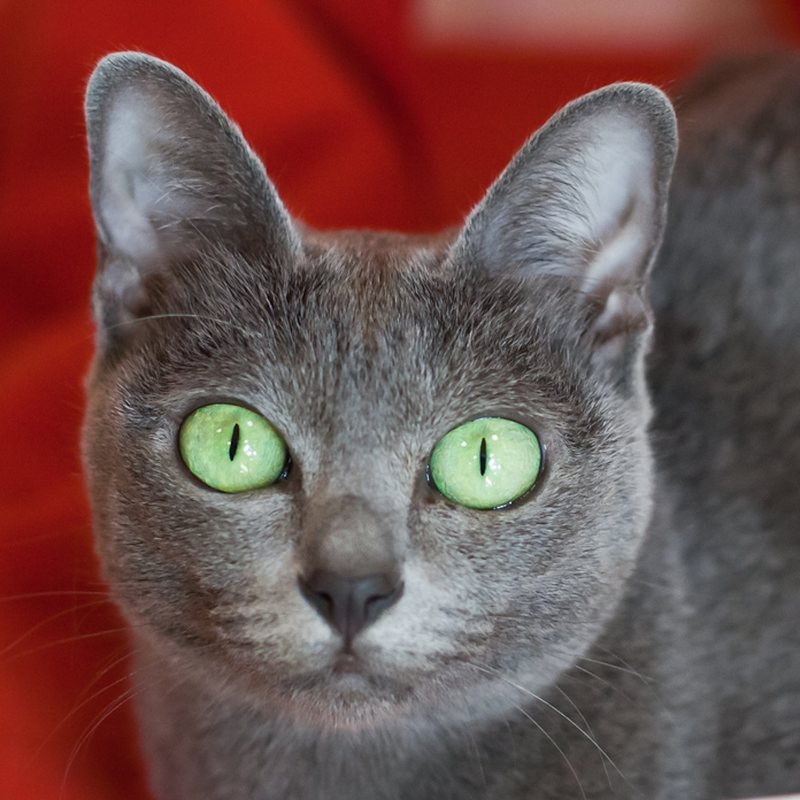

Korats are Thai cats with silver-tipped blue coats and distinctive green eyes as adults. They have a long cultural association with good fortune. Many are attentive companions, and prospective carers should understand the documented inherited conditions discussed below.
Quick facts
- Weight: about 6 to 8 pounds for females and 8 to 10 or more for males (TICA)
- Life expectancy: estimates differ, from 10 to 15 years (PetMD) to 15 or more (TICA)
- Coat: short, glossy and single, in silver-tipped blue only
- Eyes: green in adults, usually reached between two and four years of age (CFA)
- Health screening to ask about: DNA tests for GM1 and GM2 gangliosidosis
Temperament and daily life
Korats tend to bond closely with their people. The Cat Fanciers' Association describes them as loyal, trusting and extremely expressive, cats that seek out contact and take a keen interest in whatever is going on. Many can learn tricks, though usually only when they choose to, and interactive toys, puzzle toys and treats keep a clever cat busy. Some play fetch, and many like a high perch on top of a refrigerator or cupboard.
Many Korats are gentle cats that dislike loud or harsh noises, and one that is ignored while people are at home may become withdrawn. Most get along with other household pets, but some become jealous when another animal gets a lot of attention, so when a new pet arrives, keep plenty of attention on the resident Korat. Introductions and the individual cat's temperament matter.
Voices vary. Some Korats are very quiet, while others range from a quiet chirp to a full roar, and most speak up when they want something.
Grooming and care
The single coat sheds lightly, and weekly brushing keeps it in good condition. Nails, teeth and ears need the same routine care as any cat's. Most of the effort goes into company and play: regular interactive sessions, and puzzle toys that give a Korat something to work on.
Health considerations
Gangliosidosis is the only inherited disease TICA names for the breed. It comes in two forms, which are separate diseases with separate DNA tests. According to the UC Davis Veterinary Genetics Laboratory:
- GM1 gangliosidosis is caused by a mutation in the GLB1 gene. Signs such as tremors and loss of coordination begin around 3 months of age, and the disease reaches its terminal stage around 9 to 10 months, when blindness and seizures are also seen.
- GM2 gangliosidosis is caused by a mutation in the HEXB gene and progresses faster. Fine head tremors can appear as early as 4 weeks of age, followed by loss of coordination, and affected kittens die before 8 months of age.
Both are autosomal recessive. A kitten needs two copies of the same variant to be affected; a cat with one copy is a carrier and does not develop the disease. Each test identifies normal, carrier and affected cats for its own variant only. Validated tests can inform breeding decisions; have the results and their limits explained by a qualified professional. Ask a breeder for both parents' GM1 and GM2 results.
Dental disease is also on PetMD's list of the breed's concerns, so regular checkups and a tooth-brushing routine your cat accepts are worth planning for.
History
In Thailand the Korat is known as the Si-Sawat. Its earliest known record is the Cat-Book of Poems, produced during the Ayutthaya period (1350 to 1767), which illustrates 17 "good luck" cats of Thailand, the Korat among them. Old pictures show that cats like the Korat were known then. They cannot show how closely today's cats match them, genetically or in appearance.
Korats were traditionally given to brides as a sign of luck and happiness, with the silver coat standing for wealth and the green eyes, the color of young plants, for good harvests. The name is traced to King Rama V, who is said to have asked where the cat came from and been told it came from Korat, a high plateau in northeast Thailand. Jean Johnson imported the first known pair to the United States in 1959, and ten years later Daphne Negus brought nine more from Thailand to strengthen the bloodlines.
Appearance
The Korat is a medium-sized, semi-cobby cat, muscular and heavier than it looks. Seen from the front, the head is heart-shaped: the eyebrow ridges form the upper curves of the heart, and the sides of the face curve down to the chin. The large, luminous eyes look round when fully open and slanted when closed. The single coat is short, glossy and close-lying, and silver-tipped blue is the only color allowed. Each hair is lighter at the root and darkest blue just before the silver tip, and the silver sheen is strongest where the coat is shortest.
Eye color develops as the cat matures. Kittens and adolescents can have yellow, amber or amber-green eyes, and the adult green is not usually reached until two to four years of age.
Before choosing a Korat
A Korat may suit a household where people are around for company and play, and where the days are fairly calm. Plan for interactive play and for a slow, careful introduction if another pet joins the home. Ask for both parents' GM1 and GM2 results, and spend time with the individual cat, since voice and energy vary from one Korat to the next.
Korat FAQ
How is a Korat different from a Russian Blue? Both are blue cats with green eyes, but CFA's standards describe different cats. The Korat has a single coat that lies close to the body, a semi-cobby build and a heart-shaped head, and comes from Thailand. The Russian Blue has a dense double coat that stands out from the body, a longer, finer-boned build and a wedge-shaped head, and is believed to come from northern Russia.
Are Korats hypoallergenic? No breed can be assumed safe for someone with a cat allergy. Korat hair does not float off when the cat is stroked, but that does not make the Korat a low-allergen breed.
Is a gray cat with green eyes a Korat? Not necessarily. All Korats trace their ancestry back to cats from Thailand, and the breed accepts no outcrosses to other breeds. Appearance alone cannot establish a breed.
Sources
- Cat Fanciers' Association: Korat and Russian Blue
- The International Cat Association: Korat
- UC Davis Veterinary Genetics Laboratory: Korat GM1 gangliosidosis and Korat GM2 gangliosidosis
- PetMD: Korat
Try a mixed breed question
Which of the following is a correct description of the Flock Coat type in Donskoy cats?
Answer: Feels like suede and looks hairless, may go fully bald. Per TICA's official standard, the Flock coat 'appears hairless' with the texture of a soft chamois from the start, and can progress to complete baldness. A different pattern from Velour (wavy coat that thins) or Brush (wiry coat that keeps patches). Source