 Cat Trivia Games
iOS App
Khao Manee Cat Breed
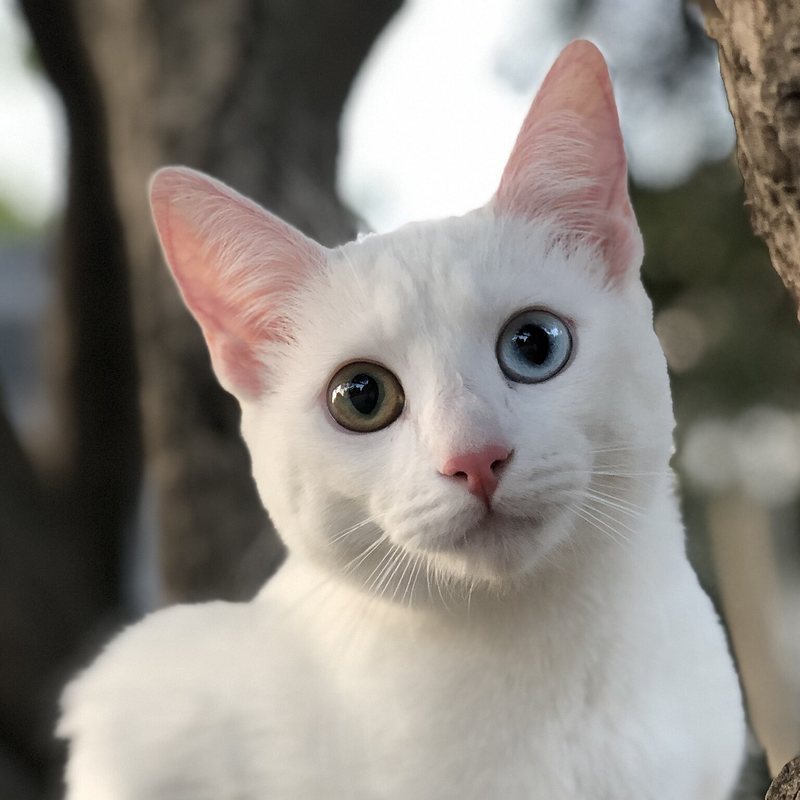

The Khao Manee is a white-coated Thai breed whose eyes may be blue, gold, or different colors. It is often described as sociable and active. Hearing should be assessed individually; eye color alone cannot tell you whether a particular cat can hear.
Quick facts
- Name: "White Gem" in Thai; also nicknamed the Diamond Eye cat
- Coat: short, pure white; a small headcap of color may persist until 18 months of age (CFA)
- Eyes: blue, gold, green or odd-eyed
- Life expectancy: 10 to 12 years (TICA)
- Health screening to ask about: a BAER hearing test
Temperament and daily life
Khao Manee are usually active, curious cats with plenty to say. The Cat Fanciers' Association's profile describes shoulder riders with a balance of activity and affection, good at communicating through body language and a variety of voices, though not necessarily noisy. Its breed standard adds that they can be shy with strangers, so do not expect every cat to greet visitors. Climbing space, puzzle toys and regular play suit an active cat, and introductions and the individual cat's temperament matter with children and other pets.
Grooming and care
The short coat is not a heavy shedder, but white hair shows on clothes and furniture, so regular brushing with a rubber brush keeps it under control. Ask your breeder or veterinarian before bathing. White, thinly furred skin is more prone to sunburn and skin cancer, usually around the ears and nose, so limit strong sun exposure and have any scabs or wounds that do not heal on those areas checked by your veterinarian.
Health considerations
Deafness is the main documented concern. White cats can be prone to congenital deafness, especially blue-eyed ones, and an odd-eyed cat may be deaf in one ear. For all-white cats in general, Cornell's Feline Health Center gives figures of 65 to 85 percent deafness when both eyes are blue, about 40 percent with one blue eye, and 17 to 22 percent with non-blue eyes. Those numbers describe white cats generally; no measured Khao Manee rate is published.
Appearance is not a reliable guide to hearing, which is why a hearing test matters. Britain's GCCF gives active breeding registration only to Khao Manee proven hearing by BAER testing, an electrical test of the hearing pathway, and strongly advises against mating two blue-eyed cats. CFA notes that breeders also use non-white kittens, which occur in some litters, to lower the chance of deaf kittens. Ask whether the kitten and its parents have had BAER tests.
Beyond hearing, published breed-specific health information is limited, and that does not establish that the breed is free of other inherited disease. Verify records, identity, and care practices regardless of price.
History
White cats appear among the good-luck cats of the Tamra Maeo, the Thai book of cat poems, where TICA says the breed is called the Kao Plort, meaning "all white". The cats stayed in Thailand until 1999, by which time their numbers had dwindled. That year Colleen Freymouth imported a cat named Sripia to the United States and set up a breeding and conservation program.
Registries have accepted the breed in stages. TICA placed it in Registration Only status in May 2009 and Preliminary New Breed status in May 2012, and its board voted in January 2015 to advance the Khaomanee to championship. CFA accepted the Khao Manee for registration in 2018 and shows it in the Provisional class. Britain's GCCF lists it among breed names accepted for registration and exhibition (all checked October 2026).
Appearance
The coat is pure, glistening white, short and close-lying. Kittens may carry a small headcap of color that shows their underlying genetics, and CFA's standard allows it until 18 months of age. TICA describes a heart-shaped head with high cheekbones. The eyes can be any shade of blue, gold or green, or one of each, and GCCF notes that the true eye color develops after three to five months of age.
Before choosing a Khao Manee
A Khao Manee may suit a home with time for play and company, and with a way to keep a white cat out of strong sun. Ask for BAER hearing results for the kitten and its parents, and if a kitten is deaf, plan for an indoor life and ways to approach it without startling it. Meeting the individual cat tells you more about its confidence with strangers than the breed description.
Khao Manee FAQ
Can a Khao Manee kitten be another color? Yes. Non-white kittens occur in some litters, and breeders use them to lower the chance of deafness. Only white cats meet the breed standard for showing.
Does Khao Manee mean diamond eye? Not exactly. Khao Manee means "White Gem" in Thai, and CFA's standard translates it as "like white diamonds". Diamond Eye is a nickname that comes from the jewel-like eyes.
Sources
- Cat Fanciers' Association: Khao Manee
- The International Cat Association: Khaomanee and the 2015 winter board meeting minutes (archived copy)
- Governing Council of the Cat Fancy (GCCF): cat breeds and the Khao Manee registration policy
- Cornell Feline Health Center: white cats and blindness or deafness
- International Cat Care: should I use sunscreen on my cat?
- International Cat Care: Khao Manee (2018, archived copy)
Quick quiz: 3 questions about the Khao Manee cat
The Khao Manee was first documented in the Tamra Maew (Cat-Book Poems) manuscript, believed to date to which historic Thai kingdom?
Answer: Ayutthaya Kingdom. The Tamra Maew manuscript describing cats like the Khao Manee is believed to originate from Thailand's Ayutthaya Kingdom (roughly 1351-1767 AD), though the oldest surviving copies date from later centuries. Source
Which organization recognized the Khao Manee for registration in 2009?
Answer: The International Cat Association (TICA). TICA accepted the Khao Manee for Registration Only status in May 2009, the breed's first formal step toward full championship recognition; CFA did not recognize the breed until 2018. Source
Which of these is NOT a typical characteristic of the Khao Manee breed?
Answer: Naturally hairless skin. Khao Manee cats have a short, smooth, fully-furred white coat. They are not a hairless breed. TICA describes them as playful, very sociable, and notably talkative, disliking being left alone for long periods. Source