 Cat Trivia Games
iOS App
HOME / BREEDS / KURILIAN BOBTAIL
Kurilian Bobtail Cat Breed
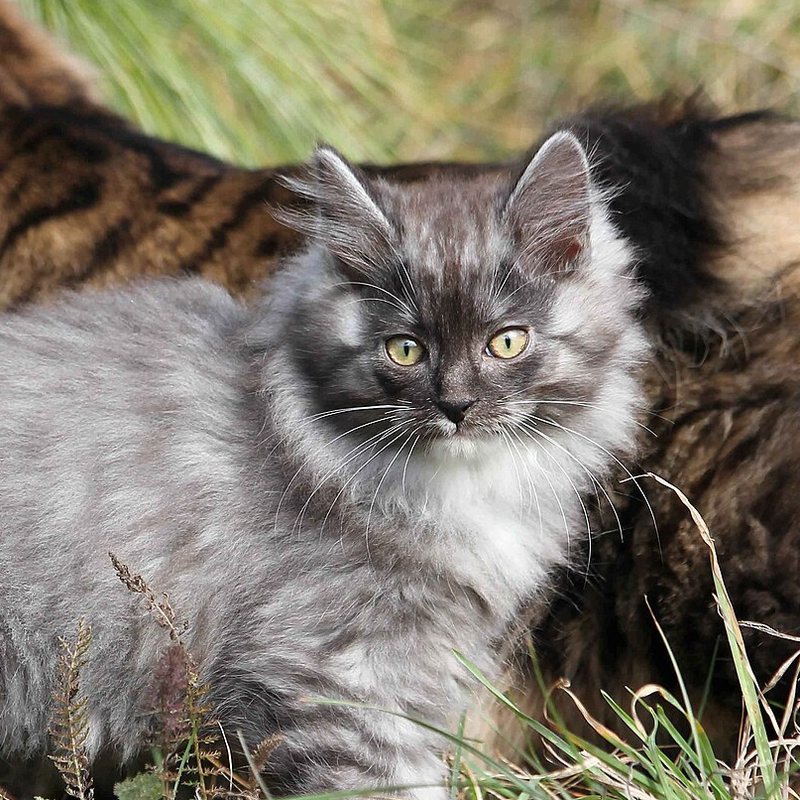

Kurilian Bobtails are sturdy cats associated with the Kuril Islands and nearby regions. They have distinctive short tails and come in two coat lengths. Many are described as active and sociable, although individual preferences for play and contact vary.
Quick facts
- Origin: the Kuril Islands, Sakhalin Island and the Kamchatka peninsula of Russia (TICA, FIFe)
- Weight: mature males up to about 15 pounds; females 8 to 11 (TICA)
- Life expectancy: 15 to 20 years (TICA)
- Tail: short and kinked, 3 to 8 cm long (FIFe), with 2 to 10 vertebrae (TICA)
- Recognition: FIFe since 2004 and TICA championship since 2012; not on CFA's breed list (checked October 2026)
Temperament and daily life
Registry descriptions are warm. TICA calls the breed independent, intelligent, inquisitive, sociable, playful and very gentle, and notes that these cats tend to seek out the highest point in a room to watch what is going on. Many are gentle and quick to learn, and some enjoy playing in water. Individual cats differ in how much contact and play they want, so plan for climbing space and regular play, and take introductions with children and other pets slowly.
Grooming and care
The coat is soft, silky and generally non-matting, so regular combing usually keeps it in order. Pay extra attention to the armpits and the area between the hind legs, where the skin is thin and knots are most likely. If you find a mat, tease it apart gently with your fingers and never use scissors, since it is hard to see where the skin ends; a tight mat close to the skin is a job for a veterinarian or qualified groomer. Otherwise, standard care applies, including a sturdy scratching post at least three feet tall and nail trims every two to three weeks.
Health considerations
Published breed-specific health information is limited, which does not establish that Kurilian Bobtails are free of inherited disease. The breed is popular in Europe but still little known in North America, so health data from there are especially thin. Ask a breeder about the parents' health and rely on your veterinarian for the individual cat. Handle the tail gently, as with any bobtailed cat, and mention any sign of tail pain or stiffness to your veterinarian.
History
According to TICA, short-tailed cats have been documented on the Kuril Islands for at least 200 years. The Kurils are a chain of about 56 volcanic islands stretching roughly 700 miles from Russia's Kamchatka peninsula to the Japanese island of Hokkaido; the breed is also associated with Sakhalin, a separate island, and with Kamchatka itself. Members of the military and scientists brought short-tailed cats back to central Russia in the middle of the twentieth century, where their mousing skills made them popular.
FIFe, which spells the name "Kurilean", describes it as being developed and promoted as a Russian aboriginal breed, distinct from the Japanese Bobtail. FIFe has recognized it since 2004, and TICA accepted it for championship competition in 2012.
Appearance
The Kurilian Bobtail is medium to large, with a compact, semi-cobby body and hind legs longer than the front. The cats feel more solid and brawny when lifted than they look, and the wide face is shaped like a trapezium. The tail is the breed's signature: no two are alike, and the short, bushy tails can be shaped like a whisk, a spiral or a snag. The coat is short or semi-long and comes in a variety of traditional colors, solid or tabby, with or without white.
Before choosing a Kurilian Bobtail
Availability varies a great deal from country to country, so finding a Kurilian Bobtail can take time. Plan for regular play and climbing space, routine combing and regular veterinary care, and ask a breeder about the parents' health. How much contact and play a particular cat wants is best learned by meeting it.
Kurilian Bobtail FAQ
Is the Kurilian Bobtail related to the Japanese Bobtail? Possibly. FIFe says the breed most likely arose from crossbreeding between Japanese Bobtails and Siberian cats brought to the islands by sailors, although it has been developed as a separate Russian breed. Genetic studies point the same way: a 2022 survey of more than 11,000 cats found that the variant linked to the Japanese Bobtail's kinked tail is common in Kurilian Bobtails, while a 2013 study found none of the Manx tail mutations in the ten Kurilians it tested.
Are Kurilian Bobtails hypoallergenic? No breed can be assumed safe for someone with a cat allergy. Spend time with the individual cat before committing.
Sources
- The International Cat Association: Kurilian Bobtail
- Fédération Internationale Féline (FIFe): Kurilean Bobtail
- World Cat Federation: EMS code and championship status and Cat Fanciers' Association: breeds (both checked October 2026)
- International Cat Care: grooming your cat and ASPCA: general cat care
- Anderson H. et al. (2022), Genetic epidemiology of blood type, disease and trait variants, and genome-wide genetic diversity in over 11,000 domestic cats. PLOS Genetics
- Buckingham K.J. et al. (2013), Multiple mutant T alleles cause haploinsufficiency of Brachyury and short tails in Manx cats. Mammalian Genome
Try a mixed breed question
The Singapura's local name 'Kucinta' is a blend of which two Malay words?
Answer: Kucing (cat) and cinta (love). Kucinta is an amalgamation of the Malay words 'kucing' (cat) and 'cinta' (love), which is why it is rendered as 'the love cat.' Source