 Cat Trivia Games
iOS App
HOME / BREEDS / TURKISH ANGORA
Turkish Angora Cat Breed
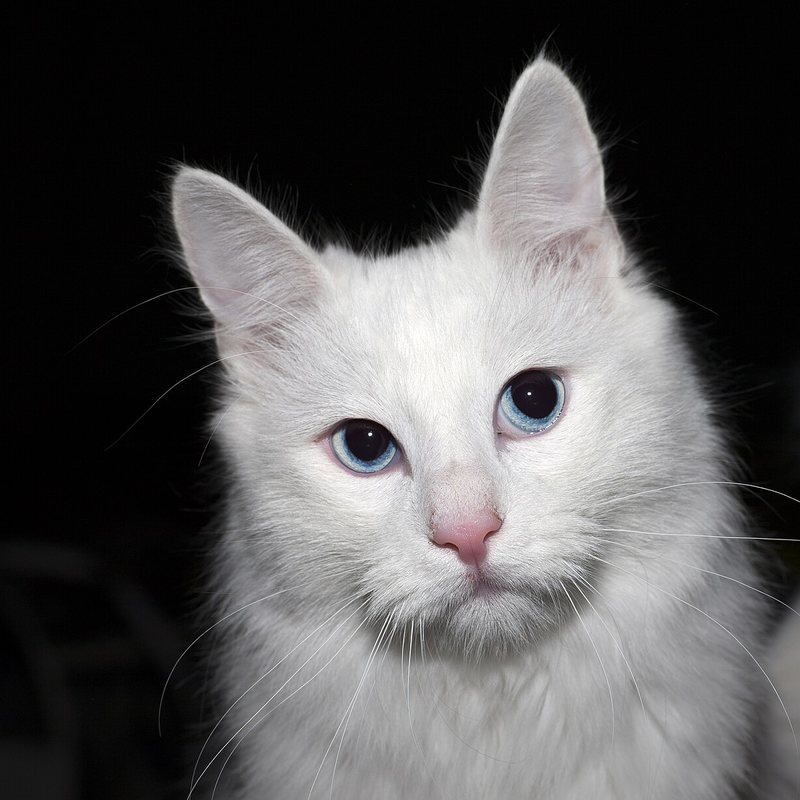

The Turkish Angora is a slender cat with a silky, semi-long coat and a full tail. Many are active and interested in people. The breed's history includes preservation programs in Turkey, and white-coated cats need a careful, individual discussion of hearing.
Quick facts
- Origin: longhaired cats from the region of Ankara, historically Angora, in Turkey; known in Europe by the 16th or 17th century
- Coat: silky and semi-long, with a thin undercoat or none at all
- Size: small to medium; TICA gives 5 to 10 pounds and PetMD 8 to 15
- Life expectancy: TICA says Turkish Angoras are known to live into their early 20s
- Registries: CFA registration in 1968, championship status for white cats in 1973 and for other colors in 1978; FIFe since 1988
Temperament and daily life
CFA calls the Turkish Angora "one of the most interactive and affectionate of all breeds", and FIFe describes it as playful, intelligent, athletic and involved, often choosing one member of the family as its constant companion. Many are talkative, and many do not like being held for more than a few minutes. Let the individual cat choose how it wants to interact: some prefer to sit beside you or watch from a high perch rather than be carried. Tall cat trees, shelves and daily play suit an athletic climber.
The ASPCA recommends keeping cats indoors, and International Cat Care describes ways to offer safe outdoor access, such as cat-proof fencing or an enclosed catio. Both matter more for a cat with any hearing loss, which cannot hear traffic coming.
Grooming and care
The coat is silky and rarely mats, so it is easier to keep than it looks. CFA says combing two or three times a month is usually enough for younger cats, while older cats may need it more often; TICA suggests a weekly combing and PetMD brushing a few times a week. Comb more often during seasonal shedding or whenever tangles start. International Cat Care advises against cutting mats out with scissors; a tight or painful mat is a job for a veterinarian or qualified groomer.
Health considerations
Hearing is the main health question for white Turkish Angoras. The gene behind a solid white coat, called dominant white or W, is linked to blue eyes and to inherited deafness, but International Cat Care notes that it does not always mean a cat will have blue eyes or be deaf. It says a white cat with two blue eyes is three to five times more likely to be deaf than a white cat with two non-blue eyes, and one with a single blue eye about twice as likely. A veterinarian quoted by the Cornell Feline Health Center says about 80 percent of white cats with two blue eyes start to show signs of deafness at around four days old. These figures describe white cats in general, not Turkish Angoras specifically; no breed-specific rate could be found.
Eye color shifts the odds but is not a hearing test, and a CFA history article stresses that blue or odd eyes do not necessarily mean a cat is deaf. A BAER test (brainstem auditory evoked response), a simple, non-invasive test done at veterinary specialist centers, shows accurately whether a cat is deaf. CFA says breeders should breed white cats to colored cats to reduce the chance of deaf kittens, and that some places require BAER testing of white kittens. A deaf cat can live well with some adjustments: International Cat Care recommends keeping it indoors or giving it only a safe enclosure outside, and using hand signals.
PetMD also lists hypertrophic cardiomyopathy (HCM), and TICA says it is a condition all breeders should screen for. HCM is diagnosed by echocardiography, so ask a breeder about the parents' heart checks.
History
Longhaired cats from the Angora region were in Europe by the 16th or 17th century, depending on the account: CFA's breed page says the 1600s, while TICA and FIFe point to the 16th century. In the 1930s, the Turkish government set up breeding programs at zoos to preserve the breed, and the Ankara Zoo took on a large effort to save and protect it. In 1962 the zoo allowed Colonel and Mrs. Walter Grant to take an odd-eyed white male, Yildiz, and an amber-eyed white female, Yildizcek, to the United States, and their first litter followed in 1963. (CFA's breed page dates the first Turkish Angoras in the United States to 1954.) CFA accepted the breed for registration in 1968 and granted championship status to white cats in 1973 and to other colors in 1978. FIFe has recognized the breed since 1988.
Appearance
The Turkish Angora is a small to medium-sized cat with a noticeably long body, long legs and a richly plumed tail. The extra-large, erect ears, set high on the head, give it what CFA calls a "bunny rabbit" look. The head is a medium-long wedge, and the almond-shaped eyes can be blue, green, amber or copper; odd eyes are common and prized. CFA recognized white cats first, but Turkish Angoras come in many other colors; CFA does not accept chocolate, lilac or the pointed pattern.
Before choosing a Turkish Angora
Plan for an active, talkative cat that wants company and room to climb, and for light but regular combing. If you are considering a white kitten, ask whether it has had a BAER test, since a kitten's eye color alone cannot tell you how it hears. Meeting the individual cat tells you more about its temperament than the breed description.
Turkish Angora FAQ
Are Turkish Angoras and Turkish Vans the same breed? No. Both come from Turkey, but they are separate breeds. The Turkish Van is a larger cat whose color usually sits on the head and tail against a mostly white coat, while the Angora is slender and comes in many solid and patterned colors.
Do Turkish Angoras like water? If a bath is needed, a Turkish Angora is likely to tolerate it well, and many show a natural interest in water. Individual cats differ, so never force a cat into water.
Sources
- Cat Fanciers' Association (CFA): Turkish Angora, a Turkish Angora history article (2001) and registration rules
- The International Cat Association (TICA): Turkish Angora
- FIFe: Turkish Angora
- PetMD: Turkish Angora
- International Cat Care: inherited deafness in white cats, grooming your cat and fencing in your garden
- Cornell Feline Health Center: deafness; ASPCA: general cat care
One question about the Turkish Angora cat
Which modern breed did the Turkish Angora help develop through crossbreeding?
Answer: Persian. In the 1800s and 1900s breeders crossed Turkish Angoras into Persian lines to lengthen and improve the Persian's coat, an effort so heavy it nearly drove the Angora itself to extinction. Source