 Cat Trivia Games
iOS App
Minskin Cat Breed
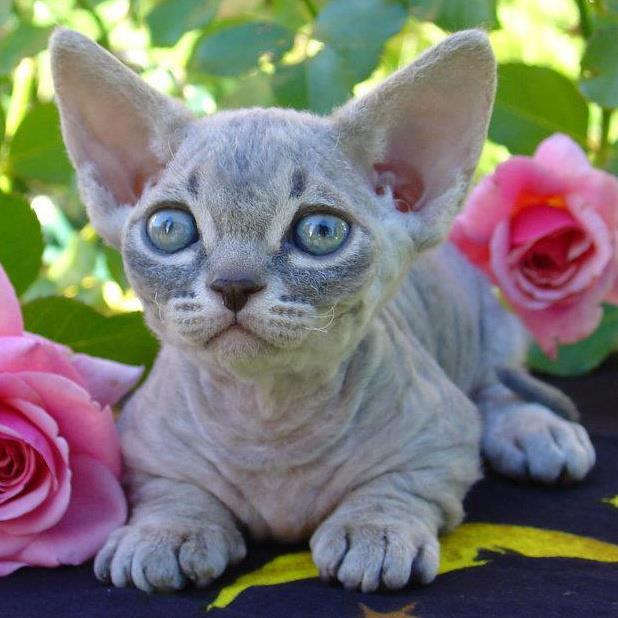

The Minskin is a developing breed with short legs and unevenly distributed fur. Its small population and unusual physical traits mean that care and welfare questions deserve careful sourcing. This guide separates documented breed information from assumptions based on its ancestry.
Quick facts
- Coat: short, dense fur on the face, ears, legs and tail; the neck, chest and belly may look hairless but carry a very thin, fine down (TICA standard)
- Legs: short, from a dominant mutation of the kind seen in the Munchkin
- Foundation: bred using the Munchkin and the Sphynx (International Cat Care)
- Status: TICA published a breed standard, last revised in May 2008; not on TICA's or CFA's current breed lists (checked October 2026)
- Size and lifespan: no reliable breed-specific figures are published
Health and welfare considerations
The Minskin combines two traits that welfare organizations single out. International Cat Care lists both hairless cats and short-legged cats among the traits that should not be continued through further breeding, and on the Minskin itself it has said that there is not enough evidence that the Munchkin's short legs come without problems, that the Sphynx adds skin and lifestyle issues, and that "we do not feel that these cats should be bred". UFAW recommends that cats with the Munchkin limb abnormality should not be used for breeding, because abnormal loads on the joints may lead to painful osteoarthritis.
Writing about the Munchkin, veterinarian Paula Simons links the short-leg mutation to a defect in cartilage formation and a predisposition to osteoarthritis and mobility problems, and describes two conditions present from birth that short-legged cats are prone to: lordosis, an inward curve of the lower spine, and pectus excavatum, a sunken chest (PetMD). TICA's Minskin standard states that the cats' size and stature do not hamper mobility or quality of life, a view the welfare sources above do not share.
Published breed-specific health information is limited, and a small population does not by itself establish any particular disease risk. The Sphynx in the Minskin's ancestry is among the breeds in which hypertrophic cardiomyopathy is more common, but that is not a measured Minskin risk. Ask about the parents' health and rely on your veterinarian for the individual cat.
Temperament and daily life
The TICA standard describes Minskins as sweet-tempered cats that respond well to being handled. Like other cats with little fur, many seek out warmth and contact, such as laps, blankets and warm resting places. Short legs mean high places are reached in stages, so ramps, low steps and low resting spots make a home easier to use. With children and other pets, introductions and the individual cat's temperament matter.
Grooming and care
Less fur changes grooming rather than removing it. Hairless cats need regular bathing, because oil that a coat would absorb builds up on bare skin; their skin is prone to yeast infections, and they are susceptible to cold and to sunburn. Frequent baths can dry the skin, so ask your veterinarian about a skin-care routine; ears and nails also need more frequent cleaning. Short-legged cats can find it harder to groom themselves, so check the areas they miss.
Provide a comfortable environment and ask your veterinarian about safe temperature management. Keep the cat indoors and limit time in strong sun; if sunscreen comes up, use only a product made for pets and labelled as safe for cats, and ask your veterinary team about it.
History
The Minskin is a hairless cat with short legs, bred using the Munchkin and the Sphynx. TICA published a Minskin breed standard, last revised in May 2008, and its 2023 registration rules list the Minskin among domestic hybrid breeds, with domestic shorthairs that are not members of a recognized breed as its permitted source. The breed does not appear on TICA's or CFA's current breed lists (checked October 2026). Widely repeated accounts of the breed's founder and founding dates could not be confirmed in the registry and welfare sources checked for this guide.
Appearance
The TICA standard describes a noticeably small, stocky cat with a rounded head, large round eyes set wide apart, large ears and short legs, the hind legs sometimes slightly longer than the front. The "fur-points" are short, closely packed soft fur covering the mask, ears, legs and tail, and the fur on the legs may extend onto the shoulders, hips and buttocks. The rest of the body is visibly more sparsely coated, and the coat as a whole is described as feeling like a fine cashmere garment. All colors are allowed.
Before choosing a Minskin
The welfare organizations cited above advise against breeding cats for short legs or for hairlessness. If you are adopting a Minskin that needs a home, or already care for one, plan for skin care, warmth, sun protection, easy access at ground level and regular veterinary checks of the joints and spine. No health test removes the concerns that come with the breed's structure.
Minskin FAQ
Is a Minskin's belly bare? Not entirely. The TICA standard says the neck, chest and abdomen may appear hairless but are covered in a very thin, fine down. A standard describes the ideal cat, and individual Minskins vary.
Do Minskins need clothes? Not necessarily, and not every cat tolerates clothing. Provide warm resting places the cat can choose, and ask your veterinarian about safe temperature management for your cat.
Are Minskins hypoallergenic? No breed can be assumed safe for someone with a cat allergy, and having little hair does not change that. Spend time with the individual cat before committing.
Sources
- The International Cat Association: Minskin breed standard, revised 2008 (archived copy)
- International Cat Care: Minskin (2023, archived copy)
- International Cat Care: inherited disorders in cats and should I use sunscreen on my cat?
- UFAW: Munchkin limb deformity
- PetMD: Munchkin and hairless cat breeds
- Cornell Feline Health Center: hypertrophic cardiomyopathy
- The International Cat Association: browse all breeds and Cat Fanciers' Association: breeds (both checked October 2026)
Try a mixed breed question
Which activity do Balinese cats typically enjoy?
Answer: Climbing to high perches. Balinese are agile, energetic cats that like to climb and survey their surroundings from above, so towers, shelves, and tall scratchers suit them well. Source