 Cat Trivia Games
iOS App
Munchkin Cat Breed
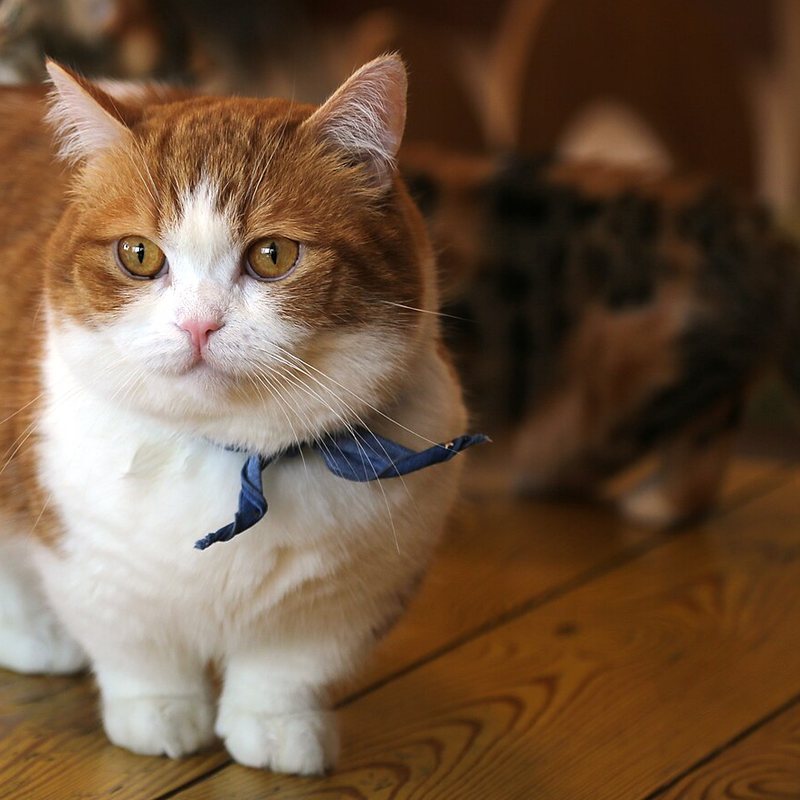

Munchkins are defined by short legs caused by an inherited skeletal trait. They can be active and affectionate, but that does not settle the welfare questions around breeding for shortened limbs. This guide covers everyday care and the evidence about mobility, including what is still uncertain.
Quick facts
- Legs: short, from a dominant mutation that shortens the long bones of the legs
- Weight: 5 to 7 pounds for females and 7 to 10 for males (TICA); PetMD gives 6 to 9
- Life expectancy: estimates differ, from around 12 to 15 years (PetMD) to 15 to 18 or more (TICA)
- Coat: short or semi-long, in all colors and patterns
- Recognition: TICA championship breed since May 2003; not recognized by CFA (checked October 2026)
Health and welfare considerations
The short legs come from a mutation that stops the long bones of the legs from growing normally. In PetMD's Munchkin profile, veterinarian Paula Simons says the mutation causes a defect in cartilage formation that predisposes the breed to osteoarthritis and mobility problems, and that "saying they can jump or run like a normal cat would be false." The same profile describes two other problems that are present from birth. Lordosis, an inward curve of the spine in the lower back, causes no obvious trouble in some cats but can cause spinal pain, leaning to one side and reduced movement. Pectus excavatum, a sunken chest, may cause no signs when mild, while severe cases compress the heart and lead to heart and breathing problems.
Sources disagree about how much the breed's structure affects the cat. TICA's breed standard states that the spine is unaffected and that the short legs do not hamper mobility. UFAW's review of the limb deformity says the welfare effects have not been evaluated in the scientific literature and are hard to assess, that the short limbs compromise jumping, and that abnormal loads on the joints may raise the risk of painful osteoarthritis. The extent of any disability may only become clear as the cat matures.
The short legs follow a dominant pattern of inheritance, and the gene is thought to be lethal in two copies: kittens that inherit it from both parents are thought to die before birth. Every cat with the gene appears to show the short legs, so there seem to be no carriers without the trait.
Welfare organizations take a clear position. UFAW recommends that cats with this abnormality should not be used for breeding, and International Cat Care lists short-legged cats among the traits that should not be continued through further breeding. CFA does not recognize the breed, reportedly because of controversy over whether the mutation poses health risks.
For a Munchkin already in your care, watch how it moves. If it stops running, jumping or playing the way it used to, talk to your veterinarian about pain management; diagnosing osteoarthritis can take x-rays or a trial of treatment. Extra weight puts more strain on a short-legged cat's spine, so ask your veterinarian what a healthy body condition looks like for your cat.
Temperament and daily life
TICA describes Munchkins as sociable, spirited cats that love to run, chase and play with toys, and that sit up on their hind legs to look around. Many stay playful and kitten-like for most of their lives, and some follow their people around the house. Many reach high places in stages rather than in one jump, so ramps, steps and cat trees with low entry points make a home easier to use. With children and other pets, introductions and the individual cat's temperament matter.
Grooming and care
A weekly brushing suits most Munchkins, and longhaired cats may need more to prevent mats and tangles. Short legs, and any joint or spine problems, can make it hard for a Munchkin to groom itself thoroughly, so look for areas it seems to miss or cannot reach.
History
Short-legged cats have been reported many times. A 1944 British veterinary report described four generations of short-legged cats, a line that disappeared during the Second World War, and later sightings in Stalingrad in 1956, New England in 1970 and Louisiana in the 1980s. The modern breed traces to a pregnant short-legged female named Blackberry, found by Sandra Hockenedel in 1983. A male from one of Blackberry's litters, Toulouse, went to her friend Kay LaFrance, and the breed was developed from those two cats, with domestic cats as outcrosses. TICA accepted the Munchkin into its New Breed program in September 1994 and granted championship status in May 2003.
Appearance
Apart from the legs, a Munchkin is a medium-sized cat with an ordinary body, and adults do not stay kitten-sized. The long bones of the legs are shortened and may be slightly bowed, and the hind legs may be a little longer than the front. Shorthairs have a medium-plush coat and longhairs a semi-long, silky one, and all colors are allowed.
Before choosing a Munchkin
Both welfare bodies cited here recommend against breeding cats with this abnormality, and no health test removes the concerns that come with the breed's structure. Caring for a Munchkin that already needs a home is a different question: plan for easy access at ground level, help with grooming, a healthy weight and regular veterinary checks of the joints and spine as the cat ages.
Munchkin FAQ
Are Munchkin cats in pain because of their legs? It depends on the individual cat. Some move comfortably, but the breed is predisposed to osteoarthritis and can have spinal problems such as lordosis, and the extent of any disability may only become clear with age. A veterinarian can assess a cat's mobility and comfort, sometimes with x-rays or a trial of pain relief.
Are all Munchkin kittens short-legged? No. A Munchkin carries one copy of the short-leg gene, so its litters can include kittens with typical leg length. Because the genetics are not well defined, it may be safer not to breed even from long-legged cats born to Munchkin parents.
Are Munchkins hypoallergenic? No breed can be assumed safe for someone with a cat allergy. Spend time with the individual cat before committing.
Sources
- PetMD: Munchkin
- The International Cat Association: Munchkin
- UFAW: Munchkin limb deformity
- International Cat Care: inherited disorders in cats
- Cat Fanciers' Association: breeds (checked October 2026)
One question about the Munchkin cat
Which Munchkin cat held the Guinness World Record for shortest statured living cat in 2014?
Answer: Lilieput. Lilieput, a Munchkin cat from Napa, California, was named the shortest statured living cat in the world by Guinness World Records in 2014. She stood 5.25 inches tall, breaking the previous record held by Fizz Girl. Source