 Cat Trivia Games
iOS App
HOME / BREEDS / ORIENTAL SHORTHAIR
Oriental Shorthair Cat Breed
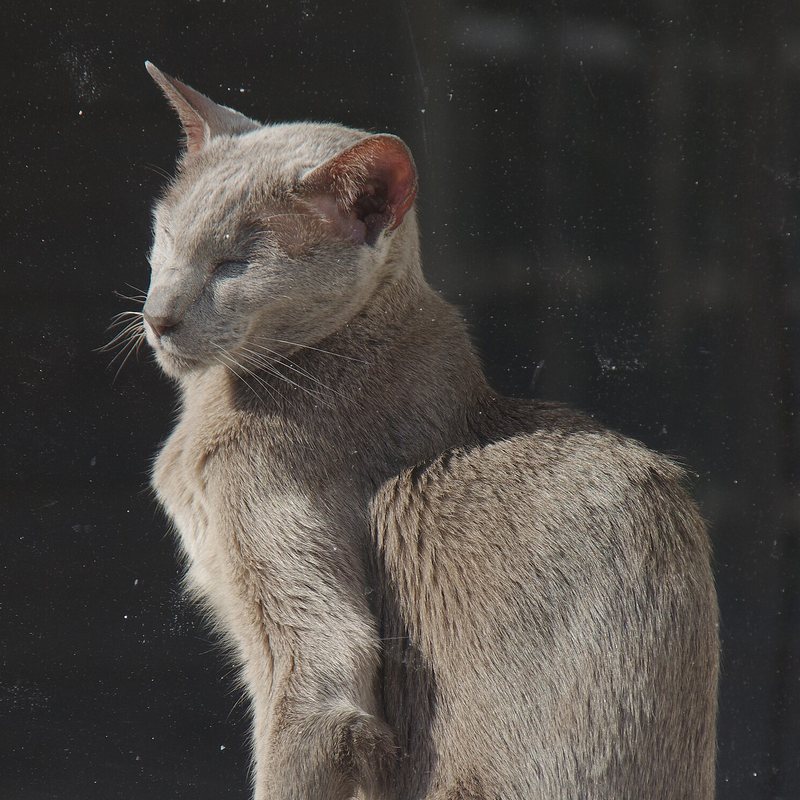

The Oriental Shorthair is a slender cat with large ears and a wide range of coat colors and patterns. Many are vocal, active and interested in what their people are doing. That can make them engaging companions, with daily play and interaction an important part of their care.
Quick facts
- Weight: about 5 to 8 pounds (TICA)
- Life expectancy: estimates differ, from 10 or more years (TICA) to 12 to 15 (PetMD)
- Coat: short and fine, in more than 600 combinations of color, pattern and coat length across the breed (CFA)
- Eyes: green, with blue or odd eyes allowed in pointed, white and bicolor cats (CFA)
- Relatives: part of TICA's Siamese Breed Group, with the Siamese, Balinese and Oriental Longhair
Temperament and daily life
CFA describes Orientals as vocal, affectionate and active, and says they can be insistent, and many are very social and talkative. Some struggle with prolonged isolation; consider the individual cat's needs and your routine. Daily play, climbing space and puzzle feeders suit an active cat, and the ASPCA has practical ideas for enrichment at home. Introductions and the individual cat's temperament matter with children and other pets.
Grooming and care
Orientals are minimal shedders, and weekly grooming with a rubber curry brush is usually enough for the short coat (CFA). Start tooth care early and ask your veterinarian about a dental routine: dental disease affects an estimated 50 to 90 percent of cats over four, although that figure is for cats in general rather than a measured risk for this breed.
Health considerations
Two inherited conditions come up most often. Progressive retinal atrophy (PRA) of the rdAc type, an inherited loss of vision, is recessive and can be detected with a DNA test; UC Davis lists the Oriental Shorthair among the breeds for which the test is appropriate and notes a high frequency of the variant in the Siamese and related breeds. The test covers only that variant. Amyloidosis, in which an abnormal protein builds up in organs such as the liver, can be both inherited and acquired; PetMD names the Oriental Shorthair and the Siamese as the breeds most predisposed to the liver form, and there is no test for it yet.
TICA's breed page also mentions a tendency to be sensitive to anesthesia, which is worth raising with your veterinarian before any procedure. Regular veterinary care, dental care and an appropriate diet are important throughout life.
History
The breed's development began in Europe in the 1950s. According to TICA, English breeders crossed Siamese with Russian Blues, British Shorthairs, Abyssinians and ordinary domestic cats. Britain's Governing Council of the Cat Fancy first recognized chestnut, lavender and white solids, and Orientals were imported to the United States in the 1970s. CFA accepted them for registration in 1974 and for championship in 1977, and when it accepted Oriental Longhairs in 1988, the breed's name became simply Oriental, with shorthair and longhair divisions.
Appearance
The Oriental has the Siamese body type in a much wider range of colors and patterns: a long, svelte, tubular body combining fine bones and firm muscles, a long, tapering wedge-shaped head, strikingly large ears and almond-shaped eyes, which are usually green. The coat is short, fine and glossy. Pointed Orientals have blue eyes, and white and bicolor cats may have blue, green or odd eyes.
Before choosing an Oriental Shorthair
An Oriental Shorthair may suit a household with time for daily play and conversation. Consider how much time the cat would spend alone, and meet the individual cat to see how active and talkative it is.
Oriental Shorthair FAQ
Do Oriental Shorthairs talk a lot? Many are vocal and some are very talkative, but individuals vary. Meeting the cat, and asking the breeder or shelter about its habits, tells you more than the breed's reputation.
How is the Oriental Shorthair related to the Siamese? It was developed from the Siamese and shares its body type, and TICA groups the two in its Siamese Breed Group. The main difference is color: the Siamese is always pointed, while Orientals can be solid, shaded, smoke, parti-color, bicolor, tabby or pointed, and usually have green eyes.
Are Oriental Shorthairs hypoallergenic? No breed can be assumed safe for someone with a cat allergy. Spend time with the individual cat before committing.
Sources
- Cat Fanciers' Association: Oriental
- The International Cat Association: Oriental Shorthair
- PetMD: Oriental Shorthair
- UC Davis Veterinary Genetics Laboratory: PRA (rdAc)
- Cornell Feline Health Center: feline dental disease
- ASPCA: feline DIY enrichment
Quick quiz: 3 questions about the Oriental Shorthair cat
Which eye shape does the Oriental Shorthair breed standard call for?
Answer: Almond-shaped. The standard specifies almond-shaped eyes set at a slant that follows the lines of the wedge-shaped head. Source
The Oriental Shorthair was developed from which parent breed?
Answer: Siamese. Breeders extended the Siamese line to keep its slim body and vocal, people-loving nature while opening it up to hundreds of non-pointed colors. Source
The Oriental Shorthair shares its chatty, talkative personality most closely with which other breed?
Answer: Siamese. CFA notes Orientals inherit their communicative, insistent nature directly from their Siamese ancestors, sharing the same vocal temperament. Source