 Cat Trivia Games
iOS App
Savannah Cat Breed
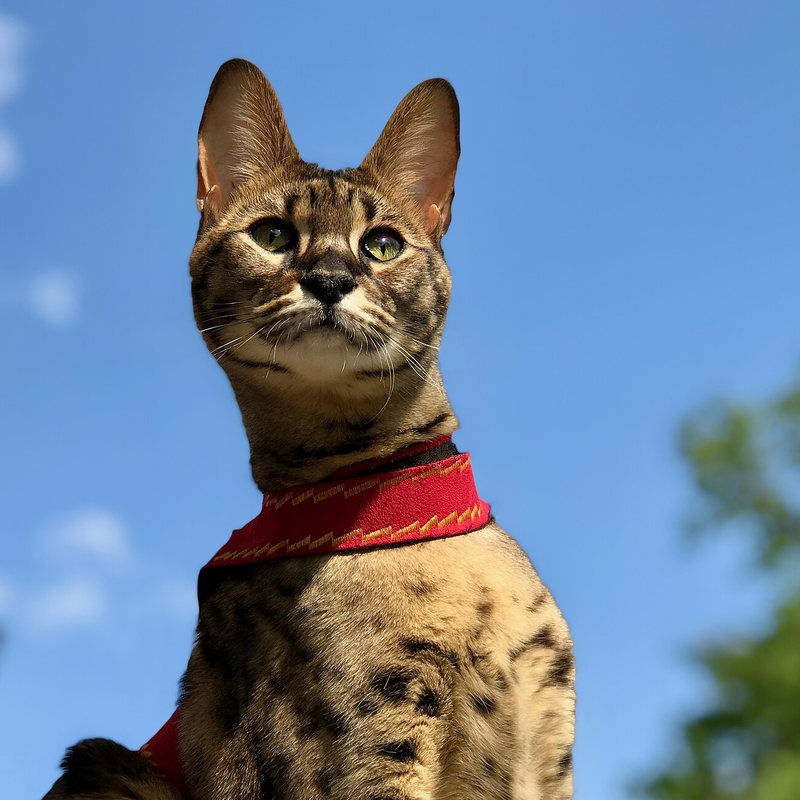

The Savannah is a cat breed with serval ancestry, long legs, large ears and a spotted coat. Its care needs and legal status require careful research. Generation labels matter, but they do not by themselves predict a cat's size, behavior or suitability for a home.
Quick facts
- Ancestry: the African serval and domestic cats; the first known Savannah kitten was born in 1986
- Size: tall and lean, medium to large (TICA); PetMD gives 11 to 20 pounds, depending on generation
- Life expectancy: 12 to 15 or more years (TICA); 12 to 20 years (PetMD)
- Coat: short, in the standard colors brown spotted tabby, silver spotted tabby, black and black smoke
- Registries: TICA registration in 2001 and championship status in 2012; not on CFA's breed list (checked October 2026)
Temperament and daily life
TICA describes the Savannah as a very curious, assertive and active cat that needs a great deal of interaction every day. Many greet their people at the door and follow them around the house, but they are not usually lap cats and tend to show affection on their own terms. Some learn to open doors or turn on taps, and many like to play in water, fetch or walk on a harness.
Savannahs climb and jump well and like high places, such as the tops of doors and cabinets, so sturdy cat trees and window perches help, along with daily play and food puzzles (the ASPCA has enrichment ideas). Keep birds, rodents and other small pets safely apart. Whether another cat or a dog suits a particular Savannah depends on both animals, so introductions need time and supervision.
Grooming and care
The short coat has no heavy undercoat and needs little work: an occasional brush or comb, and more during shedding season. Trim the nails, check the ears and keep up dental care as for any cat. A fast, agile cat is safest indoors, or outside only on a harness or in a secure enclosure. Ask your veterinarian about diet and portion sizes; less active Savannahs and spayed females can gain weight.
Health and welfare considerations
TICA recommends screening for pyruvate kinase (PK) deficiency, an inherited anemia, and progressive retinal atrophy (PRA), which leads to blindness. UC Davis lists the Savannah among the breeds suitable for its PK deficiency test and its PRA test for the rdAc (CEP290) variant. Each test covers one variant, so ask which tests the parents had and what the results mean.
TICA also notes some history of hypertrophic cardiomyopathy (HCM) in Savannahs, with no specific screening test. HCM is diagnosed by echocardiography (Cornell Feline Health Center), so ask your veterinarian whether and when heart screening makes sense for your cat.
Welfare is part of the decision. The Cat Group, a coalition of UK cat welfare organizations, names the Savannah among hybrid cats in its 2025 position statement and does not support breeding wild cat hybrids or keeping them as pets. Its concerns include the risk of injury or death to the domestic mother in serval matings, reduced fertility and problem pregnancies, wild-type behavior that can make hybrids more aggressive or territorial toward people, other pets and wildlife, and the confinement that hybrids often need, which it says is usually detrimental to their wellbeing. It considers cats less than five generations removed from the wild cat the most at risk of welfare problems as pets.
What the generation labels mean
Savannahs are described by generation. The F stands for filial: an F1 has a serval parent, an F2 a serval grandparent, and so on, and a kitten's number is one more than the lower number of its two parents. Percentages such as half serval for an F1 and a quarter for an F2 are arithmetic shortcuts that the Savannah Cat Association, a breeder group, warns "can be very misleading". A cat's TICA registration code is a separate record: it shows which breeds, and any unknown or unregistered cats, appear in the three previous generations of its pedigree. Later generations are often described as smaller and calmer, but the label alone does not tell you how a particular cat will behave.
History
The first known Savannah was born on April 7, 1986, to a domestic cat and sired by an African serval. Both the kitten, a female, and the breed were named Savannah. Patrick Kelley and Joyce Sroufe later worked to develop the breed and wrote its original TICA standard. TICA accepted the Savannah for registration in 2001 and for championship status in 2012. In the early years there were no fertile males, so breeders used males of other breeds, such as the Ocicat and Oriental Shorthair, which were then permitted outcrosses (Savannah Cat Association).
Appearance
The standard calls for a tall, lean, graceful cat with striking dark spots and other bold markings on a brown, silver, black or black smoke background. The neck and legs are very long, the large, tall ears sit high on the head, and the hooded eyes are flat across the top. Dark lines run from the eyes toward the nose. The long frame makes many Savannahs look bigger than they are: most are the size of a large domestic cat and weigh less than other cats of similar size.
Before choosing a Savannah
Start with the rules where you live, which can depend on your location, the cat's ancestry and the authority applying them, and which change. Read The Cat Group's welfare position, and plan for daily activity, tall and sturdy climbing space and secure windows. If you go ahead, ask for the cat's registration records and the parents' health test results, and meet the cat itself, since its generation label will not tell you how it behaves at home.
Savannah FAQ
Are Savannah cats legal to own? Rules can depend on your location, the cat's ancestry and the authority applying them. Check the current requirements with the relevant local agency before acquiring or relocating a hybrid-derived cat.
How tall do Savannah cats get? PetMD cites a Savannah Cat Association average of about 16.3 inches at the shoulder for first-generation cats, compared with about 9.8 inches for a domestic tabby. Height varies with generation and between individual cats.
Are Savannah cats hypoallergenic? No breed can be assumed safe for someone with a cat allergy. Spend time with the individual cat before committing.
Sources
- The International Cat Association (TICA): Savannah
- PetMD: Savannah
- Savannah Cat Association: F1, F2 and F3 explained and Savannah cat history
- The Cat Group: position statement on hybrid cats (via International Cat Care)
- UC Davis Veterinary Genetics Laboratory: PK deficiency test and PRA (rdAc) test
- Cornell Feline Health Center: hypertrophic cardiomyopathy
- ASPCA: feline DIY enrichment
- Cat Fanciers' Association: breeds (checked October 2026)
Quick quiz: 2 questions about the Savannah cat
The Savannah's record-setting height (Guinness lists a 48.4 cm individual as the tallest domestic cat ever) comes from crossing a house cat with which wild species?
Answer: Serval. The serval is a long-legged African wild cat, and its leg length is exactly what gives record Savannahs like Arcturus their extraordinary stature. The distractor to avoid is the Asian leopard cat, whose small size and spotted coat make it the ancestor of the Bengal, not the Savannah. Caracal and ocelot are unrelated to either breed, making this a test of knowing which wild cat pairs with which hybrid. Source
Which cat registry recognized the Savannah and later granted it full championship status?
Answer: TICA. The International Cat Association (TICA) registered the Savannah in 2001 and granted it championship status in May 2012 (for F4 and later generations). The CFA, by contrast, does not recognize the breed because it does not condone crossing wild and domestic cats. Source