 Cat Trivia Games
iOS App
Serengeti Cat Breed
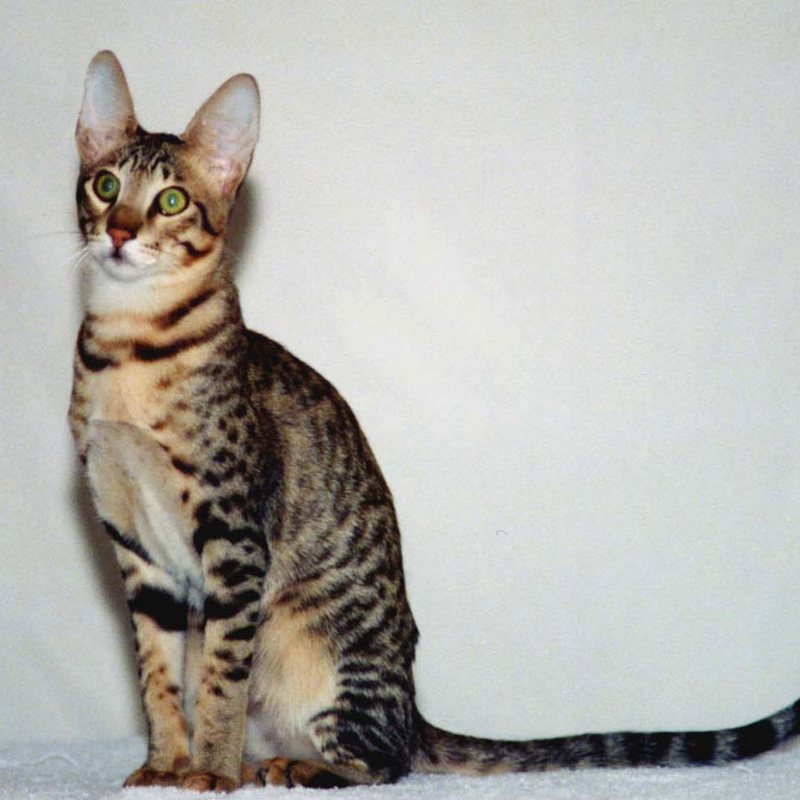

The Serengeti was developed to resemble a serval, using Bengal and Oriental Shorthair cats. It has long legs, large ears and a spotted coat. Its history is separate from the Savannah's: the breeding program did not use servals, although the Bengal side of its ancestry goes back to the Asian leopard cat.
Quick facts
- Ancestry: developed from Bengals and Oriental Shorthairs; no servals were used
- Origin: a project begun in 1995 by Karen Sausman of Kingsmark Cattery in California (TICA)
- Size: medium-boned and long-legged; TICA gives 10 to 15 pounds for males and 8 to 12 for females
- Coat: short, tight and silky, with black spots on gold, grey or silver, or solid black
- Registries: registered by TICA, whose breed page lists it as a Preliminary New Breed; not on CFA's breed list (checked October 2026)
Temperament and daily life
TICA describes the ideal Serengeti as open, self-assured and friendly. Some are shy for a few moments somewhere new, and once settled many want to be involved in whatever their people are doing. They are agile, active cats that like high places and running through the house, so tall, sturdy cat trees, shelves and daily play are worth planning for (the ASPCA has enrichment ideas). Serengetis can be vocal, which TICA attributes to their Oriental ancestry, but how much an individual cat talks varies. They usually get along with other pets when properly introduced.
Grooming and care
The short, tight coat needs little more than the ASPCA's suggested one or two brushings a week, plus regular nail trims, ear checks and dental care. Most of the daily effort goes into activity and company rather than coat care.
Health considerations
Published breed-specific health information is limited. The breed is young and small, and that does not establish that Serengetis are free of inherited disease. Its founding breeds have their own known conditions: the Bengal is on Cornell's list of breeds in which hypertrophic cardiomyopathy is more prevalent, and UC Davis offers DNA tests for some inherited conditions in Bengals and Oriental Shorthairs, including the rdAc form of progressive retinal atrophy. These are concerns in the founding breeds, not measured Serengeti rates. Ask a breeder which tests and checks the parents had, and ask your veterinarian what screening, if any, makes sense for your cat.
History
The Serengeti was created by Karen Sausman, owner of Kingsmark Cattery in California and a professional conservation biologist. She set out to develop a domestic breed partly modeled on the African serval, and unlike the Savannah, the Serengeti has no serval ancestry: TICA says it was developed by crossing Bengals and Oriental Shorthairs, in a project that started slowly in 1995. The Bengal itself descends from crosses with the Asian leopard cat (TICA). Serengetis are now bred in the United States, the United Kingdom, Europe, Australia and Russia.
Appearance
TICA's description calls for a medium-sized, long-legged, strong and muscular cat with a very upright posture and a long neck that blends into the base of the skull without tapering. The large, round-tipped ears, ideally as long as the head, sit directly on top of the skull, and the round eyes are usually gold to amber. The body resembles an Oriental Shorthair's, with heavier bone and longer legs. The coat is short and tight with a silky texture, in yellow to gold with distinct, widely spaced black spots, in grey or bright silver with black spots, or in solid black.
Before choosing a Serengeti
The breed is rare, so finding a Serengeti can take time. Plan for an active cat that wants height, play and company, and check the local rules on hybrid-derived cats, since legal definitions vary. Ask about the parents' health checks, and meet the individual cat if you can; the breed description is a starting point, not a promise about one cat.
Serengeti FAQ
Is a Serengeti part serval, like a Savannah? No. The Savannah descends from crosses between servals and domestic cats, while the Serengeti was developed from Bengals and Oriental Shorthairs to resemble a serval. The Bengal side of its ancestry goes back to the Asian leopard cat. Legal definitions of hybrid-derived cats vary, so check the current rules where you live.
Are Serengeti cats hypoallergenic? No breed can be assumed safe for someone with a cat allergy. Spend time with the individual cat before committing.
Sources
- The International Cat Association (TICA): Serengeti and Bengal
- Cornell Feline Health Center: hypertrophic cardiomyopathy
- UC Davis Veterinary Genetics Laboratory: progressive retinal atrophy (rdAc) test
- ASPCA: cat grooming tips and feline DIY enrichment
- Cat Fanciers' Association: breeds (checked October 2026)
Try a mixed breed question
The Lykoi's signature 'roaning' pattern is created by what?
Answer: White and colored hairs intermixed. Roaning is an intermixing of white and colored guard hairs; individual hairs are either normally pigmented or entirely white, producing the grizzled, wolf-like coat. Source