 Cat Trivia Games
iOS App
Singapura Cat Breed
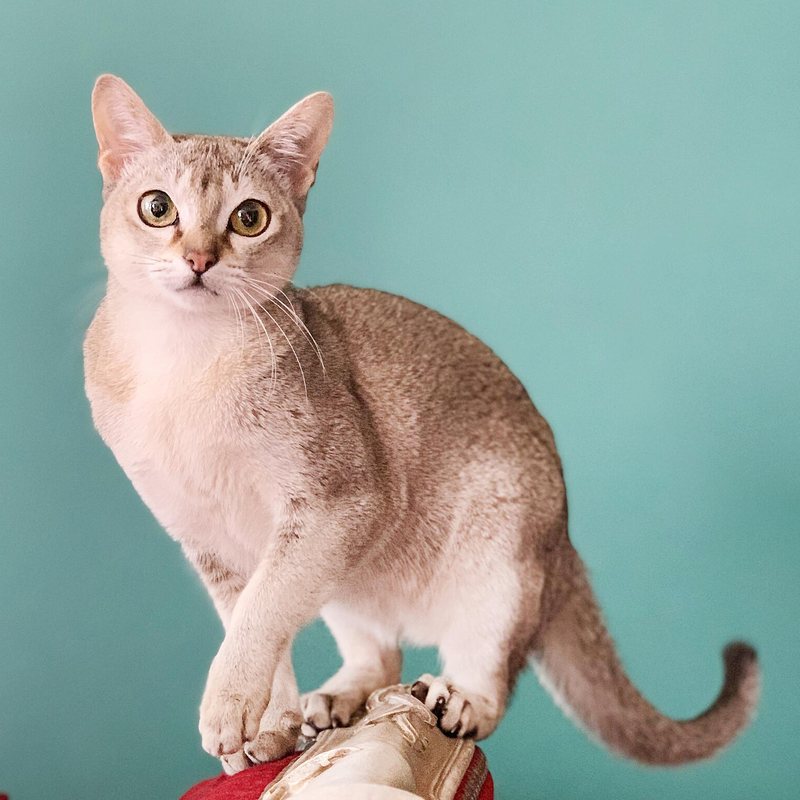

The Singapura is a small cat with a short, ticked sepia coat and large eyes and ears. Many are described as curious, active and relatively quiet. Its modern breeding history includes a disputed account of the foundation cats, which is worth separating from the breed's present-day traits.
Quick facts
- Size: among the smallest pedigreed breeds; CFA gives 6 to 7 pounds for males and 4 to 5 for females
- Coat: short and close-lying, in one color, which CFA calls sepia agouti and TICA calls sable ticked tabby
- Eyes: large and almond-shaped, in hazel, green or yellow
- Life expectancy: 11 to 18 years (TICA); 9 to 15 years (PetMD)
- Registries: CFA registration in 1981 and championship status in 1988
Temperament and daily life
CFA describes the Singapura as extroverted, curious and very playful, an intelligent cat that investigates whatever has your attention, and says its love of play usually lasts well into adulthood. Many like to be part of the action, riding on a shoulder or helping with whatever you are doing. Singapuras are relatively quiet and tend to do best in a calm home, although their voices can be surprisingly loud when they do speak up. A Singapura that is confident in familiar surroundings may become wary after a big change, so give it time to adjust.
An active small cat still needs room to play and climb: cat trees, shelves, window perches and daily interactive play all help, along with easy access to food, water, litter and resting places. Introductions and the individual cat's temperament matter with children and other pets.
Grooming and care
The short, close-lying coat does not shed heavily. A weekly combing removes dead hair, and bathing should not be needed unless the cat is being shown. Trim the nails, check the ears and keep up dental care as for any cat, and ask your veterinarian to help you judge a healthy weight for such a small frame.
Health considerations
CFA reports that very few health problems have been recorded in the breed, but the population started from a small number of cats. In a 2008 genetic study of cat breeds that sampled 24 Singapuras, the breed was among those with the lowest genetic diversity, along with the Burmese, Havana Brown and Sokoke.
Pyruvate kinase (PK) deficiency, an inherited anemia, is one condition to ask about. In a 2012 study of cat samples sent in for PK testing, the variant's frequency was 23.0 percent in Singapuras from the United States and 41.4 percent in Singapuras from the UK, the highest figures among the breeds submitted; these were samples sent for testing, not a random survey of the breed, and the authors recommend PK testing for Singapuras. UC Davis lists the Singapura among the breeds for its PK deficiency test and its test for the rdAc form of progressive retinal atrophy, which causes blindness. A cat with one copy of either variant is a carrier and is not affected itself; what the results mean for breeding is a question for the breeder and a veterinarian.
International Cat Care also lists the Singapura among the breeds affected by hypokalaemia, an inherited condition that causes episodes of muscle weakness, and notes that a gene test is available. Ask which tests the parents had, and have any weakness or reluctance to move checked by a veterinarian.
History
The Singapura is named for Singapore ("Singapura" is the Malay form of the name), where cats like it are believed to have lived as street cats. Hal and Tommy Meadow, Americans who had been working in Singapore, brought the first of the breed's foundation cats to the United States in 1975: CFA's breed page counts five cats, while a 1996 history on CFA's site names three, Puss'e, Ticle and Tes. A sixth cat was imported in 1980. CFA accepted the breed for registration in 1981 and granted championship status in 1988.
In 1990 one of CFA's Singapura breed clubs asked the CFA board to look into questions about these origins, after import documents showed that the Meadows had brought cats with the same three names into Singapore in 1974. At a 1991 board meeting, Mr. Meadow explained that the original cats had arrived in Singapore by work boat in 1971 without import or export documents, and that Tes, Ticle and Puss'e were the grandchildren of those four unnamed cats. CFA's account says the breed's official status was not in question, and it also records Chiko, a cat adopted from the SPCA in Singapore and flown to the United States in 1980, who appears behind many Singapura pedigrees.
Appearance
Small does not mean fragile: the Singapura is solid, muscular and strong for its size. The head is rounded, with noticeably large ears and large, almond-shaped eyes. Each hair carries several bands of color, which makes the coat appear to sparkle in sunlight, and dark "cheetah lines" run from the inner corners of the eyes down beside the nose.
Before choosing a Singapura
Plan for an active, people-focused cat that wants company and play, in a home calm enough for a quiet breed. The breed is uncommon, so finding a kitten can take time. Ask a breeder which DNA tests the parents had, including PK deficiency, and what the results mean, and meet the individual cat if you can.
Singapura FAQ
Is the Singapura the smallest cat breed? By standard weight it is among the smallest. TICA and PetMD call it the smallest breed, and CFA calls it one of the smallest pedigreed cats; TICA gives 6 to 8 pounds for males and 4 to 6 for females. These are breed standards: individual cats vary, and a small cat of another breed or of mixed ancestry can weigh less.
Why is the Singapura called a national monument? CFA says the cat is considered a "living national monument" in Singapore, where it is known as Kucinta, the Love Cat. In 1991 Singapore's tourism board placed Singapura statues along the river and featured the cat in promotional material; CFA's history notes that the cats used as models had been imported from the United States.
Sources
- Cat Fanciers' Association (CFA): Singapura and Singapura history article (1996)
- The International Cat Association (TICA): Singapura
- PetMD: Singapura
- Lipinski M.J. et al. (2008), The ascent of cat breeds: genetic evaluations of breeds and worldwide random bred populations. Genomics
- Grahn R.A. et al. (2012), Erythrocyte pyruvate kinase deficiency mutation identified in multiple breeds of domestic cats. BMC Veterinary Research
- UC Davis Veterinary Genetics Laboratory: PK deficiency test and PRA (rdAc) test
- International Cat Care: hypokalaemia in cats
Quick quiz: 3 questions about the Singapura cat
What is the only officially recognized coat color for the Singapura breed?
Answer: Sepia agouti. Singapura standards accept a single color-sepia agouti-dark-brown ticking over a warm old-ivory ground, giving each hair alternating light and dark bands. Source
According to the breed standard, what eye colors are accepted in the Singapura?
Answer: Hazel, green, or yellow. The CFA standard permits only hazel, green, or yellow eyes in the Singapura, warm tones that complement its sepia-agouti coat. Source
The Singapura's local name 'Kucinta' is a blend of which two Malay words?
Answer: Kucing (cat) and cinta (love). Kucinta is an amalgamation of the Malay words 'kucing' (cat) and 'cinta' (love), which is why it is rendered as 'the love cat.' Source