 Cat Trivia Games
iOS App
Sokoke Cat Breed
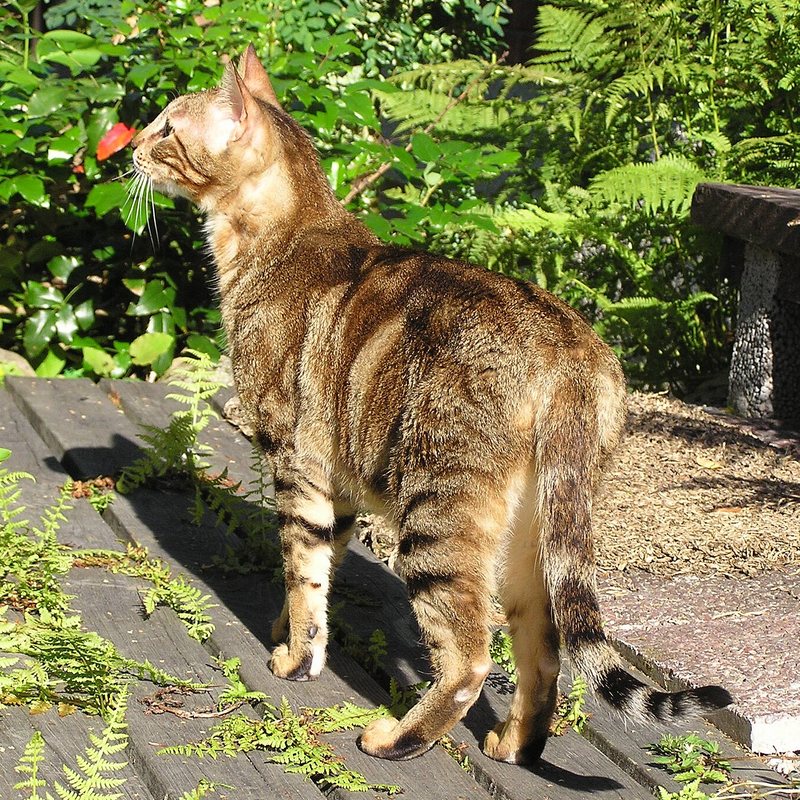

The Sokoke is a rare breed associated with coastal Kenya and a distinctive patterned tabby coat. It has a lean build and is often described as active and sociable. Published breed-specific health information is limited, so confident promises about its temperament or health deserve caution.
Quick facts
- Origin: cats of the Arabuko Sokoke forest area on the coast of Kenya; breeding began in 1978 (FIFe, GCCF)
- Coat: very short and close-lying, with little or no undercoat, in a blotched tabby pattern
- Size and lifespan: GCCF gives 5 to 10 pounds and a lifespan of 12 to 20 years
- Registries: FIFe since 1994 and GCCF since 2015; not on TICA's or CFA's breed lists (checked October 2026)
Temperament and daily life
FIFe describes Sokokes as very active cats that enjoy climbing and bond closely both with their owners and with the other cats they live with. Accounts of the voice differ: FIFe says they tend to be vocal with their people and companion cats, while GCCF's breeding policy says the breed as a whole does not seem to be as vocal as was once reported. Many are not lap cats.
An active climber needs sturdy cat trees, shelves and daily play. How a Sokoke copes with long days alone, or whether it would enjoy another cat, depends on the individual, so ask the breeder how the cat you are meeting behaves and plan its care around that. Introductions matter with children and other pets.
Grooming and care
The short, close coat has little or no undercoat, so a weekly session with a grooming glove or brush is enough. Trim the nails, check the ears and keep up dental care and regular veterinary checkups as for any cat.
Health considerations
No genetic disorders are currently known to affect Sokokes in any numbers, according to GCCF's Sokoke breeding policy. That reflects limited published data, not proof of good health, and it does not establish that Sokokes are free of inherited disease. The population is small: a 2008 genetic study of cat breeds that sampled 14 Sokokes placed the breed among those with the lowest genetic diversity. Ask a breeder how closely related the parents are and which health checks they have had, and rely on your veterinarian's advice for the individual cat.
History
Local people in the area of the Arabuko Sokoke forest called these cats khadzonzo, which GCCF translates as "looks like tree bark", and cats of this type still live among the Giriama people. In 1978 a litter was found in a hollow tree in Jeni Slater's garden in Kenya; she kept a pair of the kittens, hand-reared them and began breeding them, first calling the breed the African Shorthair. In 1983 Gloria Moeldrop took a pair of Slater's cats to Denmark, where they were first shown in 1984, and more cats were imported in 1989. PetMD dates the first litter to 1977.
FIFe says it has recognized the Sokoke since 1994; GCCF's account gives 1993, after FIFe examined 19 cats from five generations. In 2001 another breeding group of cats was found in Kenya, and in 2002 two of them were taken to Sweden to widen the gene pool. GCCF granted preliminary recognition in 2015. GCCF's breed page says TICA registers the Sokoke as a Preliminary New Breed, but the breed does not appear on TICA's current breed list (checked October 2026). According to GCCF's breeding policy, DNA studies place the Sokoke in a small, separate branch of the Asian group of breeds, with Lamu Island cats and the street cats of coastal Kenya as close relatives.
Appearance
The Sokoke is a lean cat whose hind legs are longer than its front legs, which gives it a characteristic tip-toe gait. The FIFe standard calls for a very short, close-lying, glossy coat with little or no undercoat, in any shade of black tabby, with a blotched pattern in which the dark areas preferably contain agouti (banded) hairs. The pattern has also been called the "African tabby". The eyes are amber to light green.
Before choosing a Sokoke
Sokokes are rare, so finding one may mean waiting or importing a cat from another country. Plan for an active cat that wants climbing space and company, a light grooming routine and regular veterinary care. Ask about the parents' relatedness and health, and meet the individual cat if you can, since breed descriptions of a population this small rest on relatively few cats.
Sokoke FAQ
How rare are Sokoke cats? No reliable, dated count of the world population could be found. One measure of their rarity: FIFe's breeding statistics record no Sokoke kittens registered in 2024 or 2025.
Is the Sokoke a wild cat? No. It is a domestic breed developed from the local cats of coastal Kenya, and GCCF's breeding policy names the street cats of coastal Kenya and the cats of Lamu Island as close relatives.
How do Sokokes get on with children? It depends on the cat and the children. Supervise interactions and teach children to give the cat space.
Sources
- Fédération Internationale Féline (FIFe): Sokoke, the Sokoke breed standard and breeding statistics for 2024 and 2025
- Governing Council of the Cat Fancy (GCCF): Sokoke, the Sokoke breeding policy and the Sokoke standard
- PetMD: Sokoke Forest Cat
- Lipinski M.J. et al. (2008), The ascent of cat breeds: genetic evaluations of breeds and worldwide random bred populations. Genomics
- The International Cat Association: browse all breeds and Cat Fanciers' Association: breeds (both checked October 2026)
Try a mixed breed question
A quiz-goer assumes every hairless cat carries the Sphynx's recessive coat mutation. In the Ukrainian Levkoy, where does the hairlessness actually come from, and how is it inherited?
Answer: From its Donskoy ancestry, as a dominant trait. The Levkoy was built from the Donskoy (Don Sphynx) crossed with the Scottish Fold, not from the Sphynx. The Donskoy's hairlessness is governed by a dominant gene, so any cat inheriting it is born bald or loses its coat while growing. That is the opposite of the true Sphynx, whose baldness is recessive. Same look, different genetics. Source