 Cat Trivia Games
iOS App
Snowshoe Cat Breed
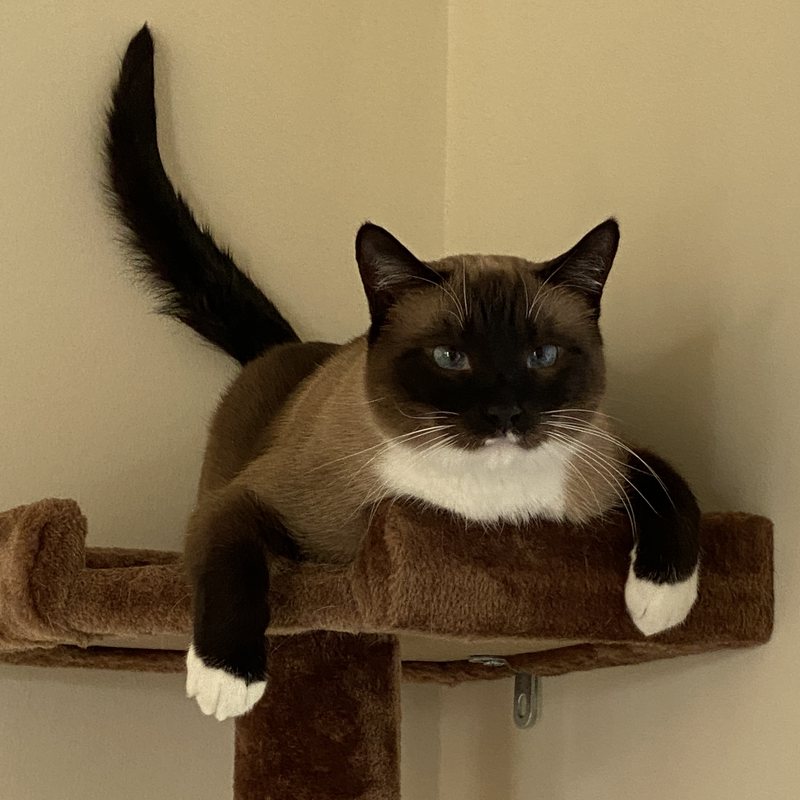
The Snowshoe has a pointed coat, white feet and blue eyes. It is often described as an active, sociable cat, though markings and temperament vary. Moe, the cat pictured here, is part of the reason this breed has a special place on the site.
Quick facts
- Origin: Philadelphia in the early 1960s, from white-footed kittens born in a Siamese litter
- Size: medium; TICA gives about 9 to 12 pounds for males and 7 to 10 for females
- Life expectancy: 15 to 20 or more years (TICA); 14 to 20 years (PetMD)
- Coat: short and single-layered, pointed, with white feet and often a white inverted V on the face
- Registries: TICA championship status in 1994; not on CFA's breed list (checked October 2026)
Temperament and daily life
TICA's description stresses variety: no two Snowshoes have the same personality, and some are shy, some bossy and some caregivers. Many are active, sociable cats that thrive on interaction and become devoted to one person in particular, while some are reserved with strangers. When they talk, the voice is usually soft and melodic, though some say very little. Many are quick to learn: walking on a leash, playing fetch and opening doors are all common, and many enjoy playing with water.
TICA also says Snowshoes are very social and should not be left alone for long periods. How much company a particular cat needs varies, so ask the breeder or shelter how the cat you are meeting copes on its own, and plan for daily play and puzzle feeders either way. PetMD notes that how well a Snowshoe settles with children and other pets depends on early socialization and careful introductions.
Moe, the cat in the photo
Moe, full name Mojito, is my nine-year-old cat. He came from a breeder's unplanned litter: his father was a Snowshoe Siamese and his mother's breed is not known, so Moe is not a pedigreed Snowshoe, just a cat with the look. He follows me from room to room, refuses to touch his food unless someone he loves is in the room, and sits on whatever I am working on. That is Moe being Moe, not a rule for every Snowshoe. There is more about Moe on my about page.
Grooming and care
The short coat is a single layer with no undercoat, so it is easy to look after: a weekly brush removes dead hair and spreads the skin oils. Trim the nails, brush the teeth with a toothpaste made for pets, and keep up regular veterinary checkups and vaccinations. An active, clever cat also needs climbing space and play.
Health considerations
TICA calls the Snowshoe an overall healthy breed, but published breed-specific health information is limited, and that does not establish that Snowshoes are free of inherited disease. PetMD raises two possibilities rather than measured Snowshoe rates. One is pica, the eating of non-food items such as string, hair ties or wool, which is reported in Oriental breeds like the Siamese; swallowed items can block the gut, so talk to your veterinarian if your cat chews or eats things it should not. The other is hypertrophic cardiomyopathy (HCM), the most common heart disease in cats, for which PetMD notes there is no genetic test for Snowshoes; HCM is diagnosed by echocardiography (Cornell Feline Health Center).
Some signs need urgent help in any cat. Sudden pain, weakness or paralysis in the back legs can be caused by a blood clot, which Cornell describes as a serious and potentially life-threatening complication of heart disease, and VCA notes that rapid or difficult breathing and crying out in pain can come with it. A cat with these signs needs a veterinarian right away.
History
In the early 1960s, Dorothy Hinds Daugherty of Philadelphia found three kittens with four white feet in a litter of Siamese. White toes or feet disqualify a cat under the CFA Siamese standard, but she liked the combination of pointed color and white feet and set out to establish a breed. She bred the kittens to a domestic American Shorthair cat with tuxedo markings, and over time the white inverted V on the face was developed as well. TICA notes that much of the early history was lost to poorly kept records, and that strict pattern rules discouraged breeders because the white markings were so inconsistent. By 1977 only one breeder remained, but by 1989 there were close to thirty documented breeders, and TICA accepted the Snowshoe as a championship breed in 1994. Snowshoes are still bred back to Siamese to keep the breed's Siamese traits.
Appearance
The breed standard describes a well-balanced, medium-sized cat, firm and muscular without being bulky, with the build of a runner and jumper rather than a weightlifter. The head is a modified wedge with medium-large ears, and the eyes range from sparkling blue to pale blue-gray. Seal point and blue point are the most common colors; chocolate and lilac are less common, partly because lighter colors show less contrast against the white feet. No two cats are marked quite alike, and paw pads can be pink, point-colored or both.
Before choosing a Snowshoe
Plan for an active, people-focused cat that wants play and company, and an easy coat. The breed is uncommon, and since markings take time to develop, a kitten's final pattern is hard to predict. Meeting the individual cat, or adult cats from the same breeder, tells you more about temperament than the breed description does.
Snowshoe FAQ
Are Snowshoe kittens born with their markings? No. Snowshoe kittens are born totally white. The point color starts to develop within a few weeks, and full color, points and white areas can take up to two years, especially in dilute colors.
Is a Snowshoe related to the Birman or the Ragdoll? No. Both of those breeds have pointed coats with white areas too, but the Snowshoe is a shorthaired cat that is not related to either.
Can you tell a Snowshoe by its markings? Not on their own. White feet and a white face pattern on a pointed cat can also appear in cats of mixed or unknown ancestry. A pedigree can identify a breed; appearance alone cannot.
Sources
- The International Cat Association (TICA): Snowshoe
- PetMD: Snowshoe
- Cat Fanciers' Association: Siamese breed standard and breed list (checked October 2026)
- Cornell Feline Health Center: hypertrophic cardiomyopathy
- VCA Animal Hospitals: aortic thromboembolism in cats
Try a mixed breed question
What is one of the most recognizable features of the Devon Rex?
Answer: Large ears and curly coat. The Devon Rex is known for its oversized, low-set ears paired with a soft, wavy (rexed) coat, an instantly identifiable combination. Source