 Cat Trivia Games
iOS App
Turkish Van Cat Breed
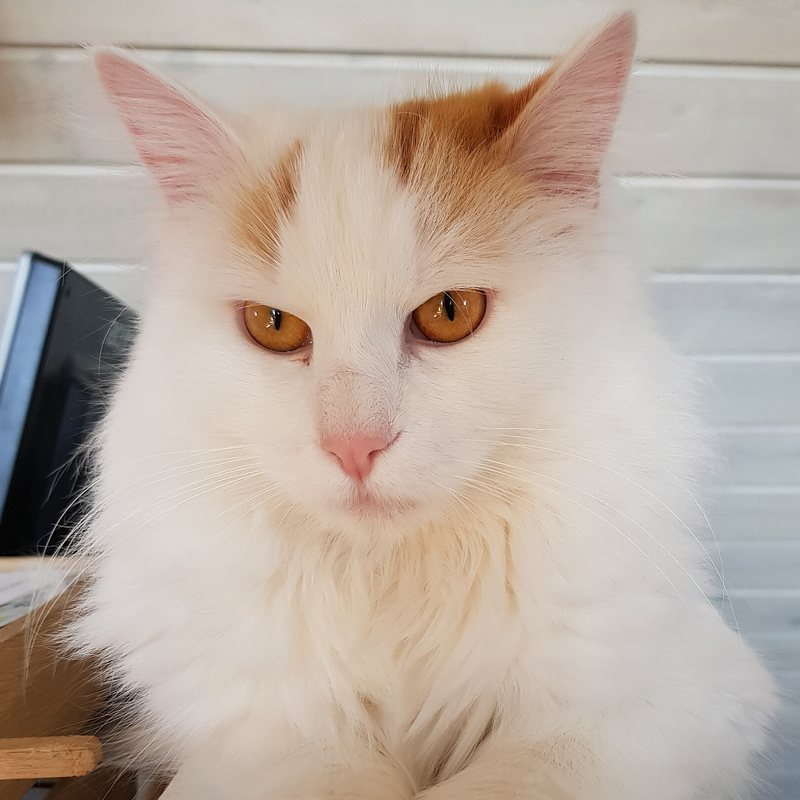

The Turkish Van is a substantial, semi-longhaired cat usually recognized by color on the head and tail against a mostly white coat. Many are active and playful. Some enjoy water, but the swimming-cat nickname is not a promise about any individual cat.
Quick facts
- Origin: cats of the Lake Van region of eastern Turkey; the pedigree breed began with a pair brought to England in the mid-1950s
- Pattern: color mainly on the head and tail; CFA allows random markings on up to 15 percent of the body
- Coat: semi-long and cashmere-like, with no undercoat (CFA)
- Size: large and slow to mature; TICA gives 10 to 20 pounds for males and 7 to 12 for females
- Life expectancy: 13 to 17 or more years (TICA); GCCF says about 12 to 14
Van cats, the Turkish Van and the van pattern
Three things share the name. Van cats are the cats living around Lake Van in eastern Turkey. The Turkish Van is the pedigree breed developed from cats taken from Turkey to England in the 1950s. The van pattern is a coat pattern, white over most of the body with color on the head and tail, which also appears in other breeds and in cats of no particular breed. Registries also differ on all-white cats: TICA accepts pure white within the Turkish Van, and GCCF recognizes an all-white form called the Turkish Vankedisi.
Temperament and daily life
Many Turkish Vans are active and playful, and PetMD notes that some can be trained to fetch. CFA says Vans are not fond of being held or carried, and FIFe says the breed does not tolerate being picked up. Respect whether the individual cat wants to be held or sit with you. A large, athletic cat needs sturdy climbing furniture and daily play, and the ASPCA recommends a scratching post at least three feet high.
Grooming and care
With no undercoat, the coat is easier to keep than its length suggests: CFA says a weekly combing should be enough for the lighter warm-weather coat, while the heavier winter coat may need more frequent attention. International Cat Care advises against cutting mats out with scissors; a tight or painful mat is a job for a veterinarian or qualified groomer. Keep up dental care and watch the cat's weight; across all cats, the Cornell Feline Health Center reports dental disease in 50 to 90 percent of cats older than four.
Health considerations
CFA says no specific genetic problems are known to affect the breed. That reflects limited published data rather than proof that none exist, so regular veterinary care matters as it does for any cat.
Hearing deserves a careful explanation because the breed is mostly white. Both the van pattern and a solid white coat come from changes in the same gene, KIT, but different ones: the van pattern is a high-grade form of white spotting, while solid white usually comes from a variant called dominant white (W), which International Cat Care links to inherited deafness. In a 2014 genetic study, all 22 cats with two copies of dominant white had some degree of hearing impairment, while the three cats tested with two copies of the white spotting variant had normal hearing, a very small sample. A CFA history article states that deafness is not associated with the Turkish Van unless caused by injury or disease, and PetMD describes white, blue-eyed Vans as typically not prone to hereditary deafness. Neither is a guarantee for an individual cat: if a cat is all white or its hearing is in doubt, a BAER hearing test gives the answer.
History
CFA dates the breed's modern history to 1955, when two British photographers, Laura Lushington and Sonia Halliday, traveling in Turkey on behalf of the Turkish Tourist Board, brought a pair of unrelated Vans back to England; GCCF dates the trip to 1954. GCCF granted the breed championship status in 1969 and TICA in June 1979. In the United States, Barbara and Jack Reark of Florida imported a breeding pair from France in 1983 and three more cats from the Netherlands, and CFA recognized the breed in 1988 and granted championship status in 1994.
Appearance
The Turkish Van is a substantial cat that CFA says takes three to five years to reach full maturity. The CFA standard calls for color on the head and tail against a white body; one or more random markings covering up to 15 percent of the body are permitted, and more than that disqualifies a show cat. The semi-long coat is soft to the roots with a cashmere-like texture and no undercoat. Eyes may be amber, blue or odd-eyed.
Before choosing a Turkish Van
Plan for a large, active cat that needs room to climb and play, weekly combing with more in winter, and a household that lets the cat decide how much handling it wants. If you are considering an all-white cat, ask about BAER testing. Meeting the individual cat tells you more about its temperament than the breed description.
Turkish Van FAQ
Do Turkish Vans really swim? Some do. CFA passes on founding breeders' reports that even Van kittens will play and swim in pools or lakes voluntarily, and quotes Laura Lushington, who wrote in 1962 that the kittens "strolled into the water too and swam out of their depth". Individual cats differ. Never put a cat in water to see whether it swims: being forced into water is frightening and can be dangerous.
Is every cat with the van pattern a Turkish Van? No. The van pattern is a coat pattern caused by high-grade white spotting, and it appears in other breeds and in random-bred cats. Only a pedigree identifies a Turkish Van.
Sources
- Cat Fanciers' Association (CFA): Turkish Van and its breed standard, a Turkish Van history article and registration rules
- The International Cat Association (TICA): Turkish Van
- Governing Council of the Cat Fancy (GCCF): Turkish Van and Turkish Vankedisi
- FIFe: Turkish Van
- PetMD: Turkish Van
- David V.A. et al. (2014), Endogenous retrovirus insertion in the KIT oncogene determines white and white spotting in domestic cats. G3
- International Cat Care: inherited deafness in white cats and grooming your cat
- Cornell Feline Health Center: feline dental disease; ASPCA: general cat care
One question about the Turkish Van cat
What unusual trait sets the Turkish Van apart from most cats?
Answer: A fondness for water. Turkish Vans like to dabble in bowls, sinks, and tubs, which is highly unusual for cats and earned them the nickname 'the swimming cat.' Source