 Cat Trivia Games
iOS App
Are Calico Cats Always Female?
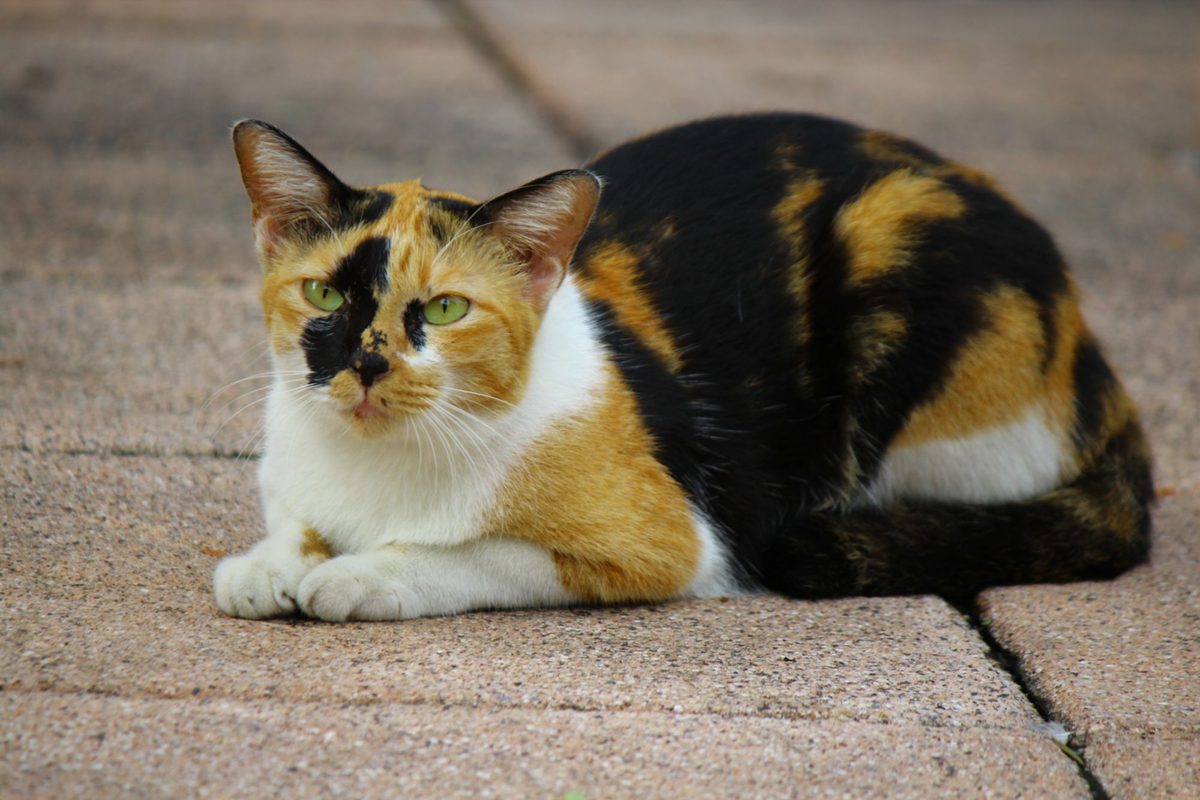
Almost always. The orange coat gene sits on the X chromosome, so a cat needs two X chromosomes, one with orange and one without, to grow orange and black patches. Females have two X chromosomes and males normally have one. Male calicos exist but are rare. Most of those studied had an extra X (XXY) or were chimeras of two fused embryos, and XXY males are usually sterile. In my count of 28,456 shelter records, 99.15% of calico, tortoiseshell and torbie cats were listed as female and 243 as male, and probably not all of those 243 are real.
Why the orange gene makes calicos female
The gene for orange fur, sex-linked orange, sits on the X chromosome. Plenty of mammals are orange, from tigers to golden retrievers to red-haired people, but only in domestic cats is orange linked to sex and far more common in males.1 A male with orange on his one X is entirely orange. A female needs orange on both X chromosomes to be fully orange. With it on just one, she is a mottled tortoiseshell or a patched calico.1
The patches come from X inactivation. "These ginger and black patches form because, early in development, one X chromosome in each cell is randomly switched off," says Kyushu University geneticist Hiroyuki Sasaki. As the cells divide, they build up orange areas where the orange X is active and black areas where the other X is.2 Solid black is a separate story, told in black cat facts.
Scientists suspected for more than a century that the orange gene was on the X chromosome. Two teams, Sasaki's and one at Stanford Medicine, found it and published side by side in Current Biology on May 15, 2025.2 Stanford ruled out 48 of 51 X chromosome variants shared by orange males because they also turned up in non-orange cats. One of the three left, a small deletion, raised the activity of a nearby gene, ARHGAP36.1 Kyushu found a deletion in ARHGAP36 in all 10 orange cats of its first sample and none of the 8 non-orange ones, and the pattern held in 49 more. Crowdfunding paid for the start of its search.2
The deletion is in a non-coding stretch of the gene, so the protein is unchanged; what changes is where the gene is switched on. In skin from four calico cats, ARHGAP36 was much more active in pigment cells from orange patches than from black or white ones.2 Christopher Kaelin, the Stanford study's lead author, said the gene is not expressed in the pigment cells of mice, people or non-orange cats. The mutation itself appears to occur in no other mammal.1
What 28,456 shelter records show
Animal shelters write down each cat's coat color and sex, and some cities publish those records. On November 19, 2026, I combined eleven public datasets from ten shelters that record both: Austin, Texas, in two record systems,1819 Bloomington, Indiana,20 Edmonton, Alberta,21 Long Beach, California,22 Louisville, Kentucky,23 Midland, Texas,24 Montgomery County, Maryland,25 Norfolk, Virginia,26 Sacramento, California,27 and Sonoma County, California.28 Together they hold more than 225,000 cats with a recorded sex.
Of those cats, 28,456 were listed as calico, tortoiseshell or torbie, three coats that all need two different X chromosomes (how they differ). The records list 28,213 of them as female, or 99.15%. The other 243 are listed as male: 0.85%, or about 1 in 117.
The chart sets that beside the other coats in the same records. Orange cats were 76.9% male, a count I go through in orange cat facts, and cats of all other colors were 53.4% male.
| Coat | Male share | Male | Female |
|---|---|---|---|
| Calico | 0.74% | 75 | 10,038 |
| Tortoiseshell | 0.97% | 123 | 12,509 |
| Torbie | 0.79% | 45 | 5,666 |
| All three | 0.85% | 243 | 28,213 |
The three coats give about the same answer. The male share is 0.74% for calicos, 0.79% for torbies and 0.97% for tortoiseshells.
Male calico and tortoiseshell cats at each shelter
| Shelter | Male share | Male | Female | Male kittens | Male adults | Males recorded neutered |
|---|---|---|---|---|---|---|
| Austin, 2013 to 2025 | 0.71% | 64 | 8,972 | 54 | 10 | 23 |
| Edmonton | 0.33% | 15 | 4,478 | 3 | 12 | 0 |
| Bloomington | 0.52% | 13 | 2,470 | 6 | 7 | 0 |
| Long Beach | 1.49% | 37 | 2,445 | 27 | 8 | 9 |
| Louisville | 1.28% | 28 | 2,165 | 10 | 18 | 20 |
| Montgomery County | 1.21% | 25 | 2,039 | 11 | 14 | 23 |
| Norfolk | 0.35% | 6 | 1,702 | 3 | 3 | 3 |
| Sacramento | 0.89% | 12 | 1,334 | no ages | no ages | 5 |
| Austin, 2025 to 2026 | 0.92% | 12 | 1,286 | 9 | 3 | 1 |
| Sonoma County | 0.36% | 4 | 1,093 | 2 | 2 | 2 |
| Midland | 10.55% | 27 | 229 | 15 | 7 | 7 |
| All shelters | 0.85% | 243 | 28,213 | 140 | 84 | 93 |
| Without Midland | 0.77% | 216 | 27,984 | 125 | 77 | 86 |
Every shelter recorded at least a few. Leaving Midland aside, the male share runs from 0.33% in Edmonton's records to 1.49% in Long Beach's. Midland's file is small, with 256 cats of these coats, and its pattern field does not always fit its colors (one entry reads "Green/White Tortoiseshell"). Its 10.55% is an outlier, so I also give the total without it: 216 males among 28,200 cats, or 0.77%, about 1 in 131.
Are the 243 males real?
Some may be. I doubt all of them are, and the records cannot tell me which. A shelter record holds what a staff member saw and typed, with no chromosome test behind it. A male calico entry can be a real XXY or chimera male, a female entered as male, or a male whose coat got the wrong label.
- The files keep one sex per cat. I looked for cats listed as male in one record and female in another. Only 1 of 225,287 cats with a recorded sex had both, and it was not a calico, tortoiseshell or torbie. The published files seem to repeat a cat's current sex on every record, so a corrected mistake leaves no trace. This check cannot find errors, and it does not show that the records are right.
- Male records lean toward kittens. Of the male records with an age, 62.5% (140 of 224) were kittens at their first intake, against 52.7% of the female records. Compared inside each shelter, a male record had about 1.4 times the odds of being a kitten (odds ratio 1.44, 95% range 1.08 to 1.92). If small kittens are sometimes sexed wrong, the mistakes would collect among kittens, and that is the way the data leans. It is a hint and not proof: the lean shows in six of the ten datasets with ages and runs the other way in four.
- Shelters differ more than chance allows. Even without Midland, the highest male share is more than four times the lowest, a wider spread than chance would give (chi-square test, p below 0.001). I know of no reason the real rate would be four times higher in one city than in another, so part of the spread probably comes from how records are kept.
- A neutered record does not settle it. 93 of the 243 males were recorded as neutered at some point. Surgery would confirm a male, and for those cats a wrong coat label would be the likelier mistake. But 48 of the 93 come from three shelters that store sex as one letter, where N means a neutered male and S a spayed female. One wrong key turns one into the other.
- Loose color labels add a few. Some records list colors, such as "Black/Orange", without naming the pattern. I counted those as tortoiseshell, or as calico when white was listed too. Counting only records that name calico, tortoiseshell or torbie outright, and leaving Midland out, gives 195 males among 28,078 cats, about 1 in 144.
So I read 243 as a ceiling. It is the most male calico, tortoiseshell and torbie cats these records could hold, and the real number is lower by an amount I cannot measure. How that compares with published figures is under how rare are male calicos, and the method is under how I counted.
Calico, tortoiseshell or torbie?
All of these coats start from one orange X and one non-orange X and differ in what else the cat inherits. The definitions are from the Cat Fanciers' Association (CFA) American Shorthair standard.3
| Coat | CFA description | What else it inherits |
|---|---|---|
| Tortoiseshell | Black with patches of red, or softly intermingled areas of red, on body and extremities | Nothing |
| Blue-cream | Blue with patches of cream, or softly intermingled areas of cream | Dilution |
| Calico | White with distinct patches of black and red, with white predominant on the underparts | White spotting |
| Dilute calico (blue-cream and white) | White with distinct patches of blue and cream | White spotting and dilution |
| Patched tabby (torbie) | A silver, brown or blue tabby with patches of red, cream or both | A tabby pattern |
Dilution comes from a separate gene that lightens the basic colors, so a dilute calico is most often white, cream and blue.4 The CFA also allows tabby markings in the red or cream patches of a calico.3
The white spotting gene is not on the X chromosome, turns up in males and females of different colors, and makes the patches bigger.5 In a 2010 interview, Mary Lyon, who proposed X inactivation, explained that spotting reduces the number of pigment cells, so each precursor cell covers a wider area and makes a larger patch.6 That is why a calico's colors sit in distinct patches, while a tortoiseshell's are often mixed.4
Quick quiz: how well do you know cat biology?
What structure passively pulls a cat's claw back into its sheath once the paw muscles relax?
Answer: An elastic ligament in the toe. An elastic ligament in the toe stores tension and snaps the toe bone back into its resting position once the flexor and extensor muscles relax, no muscular effort needed. Source
What structures cover a cat's tongue and help with food consumption and grooming?
Answer: Papillae. A cat's tongue is covered in tiny, backward-curving spines called papillae. The most common type, filiform papillae, work like a built-in hairbrush and meat-scraper, helping a cat rasp meat off bones and comb loose fur out of its coat while grooming. Source
What two main factors combine to cause muscle loss in healthy aging cats?
Answer: Reduced nutrient absorption and decreased mobility. Senior cats become less efficient at digesting and absorbing nutrients and often have decreased mobility, both of which contribute to muscle mass loss (sarcopenia). This is a normal age-related process rather than a disease. Source
How a male calico happens
A male calico needs two different X chromosomes, which an XY tomcat lacks. Studies describe several routes, including these:
- An extra X. The cat is XXY, similar to Klinefelter syndrome in people. These males are often infertile because their chromosomes do not pair properly when sperm are made.7
- A chimera. Two embryos fuse into one cat early in pregnancy. An orange male embryo fused with a black one makes a male calico who can be fertile and pass on orange or black, depending on which cells formed his testes.7
- Two X chromosomes and a piece of a Y. In 2015 a Poznan University of Life Sciences team in Poland reported the first such case in a cat: a female-looking tortoiseshell with an underdeveloped penis and part of the Y, including the SRY gene, on one X.8
| Study | Cats | Chromosomes | Fertility |
|---|---|---|---|
| Centerwall and Benirschke, 1975 (review)9 | 25 male tortoiseshell or calico cats | Abnormal chromosome numbers, mosaics and chimeras; XXY in 16 of the 25 | Almost all sterile |
| Leaman, Rowland and Long, 1999 (UK)10 | 11 male tortoiseshells | 6 XX/XY, 2 XXY, 2 XX, 1 XY | Not stated in the abstract |
| Pedersen and colleagues, 201411 | 1 tortoiseshell male | 39,XXY | Sterile: no germ cells in the testes |
| Szczerbal and colleagues, 20158 | 1 tortoiseshell cat, 8 months old | XX, with a piece of the Y attached to one X | Rudimentary penis, no scrotum, and no gonads found at surgery |
XXY is the sex chromosome abnormality reported most often in cats,8 but in the UK sample, XX/XY cats, which the Poznan team calls chimeras, outnumbered XXY cats six to two.8, 10 For an XX result like the sample's two, the Poznan team suggests a small second cell line (XXY or XY) that the test missed, or a disorder of sex development.8 Centerwall and Benirschke called male tortoiseshells and calicos convenient indicators of chromosome changes that occur independently of coat color. An XXY tomcat whose two X chromosomes carry the same color would have no patches.9
How rare are male calicos?
In a 1999 UK survey, about 1 male cat in 230 was tortoiseshell. Questionnaires from 393 veterinary practices recorded the coat color and sex of 9,816 cats brought in for vaccination or neutering, and 20 of the 4,598 males were tortoiseshell, or 0.43 percent.10
A 2011 Vetstreet column by veterinarian Marty Becker gives a different figure, 1 male in every 3,000 calicos, and credits a University of Missouri College of Veterinary Medicine study.12 The column does not cite the study, so the method cannot be checked. It also counts a share of calicos, while the UK figure is a share of male cats.
My shelter count can be put on both scales. As a share of male cats, the UK survey's measure, 243 of the 113,058 male cats in the shelter records were listed as calico, tortoiseshell or torbie: 0.21%, or about 1 in 465, half the UK rate. As a share of calico, tortoiseshell and torbie cats, the column's measure, the count is 1 in 117, more than 20 times the 1 in 3,000 figure with or without Midland.
| Source | Rate | What was counted |
|---|---|---|
| UK survey, 199910 | 0.43%, about 1 in 230 | 20 of 4,598 male cats recorded as tortoiseshell |
| Shelter records, 2026 (my count) | 0.21%, about 1 in 465 | 243 of 113,058 male cats recorded as calico, tortoiseshell or torbie |
| Vetstreet column, 201112 | About 0.03%, 1 in 3,000 | Calico cats that are male; no counts given |
| Shelter records, 2026 (my count) | 0.85%, about 1 in 117 | 243 of 28,456 calico, tortoiseshell and torbie cats recorded as male |
My count sits between the two published figures. If 1 in 3,000 were right, these 28,456 cats would include 9 or 10 real males, and more than 95% of the 243 male records would be mistakes. If the UK rate held for the shelters' 113,058 male cats, the records would show about 492 male tortoiseshells, twice what they do. The UK survey is the only one of the two whose method I could read. It rests on 20 cats, and 15.2% of the veterinary practices that were sent the questionnaire returned it.10
The shelter records agree with both sources that male calicos are rare. They cannot say which figure is closer, because I cannot separate the real males from the typing mistakes.
Calicos in science and history
- 12th century. Paintings from this period show clear calico cats. Kaelin cites them as evidence that the orange mutation is old.1
- 1949. Murray Barr and E. G. Bertram report a mass of sex chromatin in female cats' nerve cells.13 The dark spot, later called the Barr body, is an inactivated, condensed X chromosome, and it let scientists count a cell's X chromosomes for the first time.14
- 1961. Mary Lyon proposes X inactivation in female mammals, then ends the paper with the tortoiseshell cat and its mosaic of black and yellow.15
- 2001. Maryland makes the calico its state cat, effective October 1. Its colors are shared with the Baltimore oriole, the state bird, and the Baltimore checkerspot, the state insect.4
- 2001. CC, the first cloned cat, is born on December 22 in College Station, Texas, from the cells of Rainbow, a female domestic shorthair.16 Rainbow was a calico. CC had the same DNA but a visibly different coat, and a Texas A&M Foundation article puts that down to chromosome inactivation and other changes in the womb.17
- 2006. CC has three kittens, the first offspring of a cloned pet.17 She dies on March 3, 2020, at 18.16
- 2025. Two teams identify the orange gene as ARHGAP36.2
How I counted
- Records. Eleven public datasets from ten shelters, read on November 19, 2026: Austin Animal Center, Texas, in its old system (intakes from October 2013 to May 2025) and its new one (to November 2026);1819 Bloomington, Indiana (cat records mostly from 2017 on);20 Edmonton, Alberta (2012 to 2022);21 Long Beach, California (2014 to 2026);22 Louisville, Kentucky (2022 to 2026);23 Midland, Texas (June 2024 to October 2026);24 Montgomery County, Maryland (2017 to 2026);25 Norfolk, Virginia (December 2014 to April 2026);26 the City of Sacramento, California (2023 to July 2026);27 and Sonoma County, California (2013 to 2026).28 They are the part of a larger file, 539,395 cat stays from 16 public datasets, that records both coat color and sex. The same file is behind my counts of black cat adoption and of cats adopted in December, and the Austin and Long Beach records also feed my cat names study.
- One count per cat. Each animal ID counts once, with the color and age from its first stay. That gives 244,850 cats with a recorded color, 225,286 of them with one recorded sex. One more cat was male in one record and female in another. Edmonton's file has no animal IDs, so a cat that came in twice counts twice there.
- Sex. Male or female as the shelter recorded it. Neutered counts as male and spayed as female. Cats with no usable sex are left out of every share: 887 calico, tortoiseshell or torbie cats and 2,414 orange ones.
- Coat groups. Calico includes dilute calico and calico point. Tortoiseshell includes tortie, dilute tortie and blue cream. Torbie is its own group. A record that lists black and orange without naming a pattern counts as tortoiseshell, or as calico when white is listed too. Orange means orange, red, ginger, marmalade, cream, buff, apricot or flame point, alone or with white.
- Ages. A kitten is under 1 year old at its first intake, and an adult is 1 year or older. Louisville and Edmonton only mark a cat as a kitten or not. Sacramento has no usable ages, so it is missing from the kitten and adult figures.
- Tests. The kitten comparison is a Mantel-Haenszel odds ratio, which compares male and female records inside each shelter before pooling them: 1.44, with a 95% range of 1.08 to 1.92 (p = 0.017). Without Midland it is about 1.4 (p = 0.028). The spread between shelters is a chi-square test on the ten datasets other than Midland: 50.3 on 9 degrees of freedom. Both come from my own script, run on the combined file.
- Limits. Staff judge coat color by eye, and shelters use different words: the Long Beach, Montgomery County and Sonoma County files almost never say torbie. Norfolk and Sacramento record only a cat's main color. Shelter cats are not a sample of all cats, so these shares describe these records.
- Credit. Long Beach data: City of Long Beach Animal Care Services, Animal Shelter Data, licensed under CC BY 4.0,29 changed here by combining and counting the records. Edmonton data: City of Edmonton, under its Open Data Terms of Use. Louisville data: Louisville Metro, under its open data terms. Other data: City of Austin, Texas; City of Bloomington; City of Midland; Montgomery County, MD; City of Norfolk; City of Sacramento; County of Sonoma. None of these shelters, cities or counties reviewed or endorsed this page.
Use this data. Reporters, bloggers and teachers may quote these numbers and chart them, with a link to this page. That is the only condition. The counts for every shelter, for orange cats and for calico, tortoiseshell and torbie cats, are in one file: cat-coat-color-sex-2026.csv.
Think you can guess numbers like these? Play Cat Higher or Lower, a ten question game built from this site's own counts. Every data file is on the open data page.
Frequently asked questions
Are orange cats always male?
No, though most orange tabbies are.2 In a worked example from Carolyn Brown's lab at the University of British Columbia, if 30 percent of X chromosomes in a population carry orange, 30 percent of males are orange, 9 percent of females are, and 42 percent of females carry one copy of each.7 The 1999 UK survey put the orange gene's frequency at 19.7 percent.10 In my count of shelter records, 76.9% of 32,709 orange cats were male. The numbers are in orange cat facts.
Is calico a breed?
No. Calico is a coloring found in many breeds, including the domestic shorthair, the Persian and the Manx. Some breed standards set how much of the body must be white, and others allow tabby striping in the colored patches.4
Does the orange gene affect a calico's personality?
No link has been shown. Stanford found no difference in ARHGAP36 activity between orange and non-orange cats in the kidney, heart, brain or adrenal gland, though Kaelin said an untested tissue could still differ.1 Sasaki has said there is no scientific evidence yet linking coat color and personality, and he would like to study it.2
Test your cat knowledge
Now try the questions. Cat Trivia covers cat biology, behavior, breeds and history, and it is free to play, with no account.
Play Cat TriviaUp next
 Cat FactsBlack Cat Facts, Trivia Questions and AnswersWhat makes a whole coat black, and the luck stories around it.
 Cat Facts100 Cat Claims: True, False or Not That SimpleMore popular cat claims, each checked against a source.
 Cat FactsTabby Cat Breed: The Pattern and the Breeds That Wear ItThe four tabby patterns, the genes behind them and 14 breeds that carry them.
Christopher writes and runs Cat Trivia Games. The sources for this article are listed below, and how the site is made and corrected is on the editorial policy page. More about the author.
References
- Stanford Medicine News Center, Nina Bai, May 15, 2025. Scientists track down mutation that makes orange cats orange. back
- Kyushu University, May 16, 2025, on Toh and colleagues, Current Biology, 2025. Scientists find the 'meow-tation' that gives cats their orange fur. back
- The Cat Fanciers' Association. American Shorthair show standard, revised 2024 (colors). back
- Maryland State Archives, Maryland Manual On-Line. Maryland State Cat: Calico Cat. back
- Brown Lab, University of British Columbia. The 'white' in a calico cat. back
- Jane Gitschier, PLOS Genetics, 2010. The gift of observation: an interview with Mary Lyon. back
- Brown Lab, University of British Columbia. Are calico cats always female? back
- Szczerbal and colleagues, Molecular Cytogenetics, 2015 (PubMed Central). The first case of 38,XX (SRY-positive) disorder of sex development in a cat. back
- Centerwall and Benirschke, American Journal of Veterinary Research, 1975 (PubMed). An animal model for the XXY Klinefelter's syndrome in man: tortoiseshell and calico male cats. back
- Leaman, Rowland and Long, University of Bristol, Veterinary Record, 1999 (PubMed). Male tortoiseshell cats in the United Kingdom. back
- Pedersen and colleagues, Cytogenetic and Genome Research, 2014. A tortoiseshell male cat: chromosome analysis and histologic examination of the testis. back
- Vetstreet, Dr. Marty Becker, September 5, 2011. Can calico cats be male? back
- David J. B. Ashley, Nature, 1958. Occurrence of sex chromatin in the basal cells of the epidermis and in basal cell carcinomata. back
- Canadian Medical Hall of Fame. Murray Barr, 1998 inductee. back
- Embryo Project Encyclopedia, Arizona State University. "Gene Action in the X-chromosome of the Mouse" (1961), by Mary Lyon. back
- Texas A&M College of Veterinary Medicine and Biomedical Sciences, March 4, 2020. Texas A&M says goodbye to CC, world's first cloned cat. back
- Texas A&M Foundation, Maroon magazine, spring 2024. Curiosity cloned the cat. back
- City of Austin, Texas, data.austintexas.gov, public domain, read November 19, 2026. Austin Animal Center Intakes (10/01/2013 to 05/05/2025) and Austin Animal Center Outcomes (10/01/2013 to 05/05/2025). back
- City of Austin, Texas, data.austintexas.gov, no license stated on these datasets, read November 19, 2026. Austin Animal Center Intakes and Austin Animal Center Outcomes (new system). back
- City of Bloomington, Indiana, data.bloomington.in.gov, no license stated on the dataset, read November 19, 2026. Animal Shelter Animals. back
- City of Edmonton, data.edmonton.ca, under the City of Edmonton Open Data Terms of Use, read November 19, 2026. Animals Admitted to the Animal Care & Control Centre. back
- City of Long Beach Animal Care Services, data.longbeach.gov, CC BY 4.0, read November 19, 2026. Animal Shelter Data. back
- Louisville Metro Animal Services, Louisville Metro open data (LOJIC), under the Open Data Platform Terms and Use, read November 19, 2026. Louisville Metro KY - Animal Service Intake and Outcome. back
- City of Midland, Texas, ArcGIS Hub, no license stated (the city provides the data as is, with no guarantee), read November 19, 2026. Animal Intake (public view). back
- Montgomery County, MD, dataMontgomery, public domain, read November 19, 2026. OAS - Animal Shelter Pathway. back
- City of Norfolk, data.norfolk.gov, no license stated on the dataset, read November 19, 2026. Norfolk Animal Care and Adoption Center (NACC). back
- City of Sacramento, ArcGIS Hub, no license stated, read November 19, 2026. Animal Intakes and Outcomes for the Last 3 Years. back
- County of Sonoma Department of Health Services, data.sonomacounty.ca.gov, no license stated on the dataset, read November 19, 2026. Animal Shelter Intake and Outcome. back
- Creative Commons. Attribution 4.0 International (CC BY 4.0). back
Written by Christopher Fox under our editorial policy.