 Cat Trivia Games
iOS App
Orange Cat Facts: Why Most Orange Cats Are Male
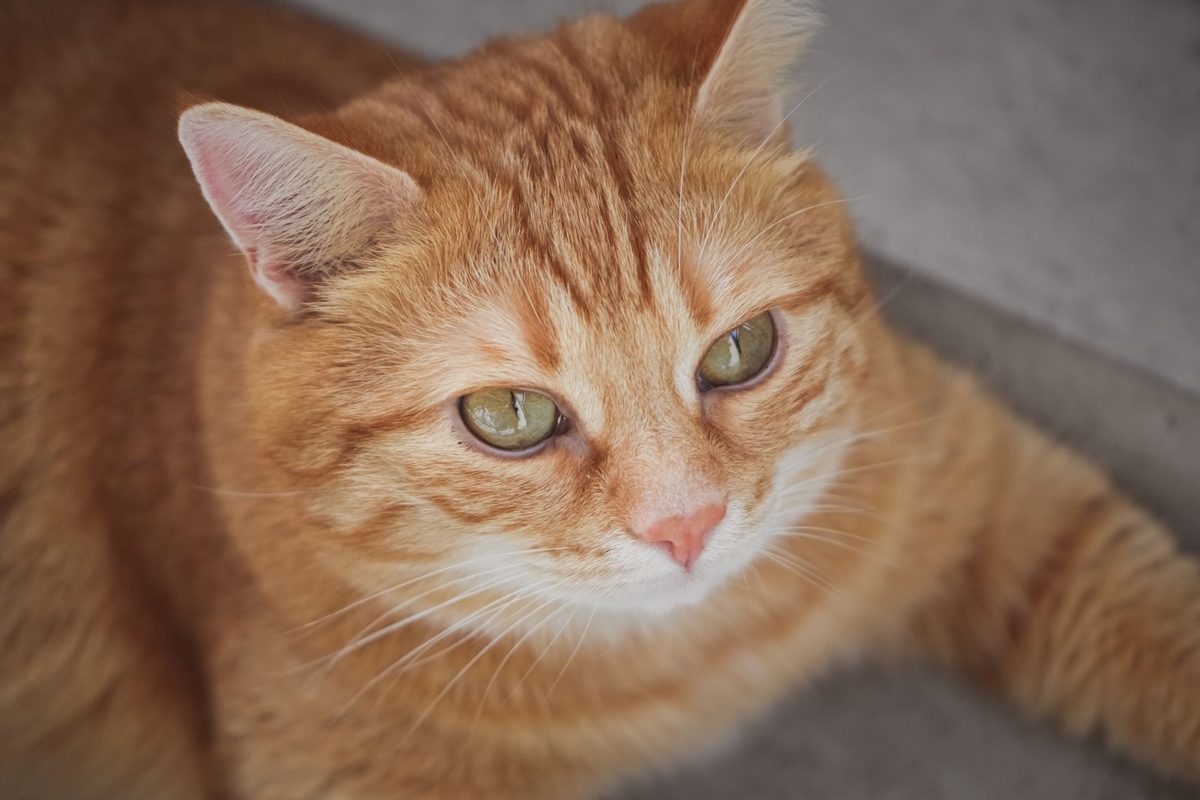
Most orange cats are male because the orange gene is on the X chromosome: one copy makes a male orange, but a female needs two. In my count of 32,709 orange cats in shelter records, 76.9% were male and 7,552 were female. In May 2025, two research teams traced the color to a small deletion in a gene called ARHGAP36. No scientific evidence yet links coat color to personality, according to the leader of one team.
Why most orange cats are male
Scientists placed the orange mutation, called sex-linked orange, on the X chromosome long before anyone found it, because orange males are so common. A male with one copy is entirely orange apart from any white patches; a female with one copy is a patchwork tortoiseshell or calico.1 So most orange tabbies are male, and calicos and tortoiseshells are nearly always female.2
How lopsided the split gets depends on how common the gene is. The Brown lab at the University of British Columbia gives an example: if 30 percent of a population's X chromosomes carry orange, 30 percent of males are orange but only 9 percent of females, who must draw orange twice (0.3 times 0.3).3 With equal numbers of each sex, the share of orange cats that are male is 1 divided by (1 plus the gene's frequency).
| Population | Orange gene frequency | Males predicted orange | Females predicted orange | Orange cats predicted male |
|---|---|---|---|---|
| Worked example, UBC lab3 | 30% | 30% | 9% | About 77% |
| United Kingdom, 1999: 9,816 cats at veterinary practices for vaccination or neutering4 | 19.7% | 19.7% | 3.9% | About 84% |
| Lorica, Colombia: 243 adult cats sampled in 20145 | 35.2% | 35.2% | 12.4% | About 74% |
| Shelter records, 2026: 113,058 male cats at ten shelters (my count) | 22.3%, the share of male cats recorded as orange | 22.3% | 5.0% | About 82% |
The often-repeated figure that about 80 percent of orange cats are male16 fits a population where a quarter of X chromosomes carry orange. I could not find a published count behind it, so I made my own from shelter records, in the next section. Real populations also stray from the math: the Lorica cats were not in Hardy-Weinberg equilibrium, the textbook balance, for the orange gene.5
How many orange cats are male? 32,709 shelter cats
Ten shelters publish records that list both a cat's coat color and its sex: Austin, Texas, in two record systems,1718 Bloomington, Indiana,19 Edmonton, Alberta,20 Long Beach, California,21 Louisville, Kentucky,22 Midland, Texas,23 Montgomery County, Maryland,24 Norfolk, Virginia,25 Sacramento, California,26 and Sonoma County, California.27 I combined their eleven public datasets on November 19, 2026. They list 32,709 cats as orange, red, ginger, cream or buff with a recorded sex.
Of those, 25,157 were male and 7,552 were female. That is 76.9% male, with a 95% range of 76.5% to 77.4%, or about 10 males for every 3 females. So not all orange cats are male: nearly one in four in these records is female.
Cats of other colors were 53.4% male. Calico, tortoiseshell and torbie cats are the mirror image of orange ones: 99.15% of them were recorded as female. I look at the 243 listed as male in are calico cats always female.
Orange cats at each shelter
| Shelter | Male share | Male | Female | Male share, kittens | Male share, adults |
|---|---|---|---|---|---|
| Austin, 2013 to 2025 | 75.2% | 7,506 | 2,479 | 75.1% | 75.3% |
| Edmonton | 81.6% | 3,855 | 868 | 81.3% | 81.8% |
| Louisville | 75.3% | 2,337 | 767 | 75.5% | 75.2% |
| Long Beach | 80.0% | 2,329 | 583 | 79.8% | 79.8% |
| Bloomington | 75.6% | 2,002 | 646 | 76.0% | 74.9% |
| Montgomery County | 76.0% | 1,927 | 608 | 75.4% | 76.2% |
| Norfolk | 79.5% | 1,530 | 394 | 80.3% | 78.2% |
| Austin, 2025 to 2026 | 72.2% | 1,226 | 472 | 73.7% | 70.8% |
| Sacramento | 80.0% | 1,299 | 324 | no ages | no ages |
| Sonoma County | 77.3% | 825 | 242 | 77.5% | 76.2% |
| Midland | 65.5% | 321 | 169 | 68.4% | 63.6% |
| All shelters | 76.9% | 25,157 | 7,552 | 76.5% | 77.1% |
| Without Midland | 77.1% | 24,836 | 7,383 | 76.6% | 77.2% |
Orange cats were mostly male at every shelter. Ten of the eleven datasets fall between 72.2%, in Austin's newest records, and 81.6%, in Edmonton's. Midland is lower, at 65.5%. Its file is small, with 490 orange cats, and its pattern field does not always fit its colors, so I also give the total without it: 77.1%.
Kittens and adults give the same answer: 76.5% of 16,712 orange kittens were male, and 77.1% of 13,612 orange adults. The word on the record matters a little more. Cats called orange, red or ginger were 78.1% male, and cats called cream, buff or flame point were 72.0% male.
How the count compares with the genetics
The formula above needs the gene's frequency. A male cat has one X chromosome, so the share of male cats that are orange gives it directly: 25,157 of the 113,058 male cats in these records, or 22.3%. From that, the math predicts that about 82% of orange cats are male and that 5.0% of female cats are orange.
The records come in lower on the first number and higher on the second: 76.9% of orange cats male, and 6.7% of female cats orange. That is 7,552 orange females where the math predicts about 5,557, close to 2,000 more. The same records hold fewer calico, tortoiseshell and torbie females than the math predicts, 25.1% of female cats against 34.6%.
I can think of three possible reasons, and this data cannot tell them apart. Coat color is typed by eye, so a tortoiseshell or calico with little black may be recorded as orange or cream. The math assumes one evenly mixed population, which real cats do not always match, as the Lorica sample showed.5 And shelter cats are not a random sample of all cats.
Against other figures, the popular 80%16 is close but a little high for these shelters. The UK frequency predicts about 84% and the Lorica frequency about 74%, and my count sits between them. I looked for a published count of orange cats by sex to compare with and did not find one I could read. The method is under how I counted.
What the 2025 discovery found
On May 15, 2025, two teams named the orange gene in back-to-back Current Biology papers, one from Stanford Medicine and one from Kyushu University in Japan.2 Both found a deletion inside ARHGAP36, a gene on the X chromosome, which the Stanford-led paper measures at 5,076 base pairs. In 188 more cats that team tested, the match was perfect: all 145 orange cats carried it on every X, all 6 tortoiseshells or calicos carried one copy, and none of the 37 other cats had it.6
The deletion changes where ARHGAP36 is switched on. It sits in an intron, a stretch that does not code for protein.7 In orange cats the gene turns on in pigment cells and lowers the working part of an enzyme called PKA, which tips the cells from black-brown eumelanin toward red-yellow pheomelanin.6
Stanford Medicine's press release says that among orange mammals, from tigers to orangutans, only domestic cats have orange linked to sex.1 The paper itself adds a second species with a sex-linked yellow or orange coat, the Syrian hamster, where mapping points to a different gene.6
The mutation looks old and appears to have happened once. Every orange cat in the Stanford-led dataset shared a common haplotype, the same stretch of surrounding DNA. With early calico paintings and no sex-linked orange in modern wildcats, the authors place a single origin more than 900 years ago, after domestication began and before breeds existed.6 The Kyushu team found the deletion widespread and also points to a single origin.7
Orange also changes how other coat genes show. Tabby markings on an orange cat come out dark orange instead of black or brown.6 It masks the agouti gene, whose non-agouti form makes a cat one solid color, so an orange coat hides which form a cat carries.5
Quick quiz: how well do you know cat biology?
Why does a single copy of the American Curl's ear-cartilage gene not cause the joint and bone problems seen in Scottish Folds?
Answer: It changes cartilage only in the outer ear. Geneticists studying the American Curl found the mutation is localized to auricle (outer ear) cartilage development, unlike the Scottish Fold's TRPV4 mutation, which acts on cartilage and bone throughout the skeleton. Source
Why does the Feline Veterinary Medical Association (formerly the AAFP) strongly oppose breeding wild cats with domestic cats, as in early Savannahs?
Answer: Welfare issues for the cats and public safety. Its 2025 position statement cites welfare issues for both the wild and the domestic cats involved, and concerns for public safety. That is a position on breeding, not a description of how every hybrid cat behaves. Source
Why is evaporative cooling through saliva more efficient for cats than relying on respiratory heat loss?
Answer: The skin surface area with saliva is larger than the respiratory tract surface area available for heat exchange. While the respiratory tract can dissipate up to 10% of total body heat in mammals, the skin surface area when coated with saliva provides a much larger evaporative cooling interface. For cats, the entire body becomes a cooling surface through grooming, whereas relying on the lungs alone is less efficient for smaller animals. Source
Orange cat behavior: the meme and the studies
Online, orange cats are cast as more chaotic and less clever than other cats. Know Your Meme dates viral posts about them to at least 2019, and r/OneOrangeBraincell, named for the joke that they all share one brain cell, was set up on February 18, 2022.9
The scientists who found the gene see no proven link to personality. Christopher Kaelin, the Stanford study's lead author, thinks the friendly-agent-of-chaos reputation more likely comes from most orange cats being male. "There are not many scientific studies of the personality of orange cats," he added.1 Hiroyuki Sasaki, who led the Kyushu team, said there is no scientific evidence yet for such a link.2
ARHGAP36 is normally active in hormone-producing organs such as the adrenal gland, hypothalamus and pituitary, yet in three orange and three black kittens the Stanford-led team found no difference in its activity there or in other tissues.6 Kaelin said a change in an untested tissue that might affect behavior cannot be excluded.1 The few studies that compare coat colors mostly measure what owners and adopters report.
| Study | Sample | Finding for orange cats | Caveat |
|---|---|---|---|
| Stelow, Bain and Kass, UC Davis, 201610 | 1,274 online surveys from cat owners | Tortoiseshell, calico and torbie females (one orange copy), black-and-white and gray-and-white cats were more often reported aggressive toward people; orange males were not named | Owner reports; handling and vet-visit aggression differed little by color |
| González-Ramírez and Landero-Hernández, Mexico, 202211 | 211 owners, each rating one cat; 16 were orange | Orange cats scored highest for friendly, calm and trainable | Not statistically significant in the main analysis; owner perceptions |
| Brown and Morgan, New York, 201512 | Adoption records, Tompkins County SPCA, a no-kill shelter | Adult cats recorded as yellow stayed longest before adoption; color made no difference for kittens | One shelter |
| Carini, Sinski and Weber, Kentucky, 202013 | 7,983 cats at an urban public shelter, 2010 to 2011 | 13.9% of orange cats were adopted, against 10.0% of black and 18.8% of white cats | Orange and white did not differ once breed and stray status were controlled |
None of these studies measured behavior directly in a large group of orange cats. A future one would need to separate coat color from sex.
A timeline of orange cats
- 12th century. A Chinese painting by Li Tang shows a calico cat, part of the Stanford-led team's evidence for the mutation's age.6
- 1604. Alessandro Vitali paints an Annunciation with a calico cat, also cited by the team.6
- 1951. Orangey, a male marmalade cat, debuts in the title role of the film Rhubarb.14
- 1961. Trainer Frank Inn picks Orangey from 25 cats for Breakfast at Tiffany's. Mental Floss calls him the only cat to win two PATSY Awards.14
- 1968. Trainer Bob Martwick finds Morris, an orange tabby, at the Humane Society in Hinsdale, Illinois. Morris later wins a PATSY Award for the 1973 Burt Reynolds film Shamus.14
- December 11, 2023. A laser experiment on NASA's Psyche spacecraft beams a 15-second video of Taters, a JPL employee's orange tabby, 19 million miles to Earth, a trip of 101 seconds.15
How I counted
- Records. Eleven public datasets from ten shelters, read on November 19, 2026: Austin Animal Center, Texas, in its old system (intakes from October 2013 to May 2025) and its new one (to November 2026);1718 Bloomington, Indiana (cat records mostly from 2017 on);19 Edmonton, Alberta (2012 to 2022);20 Long Beach, California (2014 to 2026);21 Louisville, Kentucky (2022 to 2026);22 Midland, Texas (June 2024 to October 2026);23 Montgomery County, Maryland (2017 to 2026);24 Norfolk, Virginia (December 2014 to April 2026);25 the City of Sacramento, California (2023 to July 2026);26 and Sonoma County, California (2013 to 2026).27 They are the part of a larger file, 539,395 cat stays from 16 public datasets, that records both coat color and sex. The same file is behind my counts of black cat adoption and of cats adopted in December, and the Austin and Long Beach records also feed my cat names study.
- One count per cat. Each animal ID counts once, with the color and age from its first stay. That gives 244,850 cats with a recorded color, 225,286 of them with one recorded sex. One more cat was male in one record and female in another. Edmonton's file has no animal IDs, so a cat that came in twice counts twice there.
- Sex. Male or female as the shelter recorded it. Neutered counts as male and spayed as female. Cats with no usable sex are left out of every share: 887 calico, tortoiseshell or torbie cats and 2,414 orange ones.
- Coat groups. Calico includes dilute calico and calico point. Tortoiseshell includes tortie, dilute tortie and blue cream. Torbie is its own group. A record that lists black and orange without naming a pattern counts as tortoiseshell, or as calico when white is listed too. Orange means orange, red, ginger, marmalade, cream, buff, apricot or flame point, alone or with white.
- Ages. A kitten is under 1 year old at its first intake, and an adult is 1 year or older. Louisville and Edmonton only mark a cat as a kitten or not. Sacramento has no usable ages, so it is missing from the kitten and adult figures.
- Ranges and predictions. The 95% range for the male share is a Wilson interval. The shelter row in the first table uses the share of male cats recorded as orange (25,157 of 113,058) as the gene's frequency, then the same arithmetic as the other rows.
- Limits. Staff judge coat color by eye, and shelters use different words: the Long Beach, Montgomery County and Sonoma County files almost never say torbie. Norfolk and Sacramento record only a cat's main color. Shelter cats are not a sample of all cats, so these shares describe these records.
- Credit. Long Beach data: City of Long Beach Animal Care Services, Animal Shelter Data, licensed under CC BY 4.0,28 changed here by combining and counting the records. Edmonton data: City of Edmonton, under its Open Data Terms of Use. Louisville data: Louisville Metro, under its open data terms. Other data: City of Austin, Texas; City of Bloomington; City of Midland; Montgomery County, MD; City of Norfolk; City of Sacramento; County of Sonoma. None of these shelters, cities or counties reviewed or endorsed this page.
Use this data. Reporters, bloggers and teachers may quote these numbers and chart them, with a link to this page. That is the only condition. The counts for every shelter, for orange cats and for calico, tortoiseshell and torbie cats, are in one file: cat-coat-color-sex-2026.csv.
Think you can guess numbers like these? Play Cat Higher or Lower, a ten question game built from this site's own counts. Every data file is on the open data page.
Frequently asked questions
Is orange a cat breed?
No. Orange is a coat color, which the Cat Fanciers' Association calls red; its American Shorthair standard lists solid red and red tabby as separate colors.8 The Stanford-led paper finds the mutation across continents and breeds. It also used genomes from seven breeds whose standards do not permit orange or calico, the Abyssinian, Bengal, Chartreux, Egyptian Mau, Ocicat, Havana Brown and Toyger, to rule out candidate mutations.6
Why does my orange cat have black freckles?
Orange cats can develop lentigo simplex, benign dark spots where pigment cells multiply in hairless skin, especially on the lips, nose, eyelids and gums. The Stanford-led paper calls it the only documented trait of orange cats besides coat color and compares the spots to those of Carney complex, a human condition caused by mutations in genes for part of PKA, the enzyme the orange gene acts on.6 Ask your veterinarian about any new or changing spot.
How common are orange cats?
It varies by place, as the gene frequencies in the first table show. At an urban public shelter in Kentucky, about 13 percent of the cats in one study's 2010 and 2011 data (1,062 of 7,983) were recorded as entirely or mostly orange. That study left calico, tortoiseshell and pointed cats out of its color groups.13 In my shelter count, 32,709 of 225,286 cats with a recorded sex were orange, cream or buff, or 14.5%.
Test your cat knowledge
Test what you know about cats. Cat Trivia has questions on biology, behavior, breeds and history, and it is free to play, with no account.
Play Cat TriviaUp next
 Cat FactsBlack Cat Facts, Trivia Questions and AnswersThe genetics of the other one-color coat, and the luck stories around it.
 Cat Facts100 Cat Claims: True, False or Not That SimpleMore popular cat claims, each checked against a source.
 Cat Facts161 Orange Cat Names and Why Each One FitsNames for a ginger cat, with where each one comes from.

Christopher writes and runs Cat Trivia Games. The sources for this article are listed below, and how the site is made and corrected is on the editorial policy page. More about the author.
References
- Stanford Medicine News Center, Nina Bai, May 15, 2025. Scientists track down mutation that makes orange cats orange. back
- Kyushu University, May 16, 2025. Scientists find the 'meow-tation' that gives cats their orange fur. back
- Brown Lab, University of British Columbia. Are calico cats always female? back
- Leaman, Rowland and Long, University of Bristol, Veterinary Record, 1999 (PubMed). Male tortoiseshell cats in the United Kingdom. back
- Pardo, Causil and Rodríguez, Universidad de Córdoba (Colombia), Archivos de Zootecnia, 2015. Study of the genetic diversity of the domestic cat using coat color genes in Lorica-Córdoba, Colombia (in Spanish, with an English summary). back
- Kaelin and colleagues, Current Biology, 2025 (PubMed Central). Molecular and genetic characterization of sex-linked orange coat color in the domestic cat. back
- Toh and colleagues, Current Biology, 2025 (PubMed). A deletion at the X-linked ARHGAP36 gene locus is associated with the orange coloration of tortoiseshell and calico cats. back
- The Cat Fanciers' Association. American Shorthair show standard, revised 2024 (colors). back
- Know Your Meme. Orange Cat Behavior. back
- Stelow, Bain and Kass, University of California, Davis, Journal of Applied Animal Welfare Science, 2016 (PubMed). The relationship between coat color and aggressive behaviors in the domestic cat. back
- González-Ramírez and Landero-Hernández, Autonomous University of Nuevo León, Animals, 2022 (PubMed Central). Cat coat color, personality traits and the Cat-Owner Relationship Scale: a study with cat owners in Mexico. back
- Brown and Morgan, Keuka College, Journal of Applied Animal Welfare Science, 2015 (PubMed). Age, breed designation, coat color, and coat pattern influenced the length of stay of cats at a no-kill shelter. back
- Carini, Sinski and Weber, Animals, 2020 (PubMed Central). Coat color and cat outcomes in an urban U.S. shelter. back
- Rebecca Deczynski, Mental Floss, March 25, 2015. 6 cats who made their mark on the silver screen. back
- NASA Jet Propulsion Laboratory, December 18, 2023. NASA's tech demo streams first video from deep space via laser. back
- NPR, Short Wave, Emily Kwong, May 16, 2025. Science says orange cats are special. Here's why. back
- City of Austin, Texas, data.austintexas.gov, public domain, read November 19, 2026. Austin Animal Center Intakes (10/01/2013 to 05/05/2025) and Austin Animal Center Outcomes (10/01/2013 to 05/05/2025). back
- City of Austin, Texas, data.austintexas.gov, no license stated on these datasets, read November 19, 2026. Austin Animal Center Intakes and Austin Animal Center Outcomes (new system). back
- City of Bloomington, Indiana, data.bloomington.in.gov, no license stated on the dataset, read November 19, 2026. Animal Shelter Animals. back
- City of Edmonton, data.edmonton.ca, under the City of Edmonton Open Data Terms of Use, read November 19, 2026. Animals Admitted to the Animal Care & Control Centre. back
- City of Long Beach Animal Care Services, data.longbeach.gov, CC BY 4.0, read November 19, 2026. Animal Shelter Data. back
- Louisville Metro Animal Services, Louisville Metro open data (LOJIC), under the Open Data Platform Terms and Use, read November 19, 2026. Louisville Metro KY - Animal Service Intake and Outcome. back
- City of Midland, Texas, ArcGIS Hub, no license stated (the city provides the data as is, with no guarantee), read November 19, 2026. Animal Intake (public view). back
- Montgomery County, MD, dataMontgomery, public domain, read November 19, 2026. OAS - Animal Shelter Pathway. back
- City of Norfolk, data.norfolk.gov, no license stated on the dataset, read November 19, 2026. Norfolk Animal Care and Adoption Center (NACC). back
- City of Sacramento, ArcGIS Hub, no license stated, read November 19, 2026. Animal Intakes and Outcomes for the Last 3 Years. back
- County of Sonoma Department of Health Services, data.sonomacounty.ca.gov, no license stated on the dataset, read November 19, 2026. Animal Shelter Intake and Outcome. back
- Creative Commons. Attribution 4.0 International (CC BY 4.0). back
Written by Christopher Fox under our editorial policy.