 Cat Trivia Games
iOS App
Tabby Cat Breed: The Pattern and the Breeds That Wear It
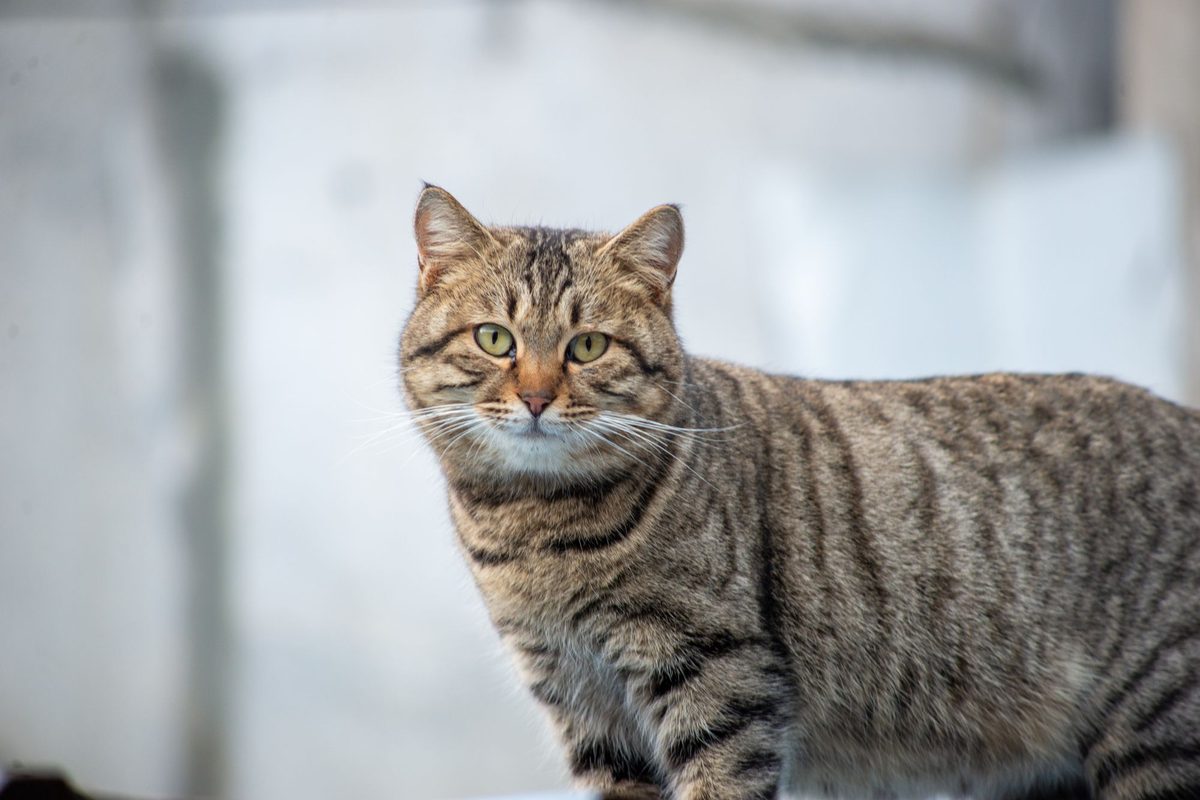
Tabby is a coat pattern, not a breed. The same stripes, swirls, spots and banded hairs turn up on pedigreed cats and on cats with no pedigree at all. Registries describe four main patterns: mackerel, classic, spotted and ticked.2 Below I go through each pattern, the genes behind them, and 14 breeds whose standards allow tabby.
The four tabby patterns
A tabby coat has two parts. The lighter background is made of hairs with wide light bands. The darker markings are made of hairs with little or no banding.4 The pattern is the shape those dark markings take.
- Mackerel. Narrow stripes down the sides. TICA describes the body as "evenly barred with vertical unbroken lines of marking color similar to the rib bones of a fish, hence the name."3 The hero photo above shows a mackerel tabby.
- Classic, also called blotched. Broad, swirled markings. CFA's American Shorthair standard asks for shoulder markings "in the shape of a butterfly" and a "large solid blotch on each side to be encircled by one or more unbroken rings."1 FIFe calls this pattern blotched.2
- Spotted. Round or oval dark spots. FIFe wants them "clearly separated from each other," and says the more spots the better.2
- Ticked. No stripes on the body. CFA describes "a cat without obvious markings on the body and with distinct tabby striping on the head, neck, legs and tail." Each body hair carries bands of color.1
A patched tabby, also called a torbie, is a tabby with red or cream patches on top. CFA defines it as "an established silver, brown, or blue tabby with patches of red and/or cream."1 The patches work the way they do on a tortoiseshell or calico. That takes two X chromosomes, one carrying the orange variant and one without it,6 which is why male calicos are rare.
The M on the forehead
The M is part of the tabby pattern. CFA's classic tabby description says the frown marks on the forehead "form an intricate letter 'M.'" Its mackerel description has the head "barred with an 'M' on the forehead."1 FIFe writes a marking "in the shape of an 'M'" into its blotched, mackerel and spotted patterns, and asks a ticked tabby for "tabby markings on the face and forehead."2
The M comes with the pattern, on any breed and on cats with no breed. Folk stories about how tabbies got the M are legends. I could not find a reliable source for any of them, so I left them out.
The genes behind the stripes
Two things have to happen before you can see a tabby. First, the agouti gene (ASIP) has to work. TICA's color guide says the dominant version "permits visualization of the tabby pattern" by putting bands of dark and light pigment on each hair.3 With two broken copies of agouti the stripes are hard or impossible to see. Geneticists call that a "ghost pattern."4 A solid black cat is the common example.6
Second, a gene sets the shape. In 2012 a team led by Christopher Kaelin reported in Science that a gene called Taqpep decides between mackerel and classic. Mackerel is dominant, so a cat needs two changed copies of Taqpep to be a classic tabby. In feral cats from northern California, all 58 classic tabbies tested carried two changed copies. All 51 mackerel tabbies carried one or none.4
The same paper has three details I did not expect:4
- The markings are set before birth. They first showed in fetal skin at seven weeks of gestation, and after that they "change in size but not number" as the cat grows.
- The wildcats that domestic cats came from have a mackerel-like pattern, and pictures of tabbies from the Middle Ages are mostly mackerel. By 1758 the classic pattern was common enough for Linnaeus to describe it as typical of the domestic cat.
- A change in the same gene gives the king cheetah its blotches and stripes in place of spots.
Taqpep does not explain spotted or ticked coats. An earlier mapping study placed the ticked coat in a separate region on chromosome B1, and found that one or more other genes turn mackerel stripes into spots.5 The ticked version covers up whatever pattern sits underneath.5 That explains an odd result in the 2012 paper. Every Abyssinian tested carried the classic tabby variant, with no blotches to show for it.4
Breeds that come in tabby
A breed standard lists the colors and patterns a registry accepts at shows. I opened the CFA standard for each breed below in November 2026 and copied the tabby patterns it names. Standards get revised, so check the linked standard if the detail matters to you. The first nine breeds also come in other colors. The last five are patterned by definition.
| Breed | Tabby patterns in the standard | What the standard says |
|---|---|---|
| American Shorthair | Classic, mackerel, ticked | The tabby pattern is worth 10 of the standard's 100 points.1 |
| British Shorthair | Classic, mackerel, spotted | For spotted cats, "good, clear spotting is essential."9 |
| Maine Coon | Classic, mackerel, ticked | Patched tabbies (torbies) are listed too.10 |
| Persian | Classic, mackerel | Each tabby color is listed as "(classic, mackerel)."11 |
| Exotic | Classic, mackerel, spotted | On a spotted Exotic the spots "may not be connected."12 |
| Norwegian Forest Cat | Classic, mackerel, spotted, ticked | Patched tabby is listed as well.13 |
| Siberian | Classic, mackerel, spotted, ticked | Tabby colors are listed as "(classic, mackerel, spotted, ticked)."14 |
| Oriental | Classic, mackerel, spotted, ticked | Each of the four patterns has its own show class.15 |
| Turkish Angora | Classic, mackerel, spotted, ticked | Tabby and white is accepted in the same four patterns.16 |
| Egyptian Mau | Spotted only | The body is "randomly spotted," and "lack of spots" disqualifies. CFA calls the Mau "the only natural domesticated breed of spotted cat."17 |
| Ocicat | Spotted | Described as a "medium to large, well-spotted agouti cat" with a tabby M on the forehead.18 |
| Bengal | Rosetted or spotted, and marble | Marble is "a modified classic tabby pattern."19 |
| Abyssinian | Ticked | The CFA standard calls the coat ticked and never uses the word tabby.20 TICA's guide says the ruddy Abyssinian "is a rufoused black ticked tabby."3 |
| Singapura | Ticked | One color only: "dark brown ticking on a warm old ivory ground color."21 |
This is a sample. Other standards allow tabby too. Some of these breeds also come in white with patches of color, and the American Shorthair standard accepts white with patches of black.1 That coat has its own page: tuxedo cat breeds. For colors that are hard to find in any pattern, see the rarest cat colors.
What breed is my tabby cat?
Most likely none. A UK study used the vet records of 7,936 cats that died in 2019. In those records 88.2% were crossbred, a label that covered domestic shorthairs, mediumhairs and longhairs as well as mixes of breeds.7
That does not make your cat a mix of breeds. Breeds were made from ordinary cats, and it did not happen the other way around. A 2013 genetics paper puts it this way: "the average random-bred cat is not a descendant of its pedigreed counterparts." The same paper notes that coat patterns and colors are single-gene traits found across the general cat population.8 A striped coat on its own does not point to a breed.
Recorded ancestry is what makes a cat a member of a breed, and most registries use the word pedigreed for those cats.8 Without a pedigree, a big longhaired tabby is a domestic longhair that looks like a Maine Coon.
A DNA ancestry test can add a hint. In the 2013 study, the best method put 88% of 477 pedigreed cats in the right breed, and 92% after a second check with five trait markers.8 Those cats were already known to belong to one of 29 breeds. For a cat with no pedigree, a result is a clue about which cat populations its ancestors came from. It does not prove a breed.
Why every orange cat is a tabby
Orange cats show tabby markings even when they carry the two broken agouti copies that turn other cats solid. The orange variant overrides the agouti change behind black coats.6 So the switch that hides stripes on a black cat does nothing on an orange one. TICA's judging rules allow for this. Solid red cats "may also be shown" in the tabby class "based on their phenotype," which the guide describes as a "bold tabby pattern."3
On an orange cat the markings are a darker orange. The orange variant sits on the X chromosome, so a male needs one copy to be orange and a female needs two.6 There is more on that in orange cat facts.
Frequently asked questions
Is a tabby a breed?
No. Tabby is a coat pattern. FIFe gives each tabby pattern a code, and says the code for a pattern is "always the same, no matter the breed."22
What breed is a tabby cat?
There is no single answer, because many breeds come in tabby. Fourteen are in the table above. A tabby with no pedigree is a domestic shorthair or longhair. Cats recorded that way, or as mixes, were 88.2% of the cats in the UK study.7
How many tabby patterns are there?
Four in most lists: mackerel, classic, spotted and ticked. FIFe has a code for each of those four, plus one for a tabby whose pattern cannot be clearly placed.22 TICA's color charts add marbled as a fifth.3 CFA standards also name patched tabby, which is a tabby with red or cream patches.1
Are tabby cats male or female?
Either. The gene region that sets mackerel or classic is on chromosome A1, which is not a sex chromosome.5 Color can lean one way. The orange variant is on the X chromosome, so a male needs one copy and a female needs two.6
How long do tabby cats live?
There is no lifespan figure for tabbies as a group. For cats in general, the UK study put life expectancy at birth at 11.74 years, and at 11.89 years for crossbred cats.7 It compared cats by sex, neutering, breed and body weight. It did not look at coat pattern, and I found no study that ties tabby markings to how long a cat lives.
Test your cat knowledge
Cat Trivia has questions on breeds, biology, behavior and history. It is free to play, with no account.
Play Cat TriviaUp next
 Cat FactsTuxedo Cat Breeds: Which Breeds Come in Black and WhiteThe other coat people take for a breed, checked against the standards.
 Cat FactsOrange Cat Facts: Why Most Orange Cats Are MaleWhy most orange cats are male, and why every one of them shows stripes.
 Cat FactsHow Many Cat Breeds Are There?Why CFA, TICA and FIFe each count a different number of breeds.

Christopher writes and runs Cat Trivia Games. The sources for this article are listed below, and how the site is made and corrected is on the editorial policy page. More about the author.
References
- The Cat Fanciers' Association. American Shorthair show standard, revised 2024 (tabby pattern descriptions, patched tabby, bi-color). back
- Fédération Internationale Féline (FIFe). Breed standards, General Part: tabby patterns, dated January 1, 2026. back
- The International Cat Association (TICA). Uniform Color Descriptions and Glossary of Terms (tabby division, with white division). back
- Kaelin and colleagues, Science, 2012 (PubMed Central). Specifying and sustaining pigmentation patterns in domestic and wild cats. back
- Eizirik and colleagues, Genetics, 2010 (PubMed Central). Defining and mapping mammalian coat pattern genes: multiple genomic regions implicated in domestic cat stripes and spots. back
- Kaelin and colleagues, Current Biology, 2025 (PubMed Central). Molecular and genetic characterization of sex-linked orange coat color in the domestic cat. back
- Teng and colleagues, Journal of Feline Medicine and Surgery, 2024 (PubMed Central). Life tables of annual life expectancy and risk factors for mortality in cats in the UK. back
- Kurushima and colleagues, Animal Genetics, 2013 (PubMed Central). Variation of cats under domestication: genetic assignment of domestic cats to breeds and worldwide random bred populations. back
- The Cat Fanciers' Association. British Shorthair show standard, revised 2026 (tabby patterns). back
- The Cat Fanciers' Association. Maine Coon Cat show standard, revised 2025 (tabby patterns and colors). back
- The Cat Fanciers' Association. Persian show standard, revised 2025 (tabby division). back
- The Cat Fanciers' Association. Exotic show standard, revised 2026 (tabby patterns). back
- The Cat Fanciers' Association. Norwegian Forest Cat show standard, revised 2026 (tabby patterns and color classes). back
- The Cat Fanciers' Association. Siberian show standard, revised 2024 (tabby patterns and colors). back
- The Cat Fanciers' Association. Oriental show standard, revised 2026 (tabby patterns and color classes). back
- The Cat Fanciers' Association. Turkish Angora show standard, revised 2021 (tabby patterns and colors). back
- The Cat Fanciers' Association. Egyptian Mau show standard, revised 2009 (pattern and disqualifications). back
- The Cat Fanciers' Association. Ocicat show standard, revised 2011 (general description and pattern). back
- The Cat Fanciers' Association. Bengal show standard, revised 2026 (rosetted/spotted and marble tabby patterns). back
- The Cat Fanciers' Association. Abyssinian show standard, revised 2025 (coat and color). back
- The Cat Fanciers' Association. Singapura show standard, revised 2007 (color). back
- Fédération Internationale Féline (FIFe). FIFe EMS System (codes for colors, patterns and amount of white). back
Written by Christopher Fox under our editorial policy.