 Cat Trivia Games
iOS App
Himalayan Cat Breed
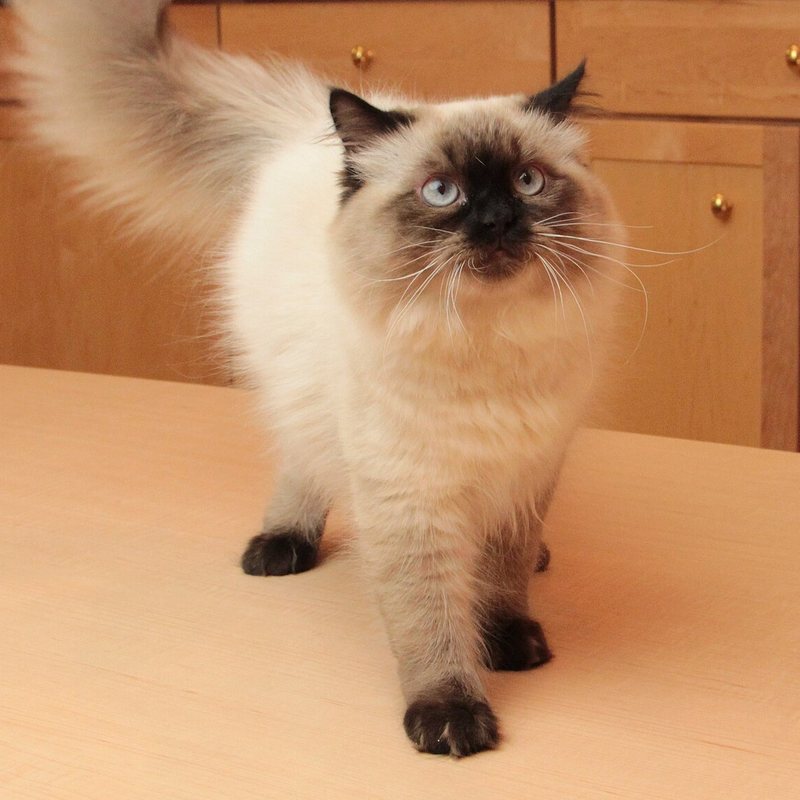

Himalayans are longhaired, pointed cats closely associated with the Persian breed. They have blue eyes and a dense coat that needs regular care. Facial structure and inherited health concerns matter as much as their often quiet temperament.
Quick facts
- Weight: about 7 to 12 pounds (PetMD), with males larger than females
- Life expectancy: estimates differ, from 8 to 11 years (TICA) to 9 to 15 (PetMD)
- Coat: long and dense over a thick undercoat, in the pointed pattern
- Eyes: blue
- Grooming: daily combing, plus regular cleaning of the face
Health and welfare considerations
A Himalayan has the Persian's flat face, and the same structural problems can follow. A very flat face can leave the eyes prominent and poorly protected by the lids, deform the tear ducts so tears spill onto the face, misalign the jaws and teeth, and narrow the nostrils and airways, a group of breathing problems called brachycephalic obstructive airway syndrome. Breathing trouble of this kind can limit a cat's ability to exercise and tolerate heat, and crowded teeth add to the risk of dental problems. A less extreme face does not guarantee freedom from breathing or other health problems. International Cat Care's view is that severe brachycephaly in Persians and similar breeds should not be continued through further breeding.
Have snoring, noisy breathing, constant tearing or sore skin on the face checked by your veterinarian. A cat breathing rapidly, with effort or with an open mouth needs a veterinarian right away, as Cornell's page on breathing difficulty explains.
Polycystic kidney disease (PKD) is the best-known inherited condition in Persian-type cats. When screening tests became available in the 1990s, PKD was found in more than a third of the Persian and Exotic Shorthair cats tested, and breeders have used screening since then to reduce it. That figure describes those cats at that time, not the rate in Himalayans today; Cornell's Feline Health Center says the disease occurs occasionally in Himalayans, that a genetic test cannot show how seriously a cat is affected, and that ultrasound is needed for a definitive diagnosis. The DNA test covers only the PKD1 variant.
Owners of Persian-group cats are also advised to ask the breeder and their veterinarian about breathing problems, progressive retinal atrophy (PRA), an inherited loss of vision, and hypertrophic cardiomyopathy (HCM), a thickening of the heart muscle.
Temperament and daily life
Himalayans are usually calm, gentle cats. TICA's profile describes a sedate and affectionate cat that would rather cuddle than climb the curtains, with sudden bursts of kitten-like play in between long rests. Many enjoy interactive toys and chasing balls. Some breeders say Himalayans are more talkative than you might expect, though nothing like a Siamese. Keep play gentle and the home cool in hot weather, since a flat face can limit exercise and heat tolerance. Introductions and the individual cat's temperament matter with children and other pets.
Grooming and care
The coat needs daily attention. Daily coat checks and regular combing help prevent painful mats, and a comb that reaches through to the thick undercoat does more than a surface brush. If a mat is tight, painful or close to the skin, ask a veterinarian or qualified groomer for help. Some owners have a groomer keep the coat shorter; whether that suits a particular cat is a decision to make with a groomer or veterinarian.
The face needs regular care as well. Himalayans tend to produce more tears than most cats, and tear staining leaves the fur damp and prone to infection, so gently wipe the eye corners and the sides of the nose. The fur under the tail can also become soiled and needs keeping clean. Ask your veterinarian about a dental care routine, since a flat face can crowd the teeth.
History
The Himalayan was created by combining the Persian's body and coat with the pointed pattern of the Siamese. Virginia Cobb and Dr. Clyde Keeler began an experimental breeding program in 1931 that produced the first Himalayan kitten, Newton's Debutante. Breeders in Canada and Britain followed in the 1950s, Britain's GCCF recognized the cats as Colorpoint Longhairs in 1955, and American associations recognized the breed as the Himalayan in 1957. The name comes from the pointed pattern, which is known as the Himalayan pattern in many other breeds.
The naming still differs between registries, which matters for registration and showing. In 1984 the Cat Fanciers' Association's board moved the Himalayan into the Persian breed as a color division, even though both breed councils had voted against the merger. A Himalayan registered with CFA is therefore a Persian shown in the Himalayan division, while TICA lists the Himalayan as its own breed within its Persian Breed Group, alongside the Persian and Exotic Shorthair. The care needs and health concerns are the same under either name.
Appearance
The Himalayan has the Persian build: a cobby body, short legs, a round head with small ears and large, round eyes, which are always blue. The long coat is cream or pale on the body, with darker color on the face mask, ears, legs, feet and tail. CFA's Himalayan division accepts seal, chocolate, blue, lilac, flame (red) and cream points, along with tortie and lynx (tabby) points in several colors.
Before choosing a Himalayan
A Himalayan needs someone who can comb it every day, keep its face clean and give it a cool, calm home. The flat face brings documented welfare concerns, so ask about the parents' PKD results and any breathing or eye problems in the line, and have the individual cat's comfort assessed by a veterinarian. Meeting the cat tells you more than the breed description.
Himalayan FAQ
Is a Himalayan a Persian? It depends on the registry. CFA shows Himalayans as Persians in a separate color division, while TICA treats the Himalayan as its own breed in the same breed group as the Persian. The cats are built the same way.
Do Himalayans change color with age? The body color can darken as a Himalayan gets older. CFA's standard allows for darker color in older cats, as long as the points still contrast clearly with the body.
Sources
- The International Cat Association: Himalayan
- Cat Fanciers' Association: Persian, including the Himalayan division and the Persian and Himalayan merger
- PetMD: Himalayan
- International Cat Care: Persian cats and brachycephaly and inherited disorders in cats
- Cornell Feline Health Center: polycystic kidney disease and breathing difficulty
- UC Davis Veterinary Genetics Laboratory: polycystic kidney disease (PKD1) test
One question about the Himalayan cat
How would you best describe a Himalayan cat's coat?
Answer: Long and silky. Inherited from its Persian ancestry, the Himalayan's coat is long, fine and silky rather than short, curly or sparse - which is exactly why it needs daily grooming. Source