 Cat Trivia Games
iOS App
HOME / BREEDS / MEKONG BOBTAIL
Mekong Bobtail Cat Breed
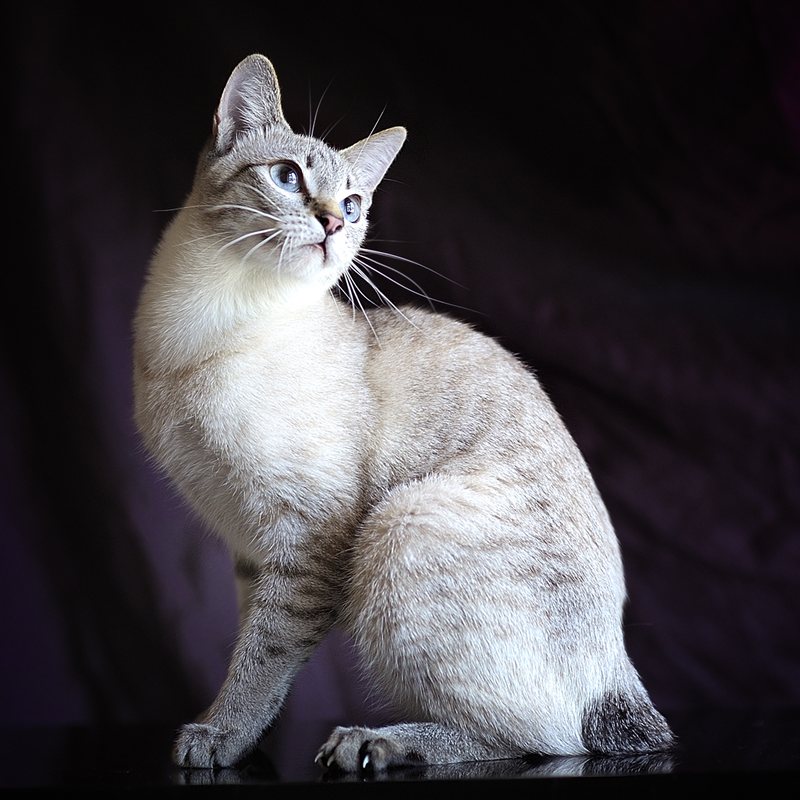

Mekong Bobtails are pointed cats with blue eyes and short, kinked tails. The breed's history and recognition differ from those of the Japanese Bobtail. Reports often describe sociable, vocal cats, but reliable breed-wide data are limited.
Quick facts
- Pattern and eyes: Siamese-style points in all pointed colors without white, with intense blue eyes
- Tail: kinks or curves starting at the base, at least three vertebrae and no longer than a quarter of the body length
- Coat: short, glossy and close-lying, with minimal undercoat
- Recognition: World Cat Federation; listed as non-recognised by FIFe; not on TICA's or CFA's breed lists (checked October 2026)
- Size and lifespan: no reliable breed-specific figures are published
Temperament and daily life
The breed standard does not describe temperament, and reliable breed-wide data are limited. Plan for daily play and interaction, climbing space and puzzle feeders, and meet the individual cat to see how sociable and talkative it is. Introductions matter with children and other pets.
Grooming and care
The short, close-lying coat has minimal undercoat and needs little grooming; an occasional brush removes loose hair. Handle the tail gently: it is made of kinked vertebrae and should never be pulled or straightened. If a cat seems sensitive about its tail or reluctant to be touched there, a veterinarian should examine it.
Health considerations
Published breed-specific health information is limited, which does not establish that Mekong Bobtails are free of inherited disease. Ask a breeder how closely related the parents are and which health checks they have had, and rely on your veterinarian for the individual cat.
The tail has been studied only indirectly. A 2022 survey of more than 11,000 cats found that the variant linked to the Japanese Bobtail's kinked tail, in a gene called HES7, is common in Mekong Bobtails (Anderson and colleagues, 2022). The survey was not designed to examine the Mekong's tail or its health, so it says nothing about whether the tail carries any risk.
History and recognition
Reliable published accounts of the breed's early history are scarce, and the registry and veterinary sources checked for this guide document mainly its recognition. That record is short and uneven. TICA listed the Mekong Bobtail in its Experimental Registry in 2009, but the breed is not on TICA's current breed list. The World Cat Federation recognizes it and publishes a breed standard updated in 2010, FIFe lists it as a non-recognised breed, and CFA does not list it (all checked October 2026).
Appearance
The WCF standard describes a medium-sized, rectangular, muscular cat that is still slender and elegant, with an almost straight back, the rump slightly higher than the shoulders, slender legs and oval paws. The head has gently rounded contours and a curved profile with a Roman nose, the ears are large and broad at the base, and the large, oval eyes are an intense blue. The coat is short, glossy and close-lying, with a silky yet crisp texture.
Before choosing a Mekong Bobtail
Availability varies widely between countries, so finding a Mekong Bobtail can take time. Plan for daily play and interaction, gentle handling of the tail and routine veterinary care, and ask a breeder about the parents' health. Meeting the individual cat tells you more than a breed description can.
Mekong Bobtail FAQ
How is a Mekong Bobtail different from a Japanese Bobtail? They are separate breeds with different histories and registries. The Mekong Bobtail is always pointed with blue eyes, while the Japanese Bobtail comes in many colors, often with white. The kinked-tail variant found in Japanese Bobtails is also common in Mekong Bobtails, so the two tails may share a genetic basis.
Is the Mekong Bobtail's short tail a health problem? No study of the breed's tail health could be found (checked October 2026). Handle the tail gently, and have a veterinarian check any sign of tail pain or stiffness.
Are Mekong Bobtails hypoallergenic? No breed can be assumed safe for someone with a cat allergy. Spend time with the individual cat before committing.
Sources
- World Cat Federation: Mekong Bobtail breed standard (2010) and EMS code and championship status
- FIFe: EMS system
- The International Cat Association: 2009 summer board meeting minutes (archived copy) and browse all breeds
- Anderson H. et al. (2022), Genetic epidemiology of blood type, disease and trait variants, and genome-wide genetic diversity in over 11,000 domestic cats. PLOS Genetics
- Cat Fanciers' Association: breeds (checked October 2026)
Quick quiz: 3 questions about the Mekong Bobtail cat
Which of these breeds is most visually similar to the Mekong Bobtail?
Answer: Siamese. Mekong Bobtails descend partly from Siamese stock, which is why they share the same pointed coat pattern, blue eyes, and vocal personality. The kinked tail is the main giveaway that tells them apart. Source
Which coat pattern does the Mekong Bobtail breed standard require?
Answer: A pointed pattern in any color. The WCF standard recognizes the breed only as a pointed, Siamese-type cat in any pointed color, with no white permitted. Source
What is a defining feature of the Mekong Bobtail’s eyes?
Answer: A vivid, intense blue. The WCF breed standard specifically calls for large, oval eyes in an intense blue. The brighter the shade, the more prized it is at shows. Source