 Cat Trivia Games
iOS App
Toyger Cat Breed
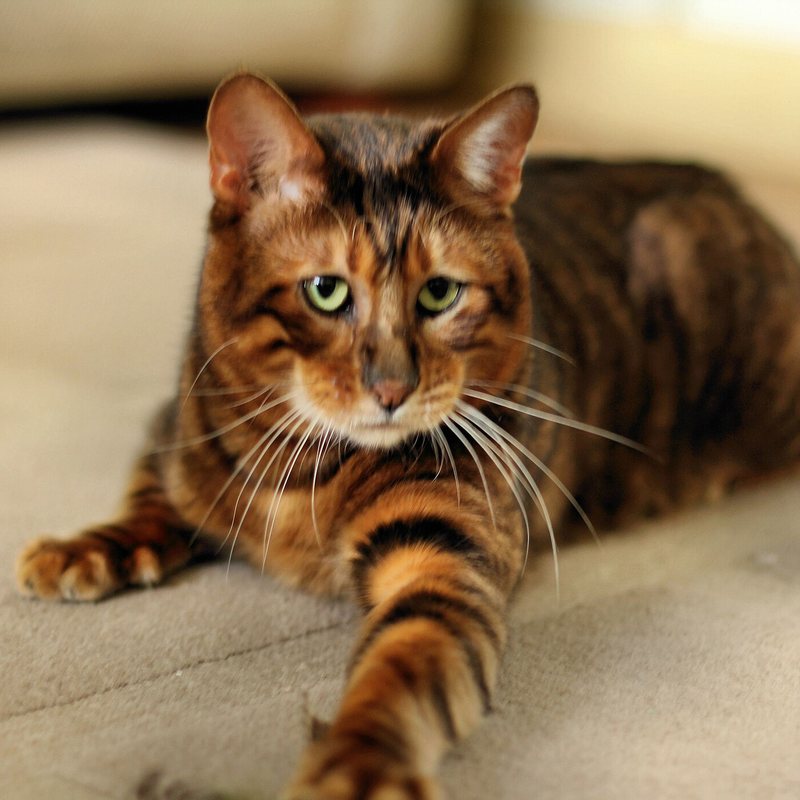

The Toyger was developed to resemble a small tiger through its striped coat and body shape. The breeding program used domestic cats, including Bengals; it did not use tigers. Many Toygers are described as sociable and playful, but their behavior varies like that of other cats.
Quick facts
- Origin: developed by Judy Sugden from the late 1980s
- Ancestry: domestic cats including a Bengal; no tigers, though the Bengal side goes back to the Asian leopard cat
- Size: TICA gives 10 to 15 pounds for males and 7 to 10 for females
- Life expectancy: 13 or more years (TICA); 9 to 13 years (PetMD); 12 to 16 years (GCCF)
- Registries: TICA registration in 1993 and championship status in February 2007; recognized by GCCF since 2015; not on CFA's breed list
Temperament and daily life
TICA describes the Toyger as friendly, outgoing and laid-back, an intelligent, interactive cat that enjoys being with people and usually gets on well with other pets. Many learn to play fetch, and some can be taught to walk on a harness, although that depends on the cat and on slow, patient training. A people-focused, intelligent cat needs daily play and something to do, such as puzzle feeders and climbing space.
Grooming and care
The short coat is easy to look after. TICA suggests an occasional brush or comb for most of the year and a daily one during the breed's short shedding seasons, while GCCF suggests a light brush and comb once a week. Trim the nails, check the ears and keep up dental care as for any cat. The ASPCA recommends keeping cats indoors; a harness or a secure enclosure is a safer way to give a Toyger time outside.
Health considerations
Breed-specific health data are limited, and some of the conditions discussed for Toygers are known mainly from the Bengal in their foundation. TICA notes that heart murmurs, possibly indicating hypertrophic cardiomyopathy (HCM), and cow hocks have occurred in the breed. GCCF recommends heart scans for HCM and DNA tests for pyruvate kinase (PK) deficiency and the Bengal form of progressive retinal atrophy, while noting anecdotal reports that these conditions occur significantly less often in Toygers than in Bengals. UC Davis lists the Toyger for its PK deficiency test. Each DNA test covers one variant, and HCM has no recommended DNA test for the breed; it is diagnosed by echocardiography (Cornell Feline Health Center). Ask a breeder which tests and heart checks the parents had, and ask your veterinarian what screening suits your cat.
History
In the late 1980s, Judy Sugden was working to make the markings of her mackerel tabbies clearer when she noticed that one of her cats had two spots of tabby markings on the temples, a possible route to the circular head pattern of a tiger. The breed's cornerstone cats were a striped domestic shorthair named Scrapmetal and a big-boned Bengal named Millwood Rumpled Spotskin, and in 1993 Sugden imported Jammu Blu, a street cat from Kashmir with spots between his ears. Her goals were a long body to show off bold vertical stripes, branching patterns, circular head markings, glittering color and a laid-back temperament. Speaking to ABC News in 2007, she said the aim was to give people something in their house that reminds them of the wild.
TICA accepted the Toyger for registration in 1993, moved it into the new breed show classes in 2000 and granted championship status in February 2007. GCCF recognized the breed in 2015 and gave it preliminary status in 2016. The Bengal in its foundation descends from crosses with the Asian leopard cat (TICA).
Appearance
TICA's standard describes a glittered, medium-sized domestic shorthair reminiscent of the big cats in pattern, type and movement. Instead of the neat vertical stripes of a mackerel tabby, the Toyger has bold, broken or branched vertical stripes in a random pattern, some looking like rosettes stretched vertically, and the facial markings ideally form a circular pattern. The goal is dark markings on a vivid, bright orange background over the top and sides of the body, with a paler underside. A long body gives the stripes room to show.
Before choosing a Toyger
Plan time for daily play and attention, a short weekly grooming routine and regular veterinary care, and ask a breeder about the parents' heart checks and DNA tests. Toygers are not common, so finding one may take time. Meeting the individual cat tells you more about how calm or busy it is than the breed's reputation does.
Toyger FAQ
Is a Toyger part tiger? No. Toygers were bred from domestic cats, including Bengals and striped domestic shorthairs. No tigers were used, although the Bengal side of the ancestry traces back to the Asian leopard cat. The tiger look comes from selecting for pattern, body shape and head markings.
How common are Toygers? Not very. A 2007 ABC News report counted about 350 registered Toygers and 25 Toyger breeders worldwide; no more recent count could be found.
Sources
- The International Cat Association (TICA): Toyger and Bengal
- Governing Council of the Cat Fancy (GCCF): Toyger
- PetMD: Toyger
- ABC News (March 9, 2007): Toyger report
- UC Davis Veterinary Genetics Laboratory: PK deficiency test
- Cornell Feline Health Center: hypertrophic cardiomyopathy; ASPCA: general cat care
- Cat Fanciers' Association: breeds (checked October 2026)
One question about the Toyger cat
Which cat registry accepted the Toyger and eventually granted it full championship status?
Answer: TICA. The International Cat Association (TICA) accepted the Toyger for registration in 1993 and advanced it to full championship status in 2007. Source