 Cat Trivia Games
iOS App
Cat Breeds for Cold Weather
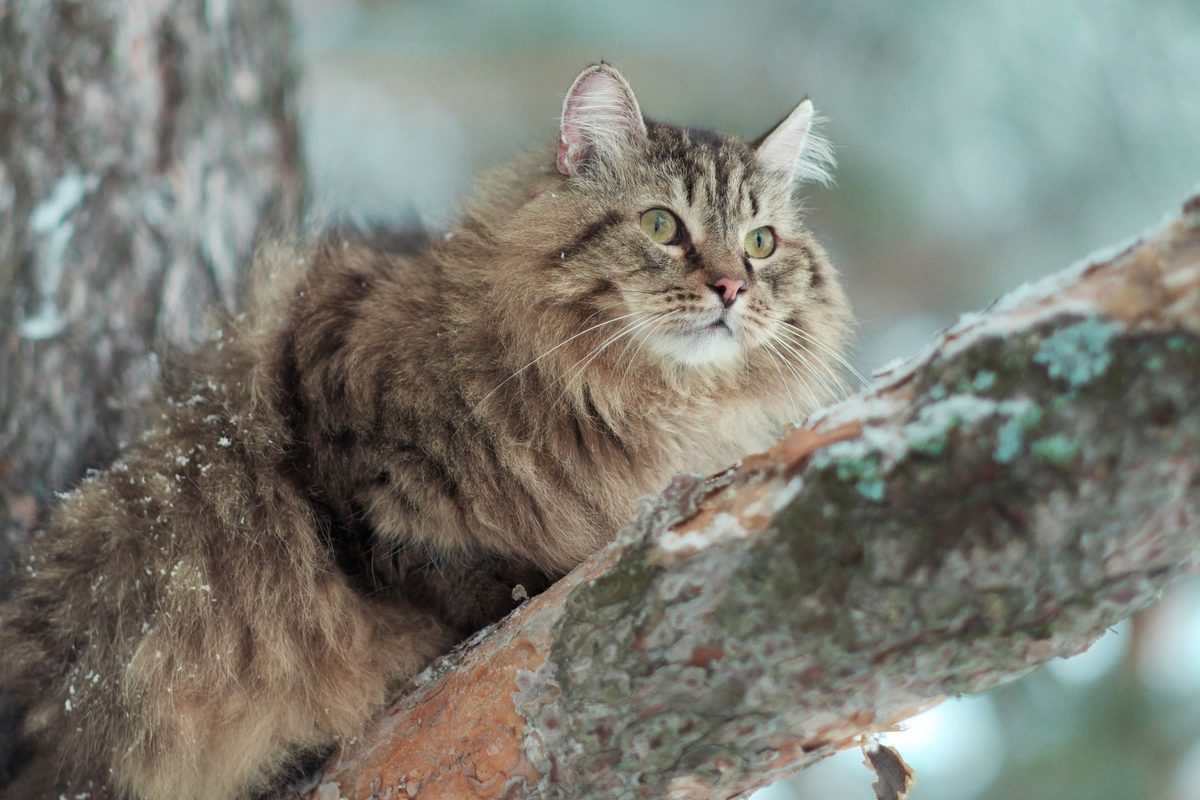
The Siberian, Norwegian Forest Cat and Maine Coon are cat breeds whose registries tie them to cold winters. Their standards call for an undercoat under a water-repellent or weatherproof top coat, large tufted paws and a long or thick tail. The Kurilian Bobtail and Turkish Van also come from cold regions but carry less undercoat: slight to moderate in the Kurilian, and none in the Van, which grows a longer, thicker winter coat.
Five cold-climate breeds compared
| Breed | Origin climate | Cold-weather features | Source |
|---|---|---|---|
| Siberian | Russia. CFA says it "hails from the unforgiving climate of Siberia". | A "triple" coat whose tight undercoat thickens in cold weather (CFA); a very dense coat, a water-repellent overcoat and a summer coat distinctly shorter than the winter one (FIFe); big rounded feet with toe tufts. | CFA1; FIFe2 |
| Norwegian Forest Cat | Norway, with "chilly Scandinavian winters" (CFA). | A woolly undercoat covered by a water-repellent coat of long, coarse, glossy guard hairs; lynx-like ear tufts; heavy tufting between the toes; a long, bushy tail. | CFA3; FIFe4 |
| Maine Coon | Maine, US. CFA calls it well suited to "the frosty winters of the northeast U.S." | A heavy, shaggy coat, shorter on the shoulders and longer on the stomach and britches (CFA); an undercoat under a glossy top coat that GCCF calls "weather-proof"; large, round, well-tufted paws; a long tail. | CFA5; GCCF6 |
| Kurilian Bobtail | The Kuril Islands, Sakhalin and Kamchatka, Russia. Kuril winters, November to March, bring high winds, heavy snow and frequent storms. | A dense, rather fine coat with a moderate undercoat in the shorthair and a slight one in the longhair; ear tufts in the longhair only; a visible tail length of 3 to 8 cm, not counting the fur. | FIFe78; Kuril Biocomplexity Project9 |
| Turkish Van | The Lake Van area of Turkey (CFA), 1,646 meters up, with cold steppe among its climate types. | No undercoat; a short summer coat and a much longer, thicker winter coat; a long tail with a brush appearance. | CFA10; IAGLR11 |
Cornell Feline Health Center's cold-weather advice makes no exception for breed or coat. Low temperatures, wind and snow or ice can predispose cats to hypothermia and frostbite, and the best way to avoid them is to keep cats indoors at all times.12
What the undercoat does
A cat's coat holds heat by trapping air between the secondary hairs, which must be dry and waterproof, and a cold-weather coat is often longer and finer to help hold in heat.13 FIFe's Siberian and Norwegian Forest Cat standards both pair an undercoat with a water-repellent outer coat,24 and CFA says the Norwegian's coat takes a long time to get wet and even longer to dry.3
These coats change with the seasons, and CFA's Siberian standard tells judges to allow for warm-weather coats.1 FIFe says the Norwegian Forest Cat's coat length and undercoat density vary by season, and its kittens can take up to six months to grow their guard hairs.4
Registries disagree on whether the Siberian's coat is triple. CFA's standard says "a TRIPLE coat", in capitals.1 FIFe names two layers: an undercoat that does not lie flat and a water-repellent overcoat, slightly hard to the touch.2 The GCCF describes a soft, fine undercoat under a coarser, more substantial topcoat.14
Tufted paws, furnished ears and long tails
CFA says the Norwegian Forest Cat's heavily furnished ears, tufted paws and long bushy tail equip it "to deflect wind and snow and brave chilly Scandinavian winters".3 FIFe wants the tail to reach at least the shoulder blades, and preferably the neck.4
The Maine Coon standard asks for large, well-tufted ears and large, round, well-tufted paws, which CFA describes as broad paws "that appear designed to navigate snow banks".5 The GCCF wants a tail at least as long as the back.6
Registries treat Maine Coons with extra toes differently. CFA's standard calls for five toes in front and four behind and disqualifies an incorrect number.5 TICA accepted the Maine Coon Polydactyl into championships as of May 1, 2015, according to a 2017 study of 70 Maine Coons, 48 of them polydactyl, from four breeding lines in Europe, Canada and the USA. It found great variability in the number and shape of the digits and in the wrist and ankle bones, with no apparent harm to the cats' welfare. The authors note that sea captains valued polydactyl cats as good luck charms, and that such cats were frequently found along North America's north-eastern coast.15
Quick quiz: how well do you know cat breeds?
What term describes the Tonkinese coat pattern with high color contrast resembling the Siamese?
Answer: Pointed. The pointed pattern shows the strongest contrast between body and extremities, mirroring the Siamese, and these cats have blue eyes. Source
What type of coat is most likely to result in a Donskoy that remains bald for life?
Answer: Rubber Bald. Per TICA's breed profile, 'The Rubber Bald is born bald and remains that way throughout its life,' making it the coat type most reliably linked to lifelong hairlessness. Source
What unusual trait sets the Turkish Van apart from most cats?
Answer: A fondness for water. Turkish Vans like to dabble in bowls, sinks, and tubs, which is highly unusual for cats and earned them the nickname 'the swimming cat.' Source
Two cold-region breeds that break the pattern
The Kurilian Bobtail comes in part from the Kuril Islands, where winters bring high winds and heavy snow,9 yet its FIFe standard asks for only a slight to moderate undercoat.8 Of several origin stories, FIFe considers the main one a cross between Japanese Bobtails and Siberian cats brought to the islands by sailors.7
The Turkish Van has a seasonal coat instead of an undercoat. CFA's standard calls for a coat "soft to the roots with no trace of undercoat", and CFA says the extremes in climate of the breed's native region give it two distinct coat lengths: a short summer coat that makes it look like a shorthair and a substantially longer, thicker winter one.10 Lake Van's listed climate types are cold steppe and cold with dry summers.11
How old are the Siberian and Norwegian Forest Cat?
CFA dates the Siberian's recorded history in Russia to the year 1000, when farmers and tradesmen were its main caretakers.1 Its date for the Norwegian Forest Cat is looser: the breed is thought to have emerged from the forest some 4,000 years ago, though its exact origins are not clear.3 A 2018 study from neighboring Denmark puts the earliest domestic cat finds in the Roman Iron Age, about AD 1 to 375, and cats stayed sparse there until the Viking Age, about AD 850 to 1050.16
The study also found that Danish cats have grown significantly larger since the Viking Age, most of all in the limb bones and jaws, by up to 16 percent. The authors point to more food and better living conditions, and possibly a shift from rat and mouse catchers to well-fed, well-cared-for pets.16
Frequently asked questions
What separates a Siberian from a Norwegian Forest Cat?
FIFe's standards give them different heads. The Norwegian Forest Cat's is triangular, with all sides equally long and a long, straight profile, and its hind legs are higher than its front legs.4 The Siberian's head is a little longer than broad, softly rounded and massive, and its thick tail is of medium length.2
Is the Siberian the same cat as the Moscow Longhair?
The GCCF treats them as one breed. It lists Siberian Forest Cat and Moscow Longhair as other names for the Siberian, which it calls the national cat of Russia, and says Siberians shed their heavy winter coat in spring and their lighter summer coat in autumn.14
What affects how a cat's coat grows and sheds?
Cats normally shed in early spring and early fall, and may also shed in response to changes in temperature or the amount of sunlight. Nutrition, hormones and the change of season all affect hair growth.13
Up next
Christopher writes and runs Cat Trivia Games. The sources for this article are listed below, and how the site is made and corrected is on the editorial policy page. More about the author.
References
- Cat Fanciers' Association (CFA). Siberian (breed profile and standard). back
- Fédération Internationale Féline (FIFe). Siberian and Neva Masquerade breed standard (PDF, dated July 1, 2026). back
- Cat Fanciers' Association (CFA). Norwegian Forest Cat (breed profile and standard). back
- Fédération Internationale Féline (FIFe). Norwegian Forest Cat breed standard (PDF, dated January 1, 2026). back
- Cat Fanciers' Association (CFA). Maine Coon Cat (breed profile and standard). back
- Governing Council of the Cat Fancy (GCCF). Maine Coon. back
- Fédération Internationale Féline (FIFe). Kurilean Bobtail Longhair and Shorthair. back
- Fédération Internationale Féline (FIFe). Kurilean Bobtail Longhair and Shorthair breed standard (PDF, dated January 1, 2026). back
- Kuril Biocomplexity Project, University of Washington. Kurils and Us: Climate. back
- Cat Fanciers' Association (CFA). Turkish Van (breed profile and standard). back
- International Association for Great Lakes Research (IAGLR). Lake Van (lake profile). back
- Cornell Feline Health Center. Cold weather tips for cats. back
- Merck Veterinary Manual. Structure of the skin in cats. back
- Governing Council of the Cat Fancy (GCCF). Siberian. back
- Hamelin A., Begon D., Conchou F., Fusellier M. and Abitbol M. (2017). Clinical characterisation of polydactyly in Maine Coon cats. Journal of Feline Medicine and Surgery 19(4): 382 to 393. back
- Bitz-Thorsen J. and Gotfredsen A.B. (2018). Domestic cats (Felis catus) in Denmark have increased significantly in size since the Viking Age. Danish Journal of Archaeology 7: 241 to 254. back
Written by Christopher Fox under our editorial policy.