 Cat Trivia Games
iOS App
Male vs Female Cats: What Differs and by How Much
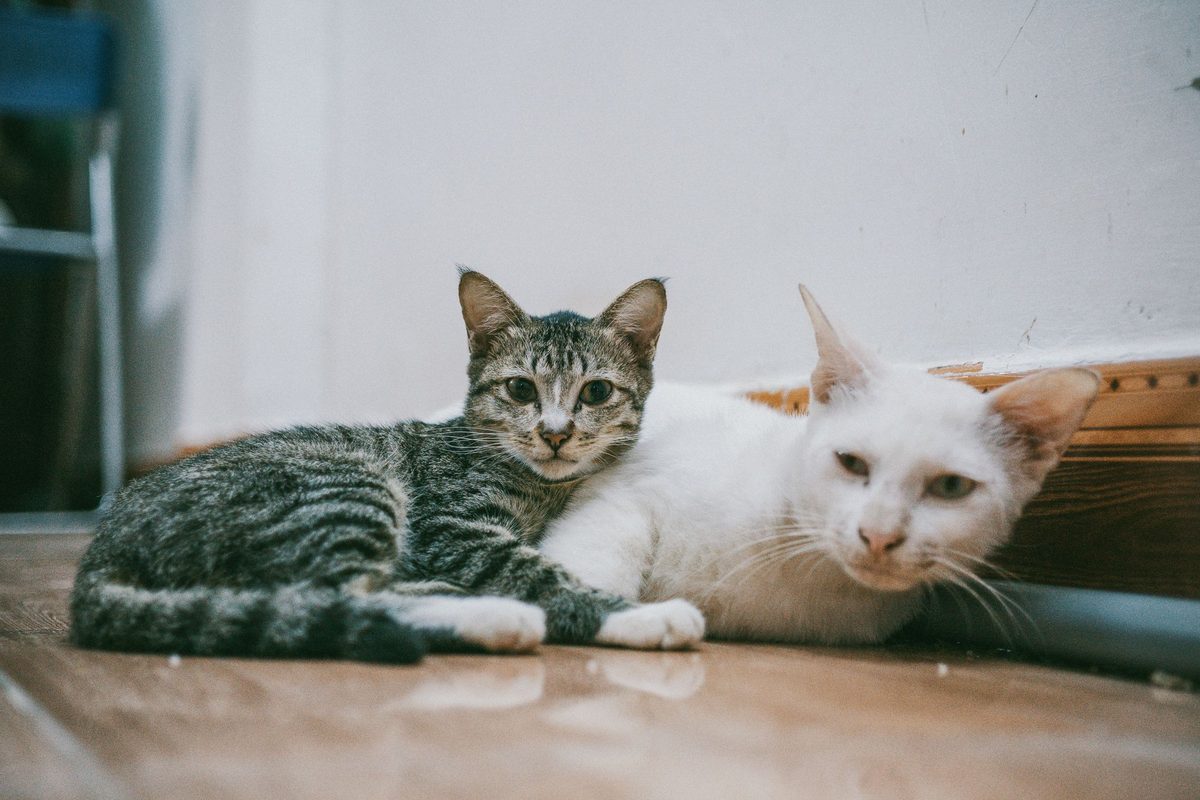
Male and female cats differ most in size and in mating behavior. Males are usually a little bigger.1 An unneutered male is more likely to roam, spray and fight, and an unneutered female may come into heat and call, but neutering makes all of that less likely.2 On affection, a University of California, Davis survey of 865 family cats found no link with sex.3 In 244,371 shelter records that note a cat's sex, I found males and females adopted at almost the same rate, with males going home a little sooner.
Jump to: Side by side, Affection, Neutering, Shelter records, Ages, Intake, Adoption, Names, Counting rules
Male or female cat: the differences side by side
Each row comes from one study or from my own count. Most of the cats studied were pets, and many were spayed or neutered. These are averages, so a given female can be bigger, bolder or friendlier than a given male.
| Measure | Males | Females |
|---|---|---|
| Weight of a lean adult, medium-sized breeds4 | 4.3 kg (9.5 lb) | 3.5 kg (7.7 lb) |
| Weight of a lean adult, the lightest breeds, the Siamese and Oriental Shorthair4 | 3.6 kg (7.9 lb) | 2.8 kg (6.2 lb) |
| Affection, as described by the parents of 865 family cats3 | Not linked to sex | |
| Demand for affection, as judged by 67 veterinarians in Japan5 | No difference noted | |
| Sociability toward people, rated by owners of 4,316 cats in Finland6 | Higher on average | Lower on average |
| Fearfulness, rated by owners of 3,255 cats in Finland7 | Lower on average | Higher on average |
| Sprayed often as adults, after neutering at 6 to 10 months8 | About 10% of 134 | About 5% of 152 |
| Paw used more, 44 neutered pet cats9 | Left | Right |
| Life expectancy at birth, UK veterinary records, 201910 | 11.18 years | 12.51 years |
| Shelter stays that ended in adoption, with the share expected from their shelters in brackets (my count) | 57.3% (57.6%) | 58.0% (57.7%) |
| Median days from arrival to adoption (my count) | 26 | 28 |
The weights come from a University of Munich study of 539 pedigreed cats and 75 without a pedigree, weighed at cat shows or veterinary surgeries, and only cats at an ideal body condition counted. Males were heavier in all five size groups, up to the giant group that held the Maine Coon, where they averaged 6.1 kg (13.4 lb) against 4.9 kg (10.8 lb). Males and females of one breed did not always land in the same size group.4
Coat color leans by sex as well, and my pages on orange cats and male calico cats count it in the same shelter records, so this page leaves color alone. The lifespan gap has a second UK study on the oldest cat ever page.
Are male or female cats more affectionate?
Are male or female cats more affectionate? On average, neither. In a 2018 University of California, Davis survey, 865 parents described the family cat that spent the most time with their children, and a cat's sex and neuter status were unrelated to how affectionate or aggressive it was. Younger cats were more often affectionate, and a cat that was the family's only cat was less affectionate on average. Nearly all of them were neutered: 49% were neutered males, 46% spayed females, 2% intact males and 4% intact females.3
Veterinarians in Japan saw affection the same way. In a survey run in 2004 and 2005, 67 small-animal vets ranked 12 breeds on 11 traits and said whether males or females showed each trait more. They noted no sex difference in demand for affection, playfulness or timidity. They rated males higher for aggression toward other cats, general activity, novelty-seeking and excitability, and females higher for nervousness and for going outside the litter box, a trait that left out spraying.5
Two owner surveys from Finland point the other way on related traits. In the first, with 4,316 cats of 56 breeds plus house cats and mixed breeds, owners rated females on average as less sociable toward people and toward other cats, and more fearful. The authors used those gaps only to test whether their questionnaire worked, and they did not study neutering, though 69% of the cats were neutered.6 In the second, with 3,255 cats of which only 11% were intact, females scored higher for fearfulness and for aggression toward people. Its authors stress that a survey like this shows links, not causes.7
A small 2026 study filmed 31 cats greeting their caregivers at home. The cats vocalized more toward men, and no other factor the team tested changed how often or how long they greeted.11 ScienceAlert reported that men got an average of 4.3 vocalizations in the first 100 seconds and women 1.8, whatever the cat's own age, sex or breed.12
None of these studies timed affection directly, such as minutes spent on a lap. They report averages from owners, parents or vets, mostly about neutered pets, and none used American shelter cats. The Finnish authors add that owners' expectations about breeds may color some answers.6 Cats Protection, a UK charity, says both sexes can be as affectionate as each other, and that genes, age, health and early life shape a cat's temperament.1 Moe, my male cat, follows me from room to room and sits on whatever I am working on, which tells you about Moe and nothing about male cats. For the breed side of the question, see the most affectionate cat breeds.
What spaying and neutering change
Most of the well-known differences belong to cats that still have their hormones. Cats Protection says an unneutered male is more likely to roam, spray and fight, and an unneutered female in heat may call, spray, try to escape or wander further than normal. After neutering, a cat of either sex is less likely to spray, fight, roam or call, and the charity says its personality otherwise stays the same.2
Timing shapes size too. The same charity says males are usually slightly larger than females, particularly if they were not neutered before about four months, when cats become sexually mature, and that unneutered males, or males neutered later in life, typically have rounder faces with bigger cheeks because of testosterone.1
Neutering does not erase every gap. In a 1984 survey of cats neutered before puberty, at 6 to 10 months, about 10% of the 134 males and 5% of the 152 females sprayed often as adults, and the females sprayed and fought less than the males. The males were more likely to spray and fight when they lived with female cats than with other males.8
Paw use survives neutering as well. All 44 cats in a 2018 Queen's University Belfast study were neutered, 24 males and 20 females, and the males still favored the left paw and the females the right.9
Weight moves the other way. In the Munich study, 50% of neutered males and 38% of neutered females were overweight, against 7% of intact males and 3% of intact females.4
Male and female cats in 244,371 shelter records
Twelve public datasets from eleven shelters record each cat's sex: Austin in two record systems,1314 Bloomington,15 Edmonton,16 Long Beach,17 Louisville,18 Midland,19 Montgomery County,20 Norfolk,21 Riverside County,22 Sacramento23 and Sonoma County.24 Of the 539,395 cat stays in my combined table, 244,371 carry a sex: 122,972 male and 121,399 female, or 50.3% male. Every dataset falls between 47.7% male, in Midland, and 52.5%, in Sacramento. Four other datasets in the table record no sex at all, which explains most of the 295,024 stays left out.
Age on arrival
| Age | Males | Females |
|---|---|---|
| Under 1 year | 65.5% | 63.2% |
| 1 or 2 years | 16.7% | 21.0% |
| 3 to 9 years | 14.1% | 11.9% |
| 10 years and up | 3.7% | 3.9% |
| Cats counted | 80,955 | 82,411 |
Males were a little more often kittens, and they were the more kitten-heavy sex in 10 of the 11 datasets that mark kittens. Among cats 1 year or older, the split runs the other way: 57.0% of 30,324 adult females were 1 or 2 years old, against 48.4% of 27,894 adult males, who were more often 3 to 9. That gap ran the same way in 8 of 9 datasets and was widest in Long Beach and Riverside County. Nothing in the records explains it.
How they came in
Most cats of both sexes arrived as strays: 80.8% of 98,709 male stays and 78.7% of 98,263 female stays, in the eleven datasets with intake types. Females were more often handed in by their owners, 19.7% against 17.6%, and that gap sits with the adults. Of stays by cats 1 year or older, 29.2% of 34,666 female stays began as an owner surrender, against 24.5% of 33,053 male stays, the same way round in 8 of 9 datasets. For kittens it almost vanished: 16.0% of female kitten stays and 15.6% of male ones. Returned adoptions came to about 1 in 100 stays for each sex. The records do not say why owners gave up a cat.
Austin's records add two details about adult strays. On arrival, 42.9% of 7,194 adult stray males were already neutered, against 31.5% of 7,963 adult stray females already spayed.1314 In the older Austin system, staff marked 20.7% of 6,802 adult stray males as injured on arrival, about twice the 10.7% of 7,549 adult stray females. Already-neutered males were marked injured almost as often as intact ones, 19.3% against 21.9%, and the notes do not say how a cat was hurt.13
Are male or female cats adopted more often?
At almost the same rate. Nine of the twelve datasets record how each stay ended. Females left by adoption in 58.0% of 75,605 stays and males in 57.3% of 75,567. If each sex had matched all cats with a recorded sex at the same shelters, the shares would have been 57.7% for females and 57.6% for males, so females ran a hair above their shelters and males a hair below.
| Shelter | Males adopted | Females adopted | Days, males | Days, females |
|---|---|---|---|---|
| Austin, 2013 to 2025 | 58.3% | 58.4% | 24 | 26 |
| Austin, 2025 to 2026 | 64.5% | 66.3% | 21 | 19 |
| Long Beach | 33.6% | 33.0% | 35 | 34 |
| Louisville | 65.1% | 66.6% | 34 | 35 |
| Montgomery County | 74.9% | 75.2% | 15 | 16 |
| Norfolk | 63.5% | 63.5% | 32 | 34 |
| Riverside County | 50.1% | 55.0% | 34 | 33 |
| Sacramento | 59.5% | 63.1% | 48 | 50 |
| Sonoma County | 56.2% | 55.3% | 24 | 29 |
| All nine datasets | 57.3% | 58.0% | 26 | 28 |
Matched by shelter and age group, females had about 3% higher odds of adoption than males (odds ratio 1.034, 95% range 1.012 to 1.058). Adopted males went home faster, though: about 6% sooner than females of the same age at the same shelter (95% range 4% to 7%), with a median of 26 days against 28, and sooner in six of the nine datasets.
The widest gap was among cats aged 10 and up, the smallest group: 40.2% of 2,065 senior female stays ended in adoption, against 39.3% expected from their shelters, and 37.1% of 1,887 senior male stays, against 38.2%. For kittens and for adults under 10, the two sexes sat within a point of each other. Black coats make a bigger gap than sex does, as my count of black cat adoption shows.
Top names for male and female shelter cats
Nine of the datasets keep the cat's name. Counting each named cat once, 59,358 males and 60,891 females, these were the ten most common names for each sex.
| Rank | Male cats | Female cats |
|---|---|---|
| 1 | Milo (316) | Luna (598) |
| 2 | Leo (295) | Bella (307) |
| 3 | Charlie (289) | Lucy (289) |
| 4 | Oliver (274) | Daisy (259) |
| 5 | Jack (246) | Lily (241) |
| 6 | Max (237) | Nala (224) |
| 7 | Smokey (209) | Willow (215) |
| 8 | Simba (203) | Cleo (177) |
| 9 | Oreo (198) | Molly (176) |
| 10 | Tiger (194) | Princess (171) |
Luna leads the female list by almost two to one, and only 25 males carried it. A few names were shared: Midnight went to 119 males and 100 females, Pumpkin to 136 and 100, and Shadow to 172 and 115. Ginger went to 166 females and 44 males, even though most orange cats are male. The most popular cat names page has the city license counts, and the cat name generator suggests a name for any cat.
How I sorted the records by sex
- Sex. I took each shelter's own entry and read neutered as male and spayed as female. Stays with no sex sit outside every share here.
- Stays or cats. Intake and adoption shares count every stay, so a cat that came back twice counts twice. Ages and names count each cat once, at its first visit. Edmonton's file has no animal IDs, so there each visit is its own cat.
- Ages. Kitten means under 1 year at intake. Nine datasets give an age in years. Louisville and Edmonton say only whether a cat is a kitten, Sacramento gives no usable age, and Midland lists strays only, so it is out of the surrender shares.
- Adoption. I kept stays that began as a stray, an owner surrender, a returned adoption or a transfer in, and that ended in adoption or in another final outcome at the shelter, such as a transfer to a rescue group, as on my black cat adoption page. The comparison group is every cat with a recorded sex at the same shelter, because stays with no sex were almost never adopted (23 of 13,156) and would pull the shelter average down. The odds ratio is a Mantel-Haenszel ratio over shelter and age group (kitten, adult, senior), and the days figure compares typical stay lengths inside the same groups.
- Limits. Sex and age are what staff wrote down, and shelter cats are not a sample of every pet cat. Corona publishes adoptions only, so it is in no adoption share. The full dataset list and the rules shared with my other counts are under how the orange count was made, and the same combined table is behind my domestic long hair cat count.
- Credit. Long Beach data: City of Long Beach Animal Care Services, Animal Shelter Data, under CC BY 4.0,25 changed here by combining and counting the records. Edmonton data: City of Edmonton, under its Open Data Terms of Use. Louisville data: Louisville Metro, under its open data terms. Other data: City of Austin, Texas; City of Bloomington; City of Midland; Montgomery County, MD; City of Norfolk; County of Riverside; City of Sacramento; County of Sonoma. None of them reviewed or endorsed this page.
Use this data. You may quote and chart these male and female counts anywhere, as long as you link to this page. Every shelter's numbers, the age, intake, surrender and adoption shares and the name counts are in male-vs-female-cats-2026.csv, and the site's other files are on the open data page.
Frequently asked questions
Should I get a male or female cat?
Cats Protection says that as long as the cat is neutered there really is not much difference, and that the personality you want matters more than the sex.1
Do female cats spray?
Some do. In the 1984 survey, about 5% of females spayed before puberty sprayed often as adults, half the rate of males neutered at the same age.8 An unspayed female in heat may spray too.2
Should a male cat live with a male or a female cat?
One survey has data on it. Neutered male cats were more likely to spray and fight when they lived with female cats than with other males.8 That is one study of 134 males, and the individual cats and how they are introduced matter more than a rule.
Test your cat knowledge
Do you know which sex is the left-pawed one now? Cat Trivia has many more questions on cat biology and behavior, free to play, with no account.
Play Cat TriviaUp next
 Cat FactsOrange Cat Facts: Why Most Orange Cats Are MaleThe X chromosome gene behind ginger males, counted in shelter records.
 Cat FactsAre Calico Cats Always Female?How rare a male calico is, and the 243 shelter records that say male.
 Cat FactsMost Popular Cat Names 2026: Data From 4 Cities and a CountyLicense and shelter counts from four cities and a county.
Christopher writes and runs Cat Trivia Games. The studies and shelter files behind this page are listed below, and how the site is made and corrected is on the editorial policy page. More about the author.
References
- Cats Protection, July 13, 2023. Should I get a male or female cat? back
- Cats Protection, February 25, 2025. Why should you neuter your cat? back
- Hart, Hart, Thigpen, Willits, Lyons and Hundenski, University of California, Davis, Frontiers in Veterinary Science, 2018 (PubMed Central). Compatibility of cats with children in the family. back
- Kienzle and Moik, Ludwig-Maximilians-Universität München, British Journal of Nutrition, 2011 (PubMed). A pilot study of the body weight of pure-bred client-owned adult cats. back
- Takeuchi Y. and Mori Y. (2009). Behavioral profiles of feline breeds in Japan. Journal of Veterinary Medical Science 71(8): 1053 to 1057. back
- Mikkola S., Salonen M., Hakanen E., Sulkama S. and Lohi H. (2021). Reliability and validity of seven feline behavior and personality traits. Animals 11(7): 1991. back
- Mikkola S., Salonen M., Hakanen E. and Lohi H. (2022). Fearfulness associates with problematic behaviors and poor socialization in cats. iScience 25: 105265. back
- Hart and Cooper, Journal of the American Veterinary Medical Association, 1984 (PubMed). Factors relating to urine spraying and fighting in prepubertally gonadectomized cats. back
- Queen's University Belfast, on EurekAlert, January 22, 2018. Researchers discover that female cats are more likely to be right-handed. back
- Teng, Brodbelt, Church and O'Neill, Royal Veterinary College, Journal of Feline Medicine and Surgery, 2024 (PubMed Central). Life tables of annual life expectancy and risk factors for mortality in cats in the UK. back
- Demirbaş, Kerman, Atilgan, Ünler, Yıldırım and Şimşek, Ethology 132(2): 87 to 94, 2026 (Ankara University record). Greeting vocalizations in domestic cats are more frequent with male caregivers. back
- David Nield, ScienceAlert, December 10, 2025. Cats meow more than twice as much at men, and we can only guess why. back
- City of Austin, Texas, data.austintexas.gov, public domain, read November 19, 2026. Austin Animal Center Intakes (10/01/2013 to 05/05/2025) and Austin Animal Center Outcomes (10/01/2013 to 05/05/2025). back
- City of Austin, Texas, data.austintexas.gov, no license stated on these datasets, read November 19, 2026. Austin Animal Center Intakes and Austin Animal Center Outcomes (new system). back
- City of Bloomington, Indiana, data.bloomington.in.gov, no license stated on the dataset, read November 19, 2026. Animal Shelter Animals. back
- City of Edmonton, data.edmonton.ca, under the City of Edmonton Open Data Terms of Use, read November 19, 2026. Animals Admitted to the Animal Care & Control Centre. back
- City of Long Beach Animal Care Services, data.longbeach.gov, CC BY 4.0, read November 19, 2026. Animal Shelter Data. back
- Louisville Metro Animal Services, Louisville Metro open data (LOJIC), under the Open Data Platform Terms and Use, read November 19, 2026. Louisville Metro KY - Animal Service Intake and Outcome. back
- City of Midland, Texas, ArcGIS Hub, no license stated (the city provides the data as is, with no guarantee), read November 19, 2026. Animal Intake (public view). back
- Montgomery County, MD, dataMontgomery, public domain, read November 19, 2026. OAS - Animal Shelter Pathway. back
- City of Norfolk, data.norfolk.gov, no license stated on the dataset, read November 19, 2026. Norfolk Animal Care and Adoption Center (NACC). back
- County of Riverside, Department of Animal Services, data.countyofriverside.us, no license stated on the dataset, read November 19, 2026. Animal Services, Animal Impound Report. back
- City of Sacramento, ArcGIS Hub, no license stated, read November 19, 2026. Animal Intakes and Outcomes for the Last 3 Years. back
- County of Sonoma Department of Health Services, data.sonomacounty.ca.gov, no license stated on the dataset, read November 19, 2026. Animal Shelter Intake and Outcome. back
- Creative Commons. Attribution 4.0 International (CC BY 4.0). back
Written by Christopher Fox under our editorial policy.