 Cat Trivia Games
iOS App
Smoke Cat: The Coat Color, the Gene and 914 Shelter Smokes
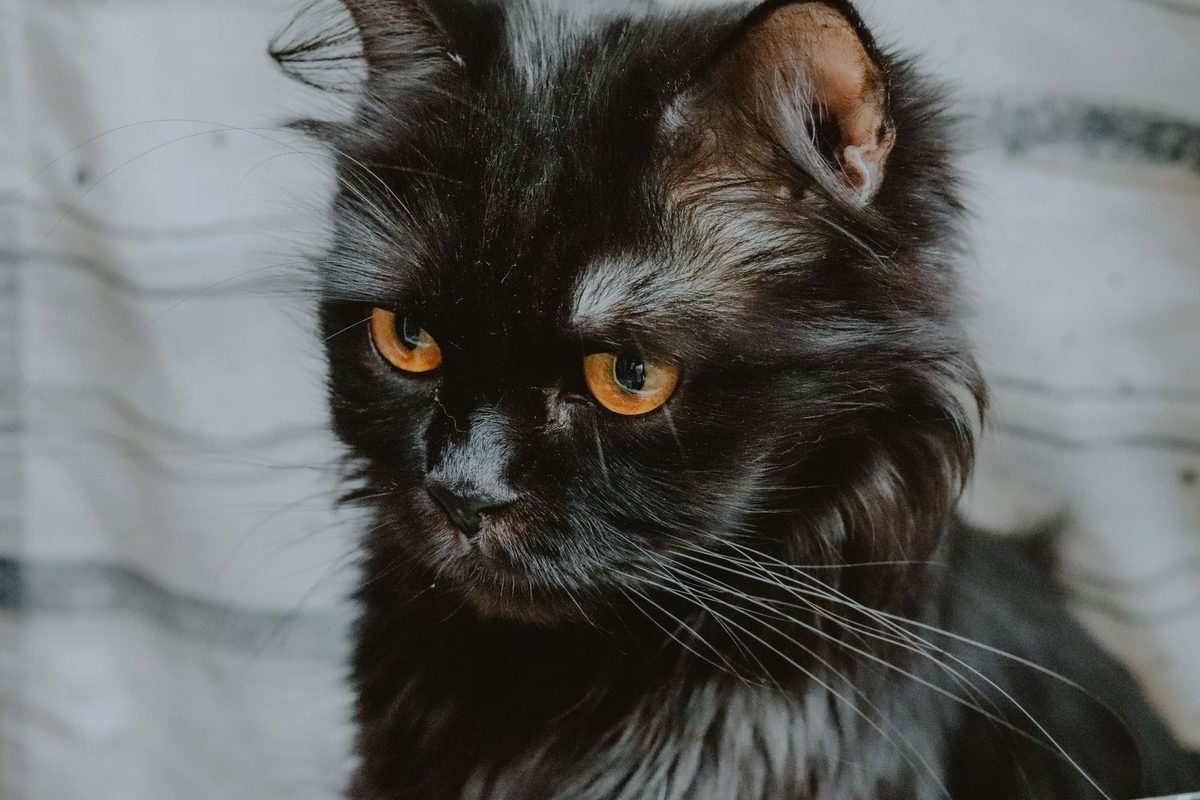
A smoke cat looks like a solid black or blue cat while it sits still. Each hair is white at the base and colored at the tip, so the pale undercoat shows when the cat moves.1 One dominant gene, called silver or inhibitor, makes the white base, and one copy is enough.2 Smoke is a color, not a breed, and TICA judges silvers and smokes in their own color division.3 I found 914 smoke cats in public shelter records, about 4 in every 1,000 cats with a recorded color, and they were adopted more often than plain black cats.
What a smoke cat looks like
The Cat Fanciers' Association (CFA) describes the black smoke as a "white undercoat, deeply tipped with black." At rest the cat "appears black." In motion the white shows, while on the mask and points it is only a narrow band next to the skin, seen when the fur is parted. The blue smoke is built the same way with blue tips.1 TICA, The International Cat Association, says a smoke should look like the matching solid color until the hair is parted.3
Long fur gives it away more easily. TICA notes that longhaired smokes may show a white ruff and ear tufts, which are usually not obvious in shorthairs, and that the belly and the underside of the tail can look paler.3 CFA's Persian standard asks for a white frill and ear tufts on both its black smoke and its blue smoke.4
To check a cat at home:
- Part the fur on the back. A smoke's hair is white near the skin and dark toward the tip.1
- Look at the nose and chin. A smoke with faint stripes can pass for a silver tabby. TICA says a nose leather with no pink center, and dark color on the chin and the front of the muzzle, point to a solid smoke.3
- Expect some stripes on the young. Tabby markings can linger in smoke coats. TICA counts them as a fault in breeds that do not ask for patterned smokes, but makes allowance for kittens and young adults.3
A smoke coat can also look different from one season to the next. CFA's Persian standard says that during a seasonal coat change a smoke's hair may look reversed, white a short way up from the root and then dark again, and calls that a normal color change.4
The smoke gene: silver on a solid coat
A smoke is what the silver gene does to a cat that is already a solid color. A 2009 study led by Marilyn Menotti-Raymond at the National Cancer Institute calls smoke a silver look that "stems from the effect of silver on a nonagouti (melanistic, i.e., black) background," with guard hairs that are silver at the base and have longer black tips than other silver cats. The team followed silver through two cat families, one started by a silver Egyptian Mau male and one by a silver Ocicat male.5 Nonagouti is the variant that makes a coat solid instead of tabby, explained on the black cat facts page.
The University of Missouri's feline genetics laboratory, which runs a DNA test for silver, says the variant "acts dominantly," so a single copy shows. On a nonagouti cat the result is a smoke, and on a coat with banded hairs it is a shaded or chinchilla silver. A cat can carry one copy or two, and its fur cannot tell you which.2 TICA's glossary still describes the inhibitor as "an unidentified, heritable factor."3 What is known about where the gene sits is on the grey tabby cat page.
Every solid color has a smoke form. TICA lists black, blue, chocolate, cinnamon, lilac, fawn, red and cream smokes, plus tortie smokes,3 and CFA shows the Persian in seven color divisions, one of them shaded and smoke.4 For how common the silver gene is in DNA-tested cats, see the rarest cat colors.
How rare is a smoke cat? 914 in shelter records
I searched the color field of twelve public shelter datasets for the word smoke: Austin, Texas, in an old and a new record system,67 Bloomington, Indiana,8 Corona, California, which lists adoptions only,9 Edmonton, Alberta,10 Long Beach, California,11 Louisville, Kentucky,12 Midland, Texas,13 Montgomery County, Maryland,14 Norfolk, Virginia,15 Sacramento, California,16 and Sonoma County, California.17 The word appears in 943 stays at all twelve. Counting each cat once leaves 914 smoke cats among 249,018 cats with a recorded color, or 3.7 in every 1,000.
| Shelter | Smoke cats | Per 1,000 cats | Black smoke share of black cats |
|---|---|---|---|
| Edmonton | 329 | 9.6 | 1.6% |
| Austin, 2013 to 2025 | 306 | 4.6 | 3.0% |
| Norfolk | 65 | 3.3 | 1.0% |
| Austin, 2025 to 2026 | 37 | 3.2 | 0.9% |
| Long Beach | 33 | 1.2 | 0.8% |
| Sonoma County | 32 | 2.7 | 1.9% |
| Montgomery County | 30 | 1.6 | 0.1% |
| Louisville | 30 | 1.4 | 0.7% |
| Corona (adoptions only) | 28 | 6.7 | 5.3% |
| Sacramento | 16 | 1.1 | 0.4% |
| Midland | 6 | 1.4 | 0.0% |
| Bloomington | 2 | 0.1 | 0.0% |
| All twelve datasets | 914 | 3.7 | 1.3% |
How often staff use the word differs a lot. Bloomington wrote it for 2 of its 16,426 cats and Edmonton for 329 of 34,195. Across all twelve, 542 black smokes stood beside 39,881 plain black cats, so about 1 black-looking cat in 75 was written down as a smoke. In Austin's older records it was about 1 in 33.
Black smoke was the most common kind, 542 of the 914. The others were 139 smoke tabbies, 117 smoke torties or calicos, 91 smokes with no other color named, 23 blue smokes and 2 more. Edmonton alone had 109 of the smoke torties and calicos, most of them written as Smoke Tortoiseshell. White was recorded alongside the smoke for 160 cats.
Blue smokes are scarce in the records
Austin's older records give the clearest test. They list 272 black smokes and 22 blue smokes. Among the plain one-color cats there, 2,656 were blue or gray and 8,604 were black. If smoke turned up on blue cats as often as on black ones, Austin would have about 84 blue smokes. Either blue smokes really are that much rarer, or a white base under blue tips is harder for staff to notice. The records cannot say which.
Smoke cats split evenly by sex. Of those with a recorded sex, 50.5% were male, against 50.6% of all cats at the same shelters, which fits a gene that the 2009 study placed on chromosome D2 rather than the X.5 They were more often kittens: 67.1% were under 1 year old at their first intake, against 55.9% of plain black cats and 53.1% of all cats at the same shelters. TICA warns that it can take time to be sure a kitten is a smoke,3 so a label written on a young kitten is an early call.
Smokey is mostly a grey cat's name
Ten of the datasets keep names. Of 348 cats named Smokey, Smoke, Smoky or Smokie, 206, or 59.2%, were recorded with a grey, blue or silver coat, plain or tabby, against 18.2% of all named cats. Only 7 had smoke anywhere in their color. Smoke cats' own most common name was still Smokey, given to 6 of the 343 named ones. More name counts are on the most popular cat names page.
Quick quiz: how well do you know cat biology?
Why do cats often bat and drop prey repeatedly before delivering the killing bite?
Answer: To wear out and exhaust the prey. Cats use a 'play' hunting strategy where they repeatedly paw, swat, and drop prey to tire it out before delivering the fatal bite. This exhaustion tactic reduces the prey's ability to struggle or injure the cat during the final strike. Source
Why does a single copy of the American Curl's ear-cartilage gene not cause the joint and bone problems seen in Scottish Folds?
Answer: It changes cartilage only in the outer ear. Geneticists studying the American Curl found the mutation is localized to auricle (outer ear) cartilage development, unlike the Scottish Fold's TRPV4 mutation, which acts on cartilage and bone throughout the skeleton. Source
Why does the Feline Veterinary Medical Association (formerly the AAFP) strongly oppose breeding wild cats with domestic cats, as in early Savannahs?
Answer: Welfare issues for the cats and public safety. Its 2025 position statement cites welfare issues for both the wild and the domestic cats involved, and concerns for public safety. That is a position on breeding, not a description of how every hybrid cat behaves. Source
Smoke cats are more often longhaired
Eleven of the datasets have a breed field, and for most cats it holds only a coat length that staff chose by eye. Of 881 smoke cats with a breed label, 36.3% were called medium hair or longhair, twice the share of plain black cats at the same shelters.
| Breed label | Smoke cats | Plain black cats | All cats |
|---|---|---|---|
| Domestic shorthair | 61.9% | 81.1% | 79.1% |
| Domestic medium hair | 22.7% | 13.0% | 11.6% |
| Domestic longhair | 13.6% | 5.1% | 4.3% |
| A named breed | 1.8% | 0.8% | 5.0% |
Because smoke shows more on long fur,3 a long-coated smoke is also easier for staff to spot and write down. These records cannot separate that from a real difference in how often long coats carry the gene. Only 16 smoke cats had a named breed, and Persian was the most common at 4, a small count.
Smoke cats were adopted more often than plain black cats
Eight of the datasets say how each stay ended, and I used the same stays as my black cat adoption count, which put black smokes in with black cats. Here they stand apart. Of 493 smoke stays, 66.1% ended in adoption. Had each shelter's smoke cats done as well as its plain black cats, the figure would be 51.4%, and as well as all its cats, 54.3%.
| Shelter | Smoke stays | Smoke adopted | Plain black adopted | All cats adopted |
|---|---|---|---|---|
| Austin, 2013 to 2025 | 302 | 64.6% | 51.2% | 54.0% |
| Norfolk | 64 | 79.7% | 57.7% | 60.2% |
| Austin, 2025 to 2026 | 29 | 72.4% | 52.4% | 57.7% |
| Long Beach | 28 | 35.7% | 27.5% | 29.1% |
| Sonoma County | 26 | 69.2% | 42.2% | 47.3% |
| Montgomery County | 18 | 72.2% | 71.8% | 73.6% |
| Louisville | 14 | 71.4% | 62.2% | 62.8% |
| Sacramento | 12 | 66.7% | 55.0% | 56.9% |
| All eight datasets | 493 | 66.1% | 51.4% | 54.3% |
The gap held when I compared cats of the same age group at the same shelter. Smoke cats had about 1.8 times the odds of adoption of plain black cats (odds ratio 1.76, 95% range 1.45 to 2.15) and about 1.6 times the odds of all other cats (1.55, 1.28 to 1.89). Matching coat length as well, in the seven datasets with both outcomes and a breed field, left 1.67 (1.36 to 2.05) against plain black cats.
Adopted smoke cats did not leave sooner, though. Austin's older records hold 302 of the 493 smoke stays, and there an adopted smoke cat waited a median of 38 days, against 25 for all adopted cats and 30 for plain black ones. Of its 195 smoke adoptions, 115 came after a longer wait than the median for cats of the same age group adopted that year, and 78 after a shorter one.
One caution runs through all of this. A smoke undercoat is easy to miss at a glance, and a cat that stays long enough to be adopted gets looked at more closely. If staff write smoke more often for cats they spend time with, the label itself would lean toward adopted cats. These files cannot rule that out.
At seven US animal shelters, 66.1% of stays by smoke cats ended in adoption, against 51.4% for plain black cats at the same shelters, according to a count of public shelter records by Cat Trivia Games.
Source: Smoke Cat: The Coat Color, the Gene and 914 Shelter Smokes, cattriviagames.com
What the smoke count includes
Every dataset's dates and the rules shared by all my shelter counts are under how the orange count was made. These apply to this page only.
- What counts as smoke. Any record with smoke in the shelter's own color text, in any position, so smoke tabbies, torties and calicos stay in. Silver on its own does not count. A black smoke is a smoke record that also says black or BLK and names no tabby, tortie or calico. A plain black cat is a black record with no smoke.
- Each cat once. A returning cat counts once, with the color and age from its first stay. Edmonton has no IDs and Bloomington gives each intake a new code, so a return there counts twice. Corona lists adopted cats only, with no sex or age, so its 28 smoke cats appear in the coat counts and breed labels only.
- Comparisons. Each comparison takes the other group's share at each shelter and weights it by that shelter's smoke cats. The odds ratios are Mantel-Haenszel, inside each shelter and age group (and coat length, where named). Sacramento gives no ages and Long Beach no breed field.
- Limits. Smoke is a call staff make by eye, with no gene test. Norfolk and Sacramento record only the main color, and some shelters almost never use the word. Shelter cats are not all cats, so these figures describe these records.
- Credit. The Long Beach rows are Animal Shelter Data from the City of Long Beach Animal Care Services, under CC BY 4.0;18 I merged them with the other files and counted them. Edmonton's rows follow the City of Edmonton Open Data Terms of Use and Louisville's follow Louisville Metro's open data terms. The remaining files come from the City of Austin, Texas, the City of Bloomington, the City of Corona, the City of Midland, Montgomery County, MD, the City of Norfolk, the City of Sacramento and the County of Sonoma. No shelter, city or county reviewed this page.
Use this data. You may quote or chart the smoke cat numbers anywhere, with a link to this page. The counts for each shelter, the adoption figures, the coat lengths and the Smokey name count are in smoke-cat-2026.csv.
Frequently asked questions
Can a smoke cat have kittens that are not smoke?
Yes, if it carries one copy of the silver variant. The Missouri lab notes that a cat may have one copy or two and that fur color cannot show which. A cat with two copies passes silver to every kitten, and the lab's DNA test is how breeders tell the two apart.2
What is the difference between a smoke cat and a silver cat?
They share one gene. On a solid, nonagouti cat the silver gene makes a smoke, and on a cat with banded hairs a shaded or chinchilla silver.2 A smoke's hairs are deeply tipped with color over a white undercoat.1 TICA calls shaded and chinchilla silvers tabby cats with a wide white band: the shaded is colored from the tip about a third of the way down the hair, and the chinchilla only at the tip of each guard hair.3
Test your cat knowledge
Would you have spotted the smoke before the fur parted? Cat Trivia has questions on coats, genes, breeds and behavior, free to play with no account.
Play Cat TriviaUp next
 Cat FactsBlack Cat Facts, Trivia Questions and AnswersThe solid black coat underneath every black smoke.
 Cat FactsGrey Tabby Cat: A Breed or a Color? 18,646 Shelter Cats CountedThe same silver gene on a striped coat, and 18,646 grey tabbies counted.
 Cat FactsWhat Is the Rarest Cat Color? Amber, Russet, Albino and MoreThe colors DNA tests almost never find.
Christopher writes and runs Cat Trivia Games. The registry standards, the genetics sources and the shelter files behind this page are listed below, and how the site is made and corrected is on the editorial policy page. More about the author.
References
- The Cat Fanciers' Association. American Shorthair show standard, revised 2024 (black smoke and blue smoke colors). back
- University of Missouri College of Veterinary Medicine, Feline Genetics and Comparative Medicine Laboratory. Silver (Inhibitor) genetic testing in domestic cat breeds, with frequently asked questions. back
- The International Cat Association (TICA). Uniform Color Descriptions and Glossary of Terms, version D (silver and smoke division, smoke colors, inhibitor). back
- The Cat Fanciers' Association (CFA). Persian: breed profile and color divisions (shaded and smoke division). back
- Menotti-Raymond and colleagues, National Cancer Institute, Journal of Heredity, 2009 (PubMed Central). Mapping of the domestic cat "SILVER" coat color locus identifies a unique genomic location for silver in mammals. back
- City of Austin, Texas, data.austintexas.gov, public domain, read November 19, 2026. Austin Animal Center Intakes (10/01/2013 to 05/05/2025) and Austin Animal Center Outcomes (10/01/2013 to 05/05/2025). back
- City of Austin, Texas, data.austintexas.gov, no license stated on these datasets, read November 19, 2026. Austin Animal Center Intakes and Austin Animal Center Outcomes (new system). back
- City of Bloomington, Indiana, data.bloomington.in.gov, no license stated on the dataset, read November 19, 2026. Animal Shelter Animals. back
- City of Corona, Corona Animal Services, CorStat, no license stated on the dataset, read November 19, 2026. CorStat - Animal Adoptions. back
- City of Edmonton, data.edmonton.ca, under the City of Edmonton Open Data Terms of Use, read November 19, 2026. Animals Admitted to the Animal Care & Control Centre. back
- City of Long Beach Animal Care Services, data.longbeach.gov, CC BY 4.0, read November 19, 2026. Animal Shelter Data. back
- Louisville Metro Animal Services, Louisville Metro open data (LOJIC), under the Open Data Platform Terms and Use, read November 19, 2026. Louisville Metro KY - Animal Service Intake and Outcome. back
- City of Midland, Texas, ArcGIS Hub, no license stated (the city provides the data as is, with no guarantee), read November 19, 2026. Animal Intake (public view). back
- Montgomery County, MD, dataMontgomery, public domain, read November 19, 2026. OAS - Animal Shelter Pathway. back
- City of Norfolk, data.norfolk.gov, no license stated on the dataset, read November 19, 2026. Norfolk Animal Care and Adoption Center (NACC). back
- City of Sacramento, ArcGIS Hub, no license stated, read November 19, 2026. Animal Intakes and Outcomes for the Last 3 Years. back
- County of Sonoma Department of Health Services, data.sonomacounty.ca.gov, no license stated on the dataset, read November 19, 2026. Animal Shelter Intake and Outcome. back
- Creative Commons. Attribution 4.0 International (CC BY 4.0). back
Written by Christopher Fox under our editorial policy.