 Cat Trivia Games
iOS App
What Is the Rarest Cat Color? Amber, Russet, Albino and More
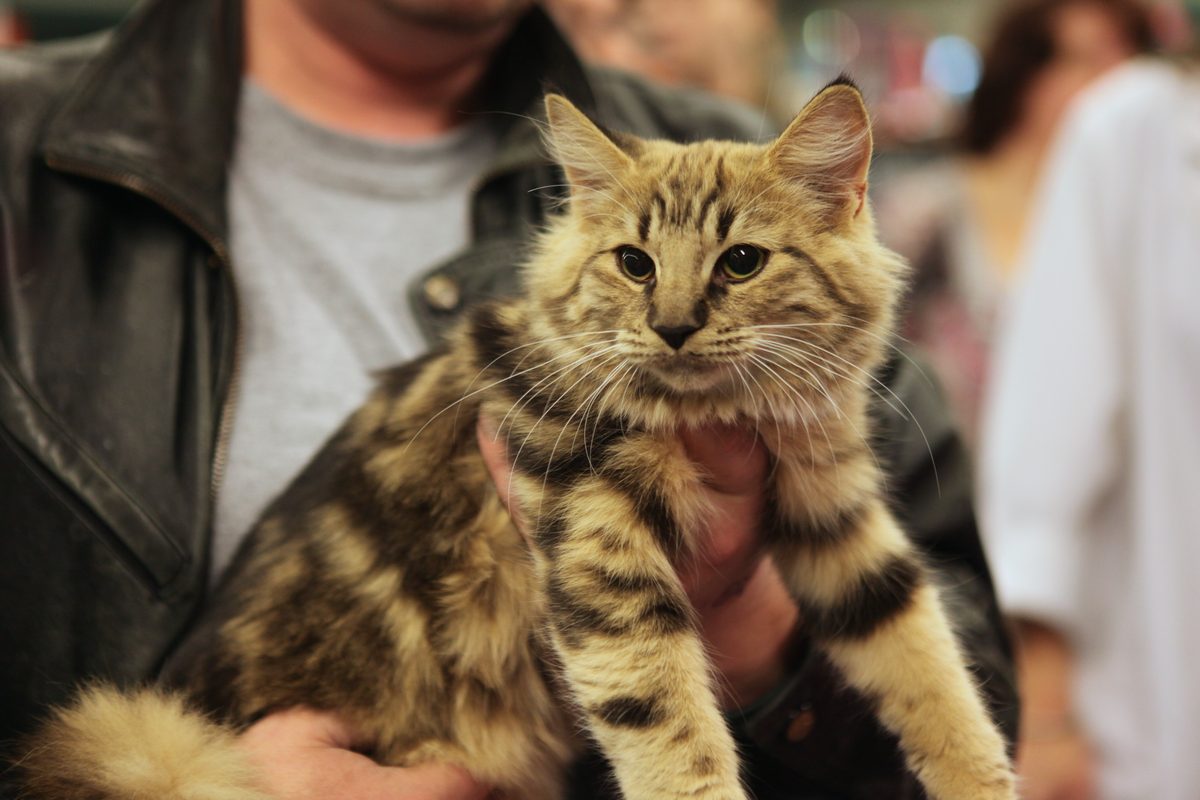

Amber is the rarest cat color in the largest DNA sample I could find: 0.03% of gene copies among 11,036 mostly pedigreed cats tested in 2022.1 It is known from Norwegian Forest Cat lines. Russet, from New Zealand Burmese, and an albino variant never turned up. No census counts cats by color, so this is genetic rarity. Male calicos are rare for another reason: they need two X chromosomes.
How rare each color is in DNA tests
The 2022 study, in PLOS Genetics, used MyCatDNA and Optimal Selection tests on 10,419 pedigreed cats from 90 breeds and breed types, plus 617 non-pedigreed cats.1 Its authors called it the largest DNA-based study of domestic cats to that date. With 94.4% pedigreed, its figures describe tested pedigree cats more than cats in general.
The figures are allele frequencies: the share of gene copies carrying a variant, not the share of cats showing a color. Most rare colors are recessive, so a cat needs two copies to show one. A cat with one chocolate and one black copy looks full colored.2
Solid and dilute coats are common by this measure. The non-agouti allele behind solid coats was the only trait variant more common than its original form, at 56.2% of gene copies.1 The dilute allele, which turns black into gray (called blue) and orange into cream, reached 41.6%.321 At the other end, russet was absent in 10,953 cats tested for it, and the albino variant first described in Oriental breeds was absent in 11,022.1
| Color or pattern | Gene | Why it is uncommon | Where it shows up |
|---|---|---|---|
| Albino | TYR | Recessive; absent from the 2022 sample1 | An Oriental and Colourpoint Shorthair pedigree4 |
| Russet | MC1R | Recessive; absent in 442 cats from 26 breeds and random-bred cats5 | Burmese from a New Zealand line5 |
| Amber | MC1R | Recessive; 0.03% of gene copies1 | Norwegian Forest Cat lines6; one random-bred Finnish cat1 |
| Salmiak | Deletion near KIT | Recessive; noticed in 2007, named in 202478 | Non-pedigreed cats only, in Finland7 |
| Sunshine (golden) | CORIN | Recessive; absent in 106 cats from 13 other breeds9 | Siberian; a few Kurilian Bobtails and ToyBobs9 |
| Charcoal | ASIP (leopard cat version) | Leopard cat ancestry; 1.9% of gene copies101 | Bengal10 |
| Cinnamon and fawn | TYRP1, plus MLPH for fawn | Recessive; fawn also needs two dilute copies2 | Abyssinian11 |
| Chocolate and lilac | TYRP1, plus MLPH for lilac | Recessive; ruled out by some breed standards21211 | Havana Brown13; lilac in British Shorthairs and Ragdolls2 |
Chocolate, cinnamon, lilac and fawn
Brown colors come from one gene, TYRP1, whose variants were identified in 2005. Its forms, from most to least dominant, are black (B), chocolate (b) and cinnamon (bl).20 Chocolate cats have two chocolate copies or one chocolate and one cinnamon. Cinnamon cats need two cinnamon copies, so black and chocolate cats can carry cinnamon unseen.2 In the 2022 sample, chocolate was 13.2% of gene copies, with 638 cats carrying two, and cinnamon was 4.0%.1
Dilution is a separate recessive gene, MLPH. A 2006 study found two copies of the same one-letter deletion in 97 unrelated dilute cats from 26 breeds and random-bred cats. The cats it checked shared one pattern of nearby DNA markers. That suggests the variant arose once.3 Dilute turns chocolate into lilac and cinnamon into fawn, so fawn needs two recessive copies at both genes.2
Breed standards split on these colors. At CFA, the Norwegian Forest Cat standard disqualifies chocolate, sable, lavender, lilac, cinnamon and fawn as evidence of hybridization, along with pointed markings.12 The Havana Brown is a solid chocolate breed with a mahogany coat and brown whiskers, rare enough that a breeder may be hard to find at a nearby show.13 The Abyssinian standard accepts four colors, cinnamon and fawn among them, and disqualifies any black hair on a cinnamon cat.11
Colors found in one breed or one place
Amber, once called X-Colour, is a yellow recessive color in Norwegian Forest Cats. A 2009 study linked it to the MC1R gene and found the variant only in amber lineages.6 The coat is a dark honey-chestnut.12 In 2022, five of 10,987 cats tested carried the variant. The only one with two copies, photographed with an amber coat, was a random-bred cat from Finland.1
Russet is a reddish Burmese color that changes with age. A 2017 study tied it to a three-letter deletion in MC1R, the amber gene. Every russet cat had two copies, and the variant followed the color through a New Zealand foundation lineage. None of 26 US Burmese tested had it.5 The paper's title is "Not another type of potato."
Sunshine is a golden tabby color in Siberians: a warm tone, a pink nose without the usual dark outline and a large cream area around the nose. A 2021 study linked it to a recessive CORIN variant and found it in three Kurilian Bobtails and two ToyBobs.9
Charcoal Bengals carry wild ancestry. In a 2014 study, 56 of 64 charcoal cats had one copy of the Asian leopard cat's ASIP gene and one domestic non-agouti copy. The authors suggest this pairing darkens the coat short of full black.10
Salmiak, the most recently described color here, was first seen in central Finland in 2007: a black-and-white coat whose colored hairs have white tips. It is still rare there.7 A 2024 study named it after salty licorice and linked it to a deletion of about 95,000 DNA letters downstream of KIT, with two copies in every salmiak cat tested.8
Quick quiz: how well do you know cat biology?
Not counting the sacrum or tail, a cat's spine is grouped into three regions. Which three?
Answer: Cervical, thoracic, and lumbar. Excluding the fused sacrum and the tail, a cat's spine is organized into cervical (neck), thoracic (chest), and lumbar (lower back) regions. Researchers call this the 'presacral' spine, and cats have 27 vertebrae spread across these three regions. Source
Onions, garlic, chives, and leeks all belong to which plant family that is toxic to cats?
Answer: Allium. Onion, garlic, chives, and leeks are all Allium species, and their sulfur compounds can damage a cat's red blood cells. Source
Persian cats bred for extremely flat faces often develop dental problems because their shortened jaws compress the teeth. What is the most common result of this compression?
Answer: Crowded and misaligned teeth. The selective breeding for very short, flat skulls in Persians results in overcrowding and misalignment of teeth because there is insufficient space in the compressed jaw. Source
Male calicos and tortoiseshells
Orange and black patches on one cat need two X chromosomes, so calicos and tortoiseshells are generally female. A male can have the pattern with an extra X chromosome (XXY) or as a chimera, formed when two embryos fuse early in pregnancy.14
Tortoiseshells made up 0.43% of males, about 1 in 230, in a 1999 UK survey of 9,816 cats brought to vets for vaccination or neutering: 20 of 4,598 males.15 Of the 11 males whose chromosomes were checked, six had a mix of XX and XY cells, two were XXY, two were XX and one was XY.15
Odd eyes and white cats
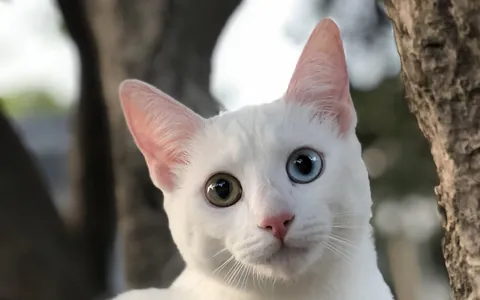
An odd-eyed cat has one blue eye; the Turkish Angora standard pairs it with green, green-gold or amber.17 In white cats, one or two blue eyes are tied to the white gene. A 2014 study found Dominant White, a form of KIT, always removes coat color but only sometimes affects eyes and hearing. Among 270 registered cats, those with two Dominant White copies had about 77 times the odds of blue eyes compared with other cats.16
CFA says odd eyes "often occur and are especially prized" in Turkish Angoras and lists amber, blue and odd-eyed for every Turkish Van coat color.1718 The Khao Manee is shown only in white. Its standard calls odd eyes the breed's rarest and most prized eye color and allows different colors between the eyes or within one eye.19
Blue eyes in white cats track with deafness. In a 1973 study of mixed-breed white cats, 17% with no blue eyes were deaf in one or both ears, against 40% with one and 85% with two.21 The Khao Manee standard notes that odd-eyed cats may be deaf in one ear.19
Frequently asked questions
Can a DNA test show whether my cat carries a rare color?
For colors with a known variant, yes. Langford Vets' chocolate test reports two copies, one or none.2 The commercial panel behind the 2022 study tested cinnamon, amber, russet and other color variants.1 The 2005 study that found the brown variants said they could identify carriers.20
Why does an amber kitten look brown?
Amber develops with age. In the CFA standard, amber kittens start warm brown, light amber kittens look blue at first, and ghost tabby markings may darken.12
Are male calico cats fertile?
XXY males are often infertile because their chromosomes do not pair properly when sperm forms. A chimera male can be fertile and pass on orange or black, depending on which cells formed the testes.14
Up next
 Cat FactsBlack Cat Facts, Trivia Questions and AnswersHow the ASIP gene turns a coat solid black.
 Cat BreedsKhao ManeeThe all-white breed known for its eyes, odd eyes included.
 Cat FactsTabby Cat Breed: The Pattern and the Breeds That Wear ItThe four tabby patterns, the genes behind them and 14 breeds that carry them.
Breed photos: mostly Wikimedia Commons contributors under free licenses, cropped. Every photographer and license is on the photo credits page.
Christopher writes and runs Cat Trivia Games. The sources for this article are listed below, and how the site is made and corrected is on the editorial policy page. More about the author.
References
- Anderson H, Davison S, Lytle KM, et al. PLOS Genetics, 2022. Genetic epidemiology of blood type, disease and trait variants, and genome-wide genetic diversity in over 11,000 domestic cats. back
- Langford Vets, University of Bristol. Chocolate coat colour: test information, with the genetics of chocolate, cinnamon and dilute colours (PDF). back
- Ishida Y, David VA, Eizirik E, et al. Genomics, 2006. A homozygous single-base deletion in MLPH causes the dilute coat color phenotype in the domestic cat. back
- Imes DL, Geary LA, Grahn RA, Lyons LA. Animal Genetics, 2006. Albinism in the domestic cat (Felis catus) is associated with a tyrosinase (TYR) mutation. back
- Gustafson NA, Gandolfi B, Lyons LA. Animal Genetics, 2017. Not another type of potato: MC1R and the russet coloration of Burmese cats. back
- Peterschmitt M, Grain F, Arnaud B, Deléage G, Lambert V. Animal Genetics, 2009. Mutation in the melanocortin 1 receptor is associated with amber colour in the Norwegian Forest Cat. back
- Heidi Anderson, Wisdom Panel. Cat coat pattern "salty licorice" (salmiak). back
- Anderson H, Salonen M, Toivola S, et al. Animal Genetics, 2024. A new Finnish flavor of feline coat coloration, "salmiak," is associated with a 95-kb deletion downstream of the KIT gene. back
- Beauvois H, Dufaure de Citres C, Gache V, Abitbol M. Animal Genetics, 2021. Siberian cats help in solving part of the mystery surrounding golden cats. back
- Gershony LC, Penedo MCT, Davis BW, Murphy WJ, Helps CR, Lyons LA. Animal Genetics, 2014. Who's behind that mask and cape? The Asian leopard cat's Agouti (ASIP) allele likely affects coat colour phenotype in the Bengal cat breed. back
- The Cat Fanciers' Association (CFA). Abyssinian breed profile and show standard. back
- The Cat Fanciers' Association (CFA). Norwegian Forest Cat breed profile and show standard. back
- The Cat Fanciers' Association (CFA). Havana Brown breed profile. back
- Brown Lab, University of British Columbia. Are calico cats always female? back
- Leaman T, Rowland R, Long SE. Veterinary Record, 1999. Male tortoiseshell cats in the United Kingdom. back
- David VA, Menotti-Raymond M, Wallace AC, et al. G3: Genes, Genomes, Genetics, 2014. Endogenous retrovirus insertion in the KIT oncogene determines White and White spotting in domestic cats. back
- The Cat Fanciers' Association (CFA). Turkish Angora breed profile and show standard. back
- The Cat Fanciers' Association (CFA). Turkish Van breed profile. back
- The Cat Fanciers' Association (CFA). Khao Manee breed profile and show standard. back
- Lyons LA, Foe IT, Rah HC, Grahn RA. Mammalian Genome, 2005. Chocolate coated cats: TYRP1 mutations for brown color in domestic cats. back
- George M. Strain, Louisiana State University School of Veterinary Medicine (from Veterinary Clinics of North America: Small Animal Practice, 1999). Congenital deafness and its recognition. back
Written by Christopher Fox under our editorial policy.