 Cat Trivia Games
iOS App
Grey Tabby Cat: A Breed or a Color? 18,646 Shelter Cats Counted
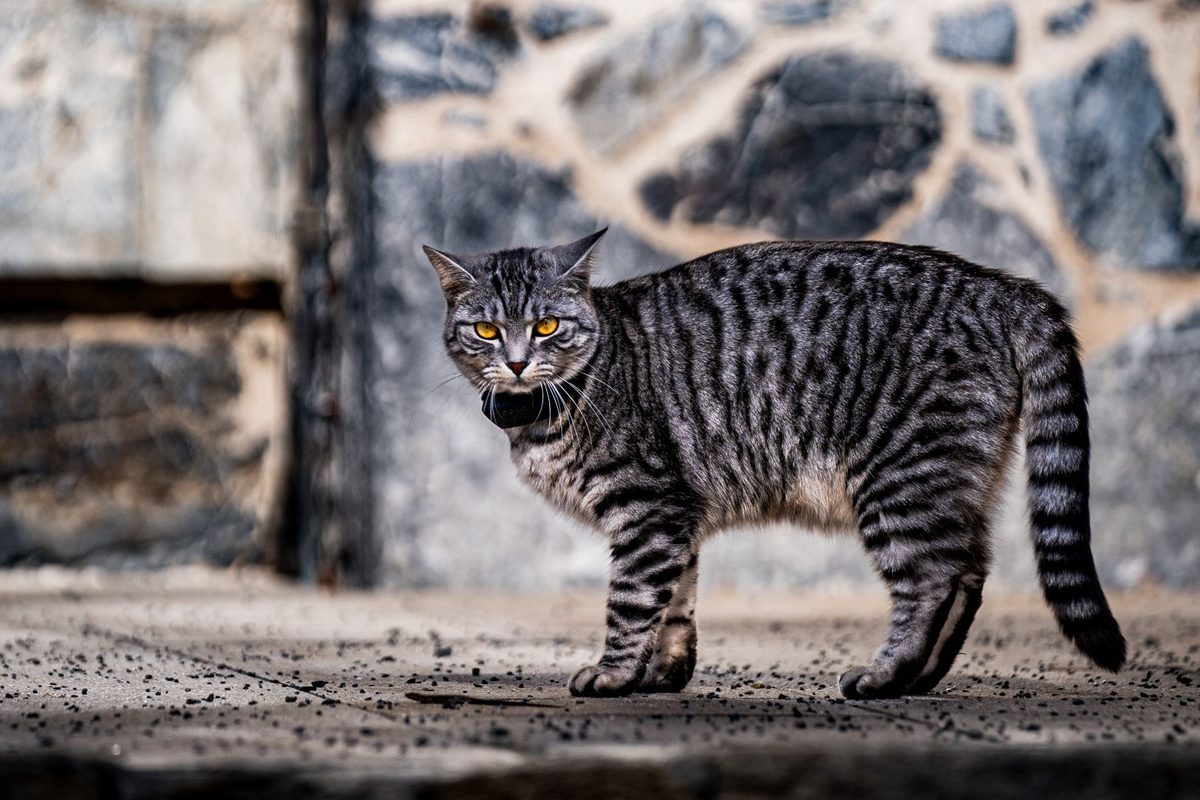
A grey tabby cat, or gray tabby cat in American spelling, is a coat and not a breed: the tabby pattern in grey, on any kind of cat. Registries split it in two. A silver tabby has dense black stripes on pale silver. A blue tabby has very deep blue stripes on pale bluish ivory,1 and blue here means grey.2 In shelter records I counted 18,646 grey tabbies among 223,665 cats with a recorded color, about 1 in 12.
Jump to: Breed or color, Silver or blue, Black stripes, Shelter count, Adoption, Breeds, Method, Use this data
Is a grey tabby cat a breed?
No. Tabby is a pattern and grey is a color, and the two together turn up on pedigreed cats and on cats with no pedigree at all. The color guide of TICA, The International Cat Association, applies to all breeds and groups cats by coat. Its tabby division is for cats that "exhibit the agouti trait, thereby permitting expression of tabby patterning."3 The pattern can be stripes, swirls, spots or ticked hairs. TICA recognizes silver tabbies "in all patterns (classic, mackerel, spotted, ticked, marbled and shaded/chinchilla)."3 My tabby cat breed page goes through each pattern and the genes that draw it.
The grey comes from a gene that lightens black. In cats with two copies of a recessive variant of the melanophilin gene, MLPH, black pigment looks grey and orange looks cream. A 2006 study found the same one-letter deletion in 97 unrelated dilute cats from 26 breeds and random-bred cats, which suggests that one mutation gave rise to it.4 Registries call this color blue: with dilution, "black becomes blue."3 So a blue tabby on a show entry form is a grey tabby in everyday words.
Silver tabby cat or blue tabby: how they differ
A silver tabby cat gets its grey from a different gene. The silver gene, also known as inhibitor, removes the yellow and red pigment, pheomelanin, from the hair, and the result is silver. One copy is enough, because the variant is dominant.2 The black of the stripes stays, so a silver tabby is black on silver.1 The gene itself is still unknown. A 2009 study mapped silver to a spot on cat chromosome D2, apart from any gene known to be linked to silver in other mammals,5 and the University of Missouri lab that tests for it says the disrupted gene "is not yet determined."2
| Coat | Stripes | Background | Genes |
|---|---|---|---|
| Brown tabby | Dense black | Brilliant coppery brown | Black, no dilution, no silver |
| Blue tabby | Very deep blue | Pale bluish ivory, with warm fawn overtones | Black diluted to blue |
| Silver tabby | Dense black | Pale, clear silver, with a white undercoat | Black, plus silver |
| Blue silver tabby, also called pewter | Sound blue | Pale, clear bluish silver, with a white undercoat | Diluted, plus silver |
The descriptions are from the Cat Fanciers' Association (CFA) standard.1 The genes column follows TICA's color guide, where dilution turns black into blue,3 and the Missouri lab's account of silver.2
To tell them apart, part the fur. Silver cats share "a translucent silvery white color of the coat at its base." In kittens and young cats TICA says the white shows first behind the ears and between the toes, then on the belly and lower sides, and it can take time to be sure a kitten is silver.3 A blue tabby sits in TICA's tabby division, which has no white at the base of the coat,3 and the CFA standard asks for a warm fawn patina over the whole.1 Britain's Governing Council of the Cat Fancy (GCCF) describes the same split in its British Longhair standard: a blue tabby has a "bluish fawn" ground and a black silver tabby a "silver" one.6
What type of cat is grey with black stripes?
In registry terms, a grey cat with black stripes is a silver tabby. The CFA standard gives the silver tabby "dense black" markings on a "pale, clear silver" ground and says the silver tabby "genetically is a shaded cat expressing the agouti pattern."1 TICA calls the color black silver tabby: "Dense black pattern markings on a clear silver white ground."3 The GCCF uses the same name.6 If the stripes are dark grey and not black, the cat is more likely a blue tabby or a blue silver tabby.
The coat does not point to a breed. A grey cat with black stripes and no pedigree is a domestic shorthair or longhair in that color. Shelters rarely use the word silver for these cats: most grey tabbies in the count below were simply written down as gray or grey tabbies.
How common are grey tabby cats? 18,646 shelter cats
Nine public datasets from eight shelters name grey tabbies in their color records: Austin, Texas, in two record systems,78 Edmonton, Alberta,9 Long Beach, California,10 Louisville, Kentucky,11 Montgomery County, Maryland,12 Norfolk, Virginia,13 Sacramento, California,14 and Sonoma County, California.15 The records were read on November 19, 2026, and I counted the grey tabbies in them for this page.
Of 223,665 cats with a recorded color, 18,646 were grey tabbies: 8.34%, or about 1 in 12. Brown and black tabbies, counted the same way, came to 47,364, or 21.18%, about two and a half times as many. Another 22,960 cats were recorded as grey, or grey and white, with no pattern named, and some of those may be tabbies too.
| Shelter | Share of cats | Grey tabbies | Male share |
|---|---|---|---|
| Montgomery County | 11.87% | 2,193 | 50.4% |
| Louisville | 9.67% | 2,033 | 52.3% |
| Long Beach | 9.00% | 2,409 | 52.2% |
| Sacramento | 8.32% | 1,205 | 52.2% |
| Edmonton | 8.08% | 2,732 | 54.6% |
| Sonoma County | 7.73% | 906 | 51.1% |
| Austin, 2013 to 2025 | 7.54% | 4,995 | 52.2% |
| Austin, 2025 to 2026 | 7.44% | 849 | 51.1% |
| Norfolk | 6.70% | 1,324 | 48.7% |
| All nine datasets | 8.34% | 18,646 | 52.0% |
The word on the record depends on the shelter. Across the nine datasets, 13,698 grey tabbies were called gray or grey, 4,305 blue and 646 silver. Almost all the blue ones come from Austin's older records, where 4,032 of 4,995 grey tabbies were entered as blue tabby. Shelter staff judge color by eye, so I counted all three words as grey tabby and did not try to split silver from blue.
In the seven datasets that record a second color, 5,374 grey tabbies, or 33.3%, had white recorded as well.
Grey tabbies were close to half male: 8,967 males and 8,274 females, or 52.0% male (95% range 51.3% to 52.8%). Cats of other colors, leaving out orange, calico, tortoiseshell and torbie cats, were 53.7% male in the same records. So grey tabbies show none of the lopsided split of orange cats. Another 1,405 grey tabbies had no usable sex on record.
Are grey tabby cats adopted faster?
A little. Eight of the datasets also record how each stay ended. With the same rules as my black cat adoption count, I kept stays that ended in adoption, transfer to another group, euthanasia or death. Of 13,227 grey tabby stays, 55.2% ended in adoption, against 53.1% for other cats. Adopted grey tabbies left after a median of 25 days, against 27.
| Shelter | Grey tabby adopted | Others adopted | Days, grey tabby | Days, others | Grey tabby stays |
|---|---|---|---|---|---|
| Austin, 2025 to 2026 | 63.8% | 57.2% | 17 | 20 | 450 |
| Montgomery County | 77.4% | 73.1% | 15 | 16 | 1,710 |
| Long Beach | 32.5% | 28.8% | 33 | 35 | 2,126 |
| Louisville | 65.5% | 62.5% | 31 | 35 | 983 |
| Sacramento | 59.2% | 57.0% | 50 | 49 | 973 |
| Austin, 2013 to 2025 | 54.6% | 54.0% | 22 | 25 | 4,931 |
| Sonoma County | 47.6% | 47.3% | 28 | 27 | 739 |
| Norfolk | 56.5% | 60.5% | 32 | 33 | 1,315 |
| All eight datasets | 55.2% | 53.1% | 25 | 27 | 13,227 |
Grey tabbies were adopted a little more often in seven of the eight datasets. Norfolk went the other way, 56.5% against 60.5%. Compared with cats of the same age at the same shelter, grey tabbies had about 4.5% higher odds of adoption (odds ratio 1.045, 95% range 1.004 to 1.087), and adopted grey tabbies stayed about 7% less time (95% range 4% to 9% less). Both differences are small, and the records cannot say why.
By age, 57.7% of grey tabby kitten stays ended in adoption, against 56.1% for other kittens, with medians of 25 and 29 days. For adults it was 52.5% against 50.0%, and 18 days against 20. Only 235 stays were grey tabby seniors, too few to compare.
Breeds that come in silver tabby
Silver tabby is a show color in many breeds. I opened the current CFA standard for each breed below in November 2026. Standards get revised, so check the linked standard if the detail matters to you.
| Breed | Name in the standard | Patterns |
|---|---|---|
| American Shorthair1 | Silver tabby | Classic, mackerel, ticked |
| British Shorthair16 | Silver tabby | Classic, mackerel, spotted |
| Maine Coon17 | Silver tabby | Classic, mackerel, ticked |
| Persian18 | Silver tabby | Classic, mackerel |
| Exotic19 | Silver tabby | Classic, mackerel, spotted |
| Norwegian Forest Cat20 | Silver tabby | Classic, mackerel, spotted, ticked |
| Siberian21 | Silver tabby | Classic, mackerel, spotted, ticked |
| Oriental22 | Ebony silver tabby | Classic, mackerel, spotted, ticked |
| Egyptian Mau23 | Silver, with charcoal markings | Spotted |
| Ocicat24 | Ebony silver | Spotted |
| British Longhair (GCCF)6 | Black silver tabby | Classic, mackerel, spotted, ticked |
The American Shorthair, British Shorthair, Maine Coon, Persian, Exotic, Norwegian Forest Cat, Siberian and Oriental standards also list a blue tabby and a blue silver tabby. Grey tabbies have a long show history. At the first cat show in the United Kingdom, at the Crystal Palace in London on July 13, 1871, Best in Show went to a 14-year-old female blue tabby shorthair owned by Harrison Weir, according to the GCCF.25
How I counted
- Records. Nine public datasets from eight shelters, read on November 19, 2026: Austin Animal Center, Texas, in its old system (intakes from October 2013 to May 2025) and its new one (to November 2026);78 Edmonton, Alberta (2012 to 2022);9 Long Beach, California (2014 to 2026);10 Louisville, Kentucky (2022 to 2026);11 Montgomery County, Maryland (2017 to 2026);12 Norfolk, Virginia (December 2014 to April 2026);13 the City of Sacramento, California (2023 to July 2026);14 and Sonoma County, California (2013 to 2026).15 They come from the same combined file as my counts of orange cats, male calicos and black cat adoption.
- What counts as a grey tabby. A record counts when one of its colors is gray, grey, blue, silver or SLVR followed by tabby, tab or tiger, and any other color on it is white, black, plain grey or another grey tabby. I took tiger to mean a striped tabby. Austin's new system and Edmonton sometimes split color and pattern, as in Blue/Tabby or Grey / Tabby, and those count too. Every value I counted, shelter by shelter, is listed in the download.
- Set aside. 297 records that pair a grey tabby with another color such as orange, cream, tortoiseshell, calico, torbie, brown or tan, which are patched tabbies or unclear mixes, and 105 Montgomery County records of BL TABBY, which could mean blue or black. Both groups still count among the cats with a recorded color.
- One count per cat. Each animal ID counts once, with the color from its first stay, for the shares and the sex split. Edmonton's file has no animal IDs, so a cat that came in twice counts twice there. Sex is as the shelter recorded it, with neutered counted as male and spayed as female.
- Adoption. One row per stay, for stays that began as a stray, an owner surrender, a returned adoption or a transfer in, and ended in adoption, transfer to another group, euthanasia or death. Days run from arrival to adoption, for adopted cats only. The same-age comparison sets grey tabbies against other cats inside each shelter and age group (kittens under 1, adults 1 to 9, seniors 10 and up; Louisville only separates kittens from older cats, and Sacramento has no ages): a Mantel-Haenszel odds ratio for adoption, and a ratio of typical stay lengths for days.
- Left out. Bloomington, Indiana, records grey cats as Grey, Grey and White or Black and grey, with no pattern. Midland, Texas, joins color and a separate pattern field that do not always fit, so a record such as Black/Grey Tabby could be either coat. Corona, California, lists adoptions only. Dallas, Riverside County, Broward County and Los Angeles County publish no coat color.
- Limits. Staff judge color by eye, and the split between silver, blue and plain grey tabby on these records is not reliable. Norfolk and Sacramento record only a cat's main color. Shelter cats are not a sample of all cats, so these shares describe these records.
- Credit. Long Beach data: City of Long Beach Animal Care Services, Animal Shelter Data, licensed under CC BY 4.0,26 changed here by combining and counting the records. Edmonton data: City of Edmonton, under its Open Data Terms of Use. Louisville data: Louisville Metro, under its open data terms. Other data: City of Austin, Texas; Montgomery County, MD; City of Norfolk; City of Sacramento; County of Sonoma. None of these shelters, cities or counties reviewed or endorsed this page.
Use this data. Reporters, bloggers and teachers may quote these numbers and chart them, with a link to this page. That is the only condition. The counts for every shelter, the adoption figures and the full list of color values I counted are in one file: grey-tabby-cats-2026.csv.
Think you can guess numbers like these? Play Cat Higher or Lower, a ten question game built from this site's own counts. Every data file is on the open data page.
Frequently asked questions
Is a grey tabby the same as a silver tabby?
Not in registry terms. A silver tabby has black markings on a silver ground and white at the roots of the hair, from the silver gene.3 A grey tabby without silver is a blue tabby, with very deep blue markings on a pale bluish ivory ground.1 Shelter records use grey, blue and silver loosely, as the counts above show.
What eye color does a grey tabby have?
Breed standards set eye color only for show cats. The CFA American Shorthair standard asks for green to hazel eyes in a silver tabby, with green preferred, and gold eyes in a blue tabby.1 The GCCF British Longhair standard asks for copper, orange or deep gold eyes in every color except the black silver tabby, which may have green or hazel eyes, green preferred.6
Are grey tabby cats rare?
No. In the shelter records above, about 1 in 12 cats with a recorded color was a grey tabby, and in Montgomery County it was 11.87%. Cats recorded as silver tabbies were much scarcer, 646 of the 18,646.
Test your cat knowledge
Cat Trivia has questions on cat biology, behavior, breeds and history. It is free to play, with no account.
Play Cat TriviaUp next
 Cat FactsTabby Cat Breed: The Pattern and the Breeds That Wear ItThe four tabby patterns and the genes that draw them.
 Cat FactsOrange Cat Facts: Why Most Orange Cats Are MaleThe tabby color that does lean to one sex, counted in the same records.
 Cat FactsAre Black Cats Adopted Less? Adoption Rates at 7 SheltersThe adoption count this page's method comes from.
Christopher writes and runs Cat Trivia Games. The datasets and standards behind this page are listed below, and how the site is made and corrected is on the editorial policy page. More about the author.
References
- The Cat Fanciers' Association. American Shorthair show standard, revised 2024 (silver, blue and brown tabby colors and eye colors). back
- University of Missouri College of Veterinary Medicine, Feline Genetics and Comparative Medicine Laboratory. Silver (Inhibitor) genetic testing in domestic cat breeds, with frequently asked questions. back
- The International Cat Association (TICA). Uniform Color Descriptions and Glossary of Terms, version D (tabby division, silver and smoke division, pigment genotypes). back
- Ishida and colleagues, Genomics, 2006 (PubMed). A homozygous single-base deletion in MLPH causes the dilute coat color phenotype in the domestic cat. back
- Menotti-Raymond and colleagues, Journal of Heredity, 2009 (PubMed). Mapping of the domestic cat "SILVER" coat color locus identifies a unique genomic location for silver in mammals. back
- The Governing Council of the Cat Fancy (GCCF). British Longhair standard of points (tabby colors and eye color). back
- City of Austin, Texas, data.austintexas.gov, public domain, read November 19, 2026. Austin Animal Center Intakes (10/01/2013 to 05/05/2025) and Austin Animal Center Outcomes (10/01/2013 to 05/05/2025). back
- City of Austin, Texas, data.austintexas.gov, no license stated on these datasets, read November 19, 2026. Austin Animal Center Intakes and Austin Animal Center Outcomes (new system). back
- City of Edmonton, data.edmonton.ca, under the City of Edmonton Open Data Terms of Use, read November 19, 2026. Animals Admitted to the Animal Care & Control Centre. back
- City of Long Beach Animal Care Services, data.longbeach.gov, CC BY 4.0, read November 19, 2026. Animal Shelter Data. back
- Louisville Metro Animal Services, Louisville Metro open data (LOJIC), under the Open Data Platform Terms and Use, read November 19, 2026. Louisville Metro KY - Animal Service Intake and Outcome. back
- Montgomery County, MD, dataMontgomery, public domain, read November 19, 2026. OAS - Animal Shelter Pathway. back
- City of Norfolk, data.norfolk.gov, no license stated on the dataset, read November 19, 2026. Norfolk Animal Care and Adoption Center (NACC). back
- City of Sacramento, ArcGIS Hub, no license stated, read November 19, 2026. Animal Intakes and Outcomes for the Last 3 Years. back
- County of Sonoma Department of Health Services, data.sonomacounty.ca.gov, no license stated on the dataset, read November 19, 2026. Animal Shelter Intake and Outcome. back
- The Cat Fanciers' Association. British Shorthair show standard, revised 2026 (silver tabby colors). back
- The Cat Fanciers' Association. Maine Coon Cat show standard, revised 2025 (silver tabby colors). back
- The Cat Fanciers' Association. Persian show standard, revised 2025 (silver tabby colors). back
- The Cat Fanciers' Association. Exotic show standard, revised 2026 (silver tabby colors). back
- The Cat Fanciers' Association. Norwegian Forest Cat show standard, revised 2026 (tabby patterns and silver tabby colors). back
- The Cat Fanciers' Association. Siberian show standard, revised 2024 (silver tabby colors). back
- The Cat Fanciers' Association. Oriental show standard, revised 2026 (tabby patterns and silver tabby colors). back
- The Cat Fanciers' Association. Egyptian Mau show standard, revised 2009 (pattern and colors). back
- The Cat Fanciers' Association. Ocicat show standard, revised 2011 (colors). back
- The Governing Council of the Cat Fancy (GCCF). British: breed history and colors. back
- Creative Commons. Attribution 4.0 International (CC BY 4.0). back
Written by Christopher Fox under our editorial policy.