 Cat Trivia Games
iOS App
Cat That Looks Like a Leopard: Spotted Cat Breeds Compared
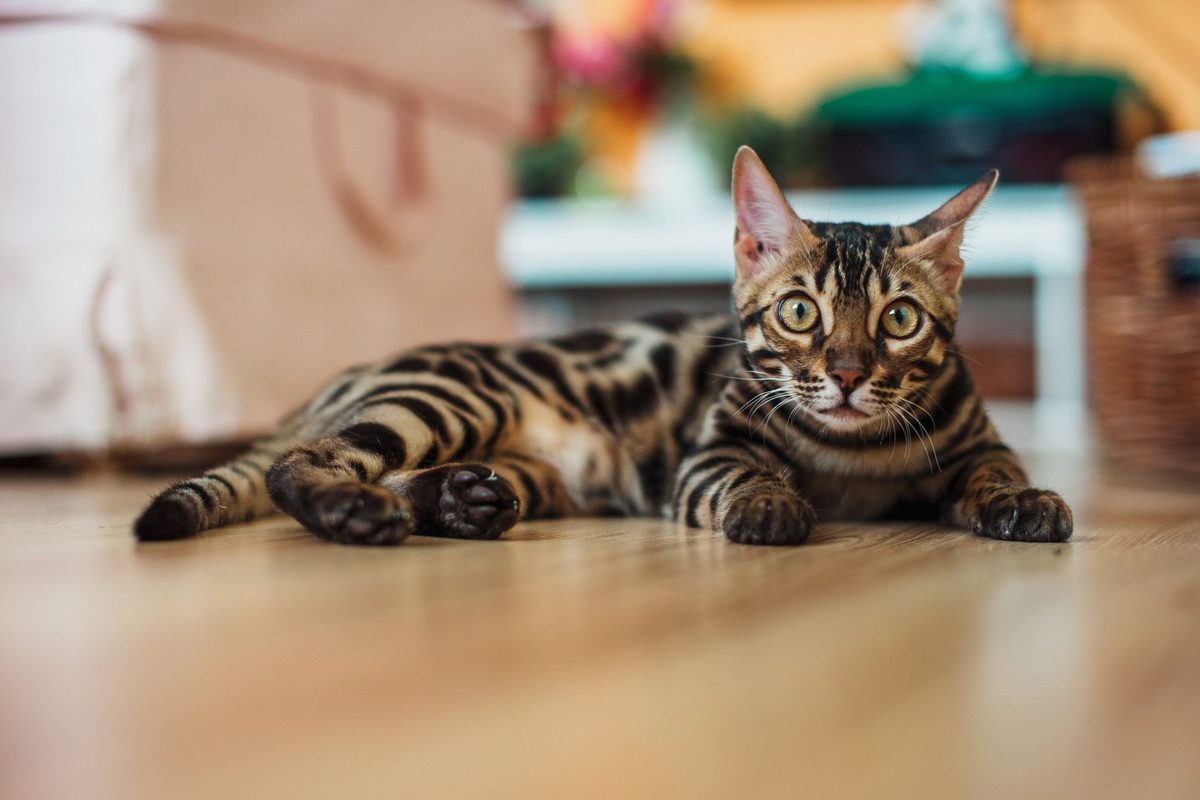
The Bengal is the closest thing to a cat that looks like a leopard. The Cat Fanciers' Association (CFA) says it is the one spotted breed with rosettes,1 the flower-shaped spots a leopard wears on its back.2 The other spotted cat breeds are the Egyptian Mau and the Ocicat, which are fully domestic, and the Savannah, which comes from crosses with the serval, a wild cat from Africa.3
Spotted cat breeds compared
Spotted cat breeds are the ones whose registry standards call for spots. The table gives the spots as each registry or breed body describes them. Two of the five, the Bengal and the Savannah, come from crosses with wild cats.
| Breed | What the spots look like | Wild cat ancestor |
|---|---|---|
| Bengal | Two-toned rosettes with dark outlines and lighter centers, or plain spots; the belly must be spotted (CFA)1 | Yes: the Asian leopard cat, many generations back1 |
| Egyptian Mau | Random spots of any size or shape; a Mau with no spots is disqualified (CFA)4 | None; CFA calls it a natural breed4 |
| Ocicat | Large, thumbprint-shaped spots, with a bull's-eye of spots on each side (CFA)5 | None; GCCF says it "contains no wild DNA"6 |
| Savannah | Black, bold, distinct spots over the whole body, on gold or silver (Savannah Cat Association)3 | Yes: the serval3 |
| Serengeti | Distinct, widely spaced black spots on yellow to gold, or on grey or silver (TICA)7 | No serval: bred from Bengals and Oriental Shorthairs7 |
Bengal: the breed with rosettes
CFA's standard asks for rosettes that are "two toned, with dark outlines, and a lighter center." They come in many shapes, from round and open donuts to pancakes, paw prints and arrowheads, and judges prefer them to single spots. A Bengal with plain spots and no rosettes is still allowed.1 Some Bengals have "glitter," a sparkle at the hair tips that shows when the light catches it.1
The look started with a real wild cat. In 1963 Jean Mill crossed a black domestic tom with a female Asian leopard cat. She later built the breed from hybrids bred by a researcher, Dr. Willard Centerwall, along with spotted domestic cats.1 The Governing Council of the Cat Fancy (GCCF), the main UK registry, says the leopard cat is about the size of a domestic cat, lives across much of Asia and is not endangered. Burmese, Egyptian Mau, Ocicat, Abyssinian and American Shorthair cats were also used in the foundation.8
All three registries keep the early hybrids out of the show ring. TICA registers the first crosses (F1, 2G and 3G) as foundation generations that are not eligible for show.9 CFA accepted Bengals for registration in 2016, requiring five generations of pure domestic ancestry.1 The GCCF stopped registering first-generation Bengals on June 1, 2002.8
Some wild DNA is still at work. A 2014 study found a leopard cat version of the agouti gene still passed down in Bengals. Of 64 Bengals reported as having the darker "charcoal" coat, 56 carried that leopard cat version alongside a domestic one, and the authors call it the first leopard cat gene variant confirmed in the breed.10
Egyptian Mau: spots with no wild cross
The Egyptian Mau is spotted by nature. CFA's standard calls it "the only natural domesticated breed of spotted cat,"4 and the GCCF says it comes from the modern street cats of Egypt.11 The spots are scattered at random and can be round, oblong or irregular, and the underside has dark "vest button" spots. The breed allows no outcrosses to other breeds.4
CFA points to Egyptian papyri and frescoes from as far back as 1550 B.C. that show spotted cats like today's Maus. The modern breed began with Nathalie Troubetskoy, a Russian princess living in Rome, who brought three Maus with her when she moved to the United States in 1956.4 More on those paintings is in my cats in ancient Egypt article.
Ocicat: named for the ocelot, bred from house cats
The Ocicat looks wild and is entirely domestic. The first one, Tonga, was born in 1964 when a breeder tried to cross an Abyssinian with a Siamese. He came out spotted, and he reminded the breeder's daughter of an ocelot, which gave the breed its name. American Shorthairs were added later.5 The GCCF says the breed "contains no wild DNA."6
CFA describes the spots as thumbprint-shaped and large. On a show-quality cat each side has a bull's-eye, a spot circled by other spots, and the pattern comes in 12 colors, from tawny and chocolate to silver shades.5
Savannah: a serval in the family tree
The Savannah is a spotted breed with a wild cat close behind it. It comes from breeding spotted domestic cats to servals, and its breed association says the goal is a cat that looks like a serval with fully domestic habits. The first known Savannah kitten was born on April 7, 1986, to a Siamese mother, and her father was a serval.3 An F1 Savannah has a serval parent, an F2 a serval grandparent, and so on.12
Registries disagree about it. TICA accepted the Savannah in 2001 and counts the fourth generation as the first that can be classed as purebred. The GCCF does not accept the breed, on ethical grounds, and the UK's Animal Welfare Committee found that no member of the World Cat Congress other than TICA recognizes it.13
The committee, an expert body of the UK, Scottish and Welsh governments, wrote in 2024 that Savannahs, Bengals and Chausies have complex needs and are not suited to life as pets in small indoor homes, and that many later-generation hybrids keep wild traits that make them hard to keep. The serval and the domestic cat last shared an ancestor more than 8 million years ago. Servals carry their kittens for about 75 days and domestic cats for about 65, so a domestic mother can give birth to kittens that are effectively premature.13 Rules can depend on your location, the cat's ancestry and the authority applying them. Check the current requirements with the relevant local agency before acquiring or relocating a hybrid-derived cat.
Where the spots come from
A tabby's markings are dark hairs laid over a lighter background of banded hairs. The wild cats that domestic cats came from have a striped, mackerel-like pattern, and a gene called Taqpep shapes it. Broken copies of Taqpep give the swirled "blotched" tabby, and in cheetahs a change in the same gene makes the rare king cheetah, whose spots run together into blotches and stripes.14
Spots are a step past stripes. In a breeding study that started with an Egyptian Mau, researchers found that one or more "modifier" genes break mackerel stripes into spots.15 A 2021 study adds that spots like the Mau's and the Ocicat's appear only in cats with the mackerel version of the Tabby gene, and that the gene that turns stripes into spots is still not known. It also linked a gene called Dkk4 to the "servaline" coat of some Savannahs, with many small spots in place of fewer large ones.16 For the four tabby patterns and the breeds that wear them, see my tabby cat page.
Is there a leopard print cat breed?
No breed is called leopard print. A leopard's rosettes have no dot in the center, while a jaguar's do,2 and of the domestic breeds, CFA names only the Bengal as having rosettes.1 One breed was made to look like a small leopard. Paul Casey started the California Spangled after learning in 1971 that poachers had killed one of the last leopards near the Olduvai digs in Africa, hoping that people who owned a house cat that looked like a small leopard would care more about saving the wild one. PetMD says the Ocicat and Bengal have since overshadowed it.17
If stripes appeal more than spots, the Toyger was bred to look like a small tiger, and the GCCF says no new wild cat outcross was used to make it.18
Frequently asked questions
Is a Bengal cat part leopard?
No. Its wild ancestor is the Asian leopard cat, a small wild cat about the size of a house cat,8 not the leopard, which is one of the large cats.2 Leopard cats in the wild are the subject of my leopard cat camera trap story.
Why does an Egyptian Mau look worried?
CFA says its gooseberry-green eyes are framed by mascara lines and other facial markings that give it a "worried" look. It also has high shoulder blades and longer hind legs, which CFA says give it a cheetah-like gait.4
Test your cat knowledge
Could you tell an Ocicat from an Egyptian Mau? Cat Trivia has breed questions like these, free to play with no account.
Play Cat TriviaUp next
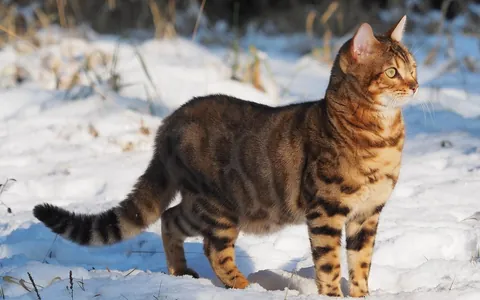 Cat BreedsBengal Cat Breed: How Much Wild Cat Is Left in a Bengal?The rosetted breed in full: temperament, care and health.
 Photo quizGuess the Cat BreedName the breed from the photo, spots and all.
Breed photos: mostly Wikimedia Commons contributors under free licenses, cropped. Every photographer and license is on the photo credits page.
Christopher writes and runs Cat Trivia Games. The sources for this article are listed below, and how the site is made and corrected is on the editorial policy page. More about the author.
References
- The Cat Fanciers' Association (CFA). Bengal (breed profile and standard). back
- San Diego Zoo Wildlife Alliance, Animals and Plants. Leopard. back
- Savannah Cat Association. Savannah cat history. back
- The Cat Fanciers' Association (CFA). Egyptian Mau (breed profile and standard). back
- The Cat Fanciers' Association (CFA). Ocicat (breed profile). back
- Governing Council of the Cat Fancy (GCCF). Ocicat and Ocicat Classic. back
- The International Cat Association (TICA): Serengeti. back
- Governing Council of the Cat Fancy (GCCF). Bengal. back
- The International Cat Association: Bengal. back
- Gershony L.C., Penedo M.C.T., Davis B.W., Murphy W.J., Helps C.R. and Lyons L.A. (2014). Who's behind that mask and cape? The Asian leopard cat's Agouti (ASIP) allele likely affects coat colour phenotype in the Bengal cat breed. Animal Genetics 45(6). back
- Governing Council of the Cat Fancy (GCCF). Egyptian Mau. back
- Savannah Cat Association. F1, F2 and F3 explained for Savannah cats. back
- Animal Welfare Committee, GOV.UK (December 19, 2024). Opinion on the welfare implications of current and emergent feline breeding practices. back
- Kaelin and colleagues, Science, 2012 (PubMed Central). Specifying and sustaining pigmentation patterns in domestic and wild cats. back
- Eizirik and colleagues, Genetics, 2010 (PubMed Central). Defining and mapping mammalian coat pattern genes: multiple genomic regions implicated in domestic cat stripes and spots. back
- Kaelin C.B., McGowan K.A. and Barsh G.S. (2021). Developmental genetics of color pattern establishment in cats. Nature Communications 12: 5127. back
- PetMD. California Spangled Cat. back
- Governing Council of the Cat Fancy (GCCF). Toyger. back
Written by Christopher Fox under our editorial policy.