 Cat Trivia Games
iOS App
Siamese Mix Cats: What the Label Tells You
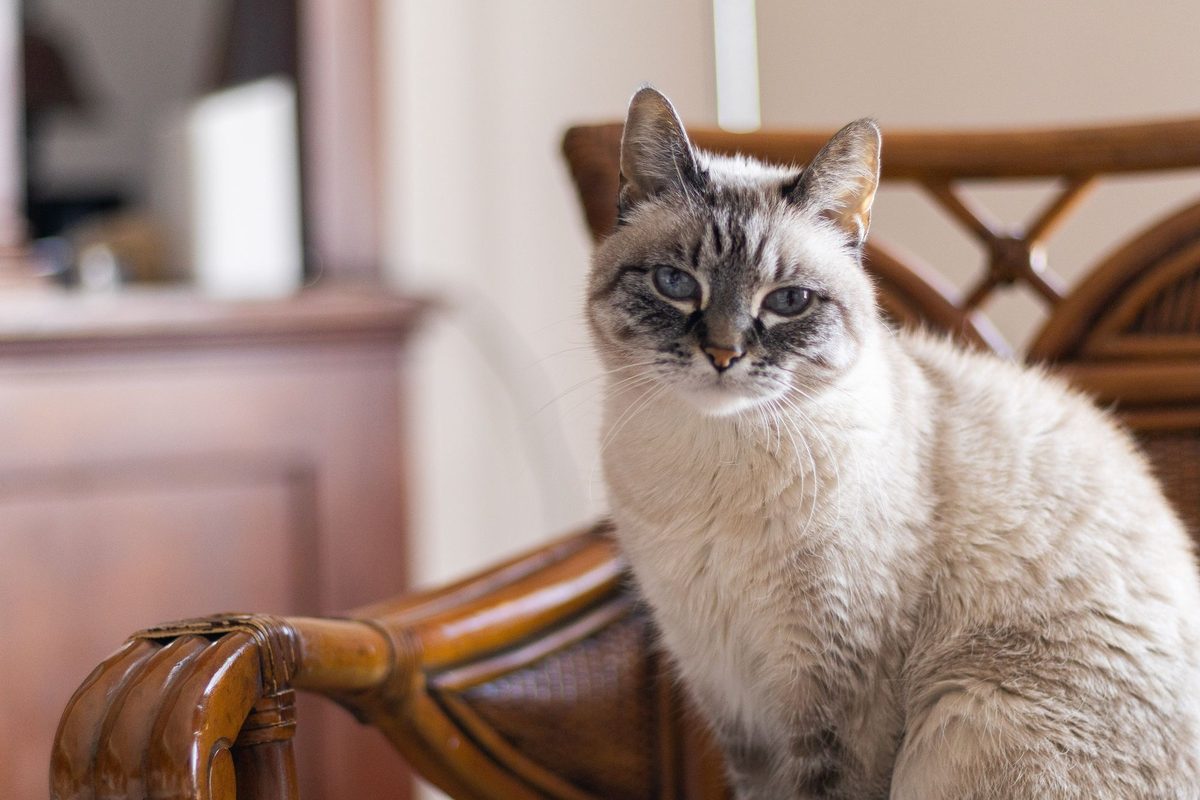
A Siamese mix is a cat with no known pedigree that looks partly Siamese, and in practice that means points: a cream or white body with color on the face, ears, feet and tail.1 Of 2,879 shelter records labeled Siamese mix, 93.1% of those with a color written down were pointed. The label is a staff guess from looks, and whether a shelter adds "mix" at all depends mostly on its own forms. A DNA test can show whether a cat carries the points gene, but not that it had a Siamese parent.
Jump to: Meaning, Shelter habits, Colors, Second name, Age and adoption, Genetics, DNA tests, Rules
What is a Siamese mix?
What is a Siamese mix? On a shelter card it is nearly always a pointed cat, and the word mix is often a hedge. The Cat Fanciers' Association (CFA) warns that a cat that looks Siamese may be another breed or a cat with no pedigree at all, because the gene behind the pattern has spread into many gene pools, the general cat population included.1 The pedigreed Siamese comes in four point colors at CFA, seal, chocolate, blue and lilac, and its standard allows no white hairs in the points.2
Moe, who lives with me, would fit the label: he came from an unplanned litter, with a Snowshoe Siamese father, a mother of unknown breed and no papers. How the pattern works, and what shelters write on every cat they call Siamese, is in my Siamese cat breed guide. This page looks only at the records that add mix.
Why one shelter writes mix and another never does
Of 8,866 shelter stays with Siamese in the breed line, 2,879 add the word mix or a second name after a slash. All of them come from six of the 14 public datasets that record a breed. The other eight, Dallas,3 Los Angeles County,4 Norfolk,5 Sacramento,6 Bloomington,7 Corona,8 Midland9 and Austin's newer record system,10 never wrote Siamese mix. They hardly write mix on anything: 2 of their 308,478 breed labels.
| Shelter | Siamese labels | With mix | Share | Other breeds with mix |
|---|---|---|---|---|
| Edmonton11 | 1,022 | 1,021 | 99.9% | 96.1% |
| Austin, 2013 to 202512 | 2,057 | 1,512 | 73.5% | 76.1% |
| Sonoma County13 | 393 | 172 | 43.8% | 32.2% |
| Louisville14 | 153 | 51 | 33.3% | 22.7% |
| Riverside County15 | 192 | 50 | 26.0% | 14.3% |
| Montgomery County16 | 311 | 73 | 23.5% | 18.7% |
| Eight other datasets | 4,738 | 0 | 0% | under 0.1% |
| All 14 datasets | 8,866 | 2,879 | 32.5% |
In Edmonton the word is a default: 99.9% of all its cat labels carry Mix or a slash, starting with its most common label, Domestic Short Hair Mix. Austin's older system worked the same way and then changed. Of its Siamese labels, 94.1% carried mix from 2013 to 2018, 57.1% in 2019 and 38.6% from 2020 to May 2025, and domestic shorthair labels dropped from 98.4% mix to 14.9% over the same years. In those two systems, Siamese mix says more about the form than about the cat.
The four shelters that use the word sparingly are the fairer test. Sonoma County, Louisville, Riverside County and Montgomery County put mix or a slash on only 1.2% to 2.2% of all their cat labels, yet on 33.0% of their Siamese labels (346 of 1,049), against 21.8% of labels naming any other breed (232 of 1,066). There, staff hedged a Siamese guess more often than a guess at other breeds.
Point colors on Siamese mix cats
In the three sparing shelters that also record color, Sonoma County, Montgomery County and Louisville, the coats behind the two labels differed. Pointed cats labeled Siamese mix were more often lynx points, with tabby stripes in their points, and far more often had white noted alongside the points. Pointed cats labeled plain Siamese more often wore one of CFA's four Siamese colors.
| Point color | Siamese mix | Siamese |
|---|---|---|
| Seal point | 28.0% | 35.6% |
| Blue point | 6.8% | 4.6% |
| Chocolate point | 2.5% | 4.0% |
| Lilac point | 5.9% | 13.1% |
| CFA's four Siamese colors together | 43.2% | 57.3% |
| Lynx (tabby) point | 40.3% | 24.6% |
| Flame (red) or cream point | 8.5% | 16.8% |
| Tortie, torbie or calico point | 8.1% | 1.3% |
| White noted with the points | 19.5% | 0.9% |
| Pointed cats counted | 236 | 452 |
Lynx points were more common under the mix label at each of the three shelters, and at Austin's older system too. Across all five shelters that record color, Austin and Edmonton included, 2,634 of 2,828 Siamese mix labels had points, and lynx point was the most common single color, on 35.4% of them.
Points with white is the look of the Snowshoe, which GCCF, a British registry, describes as blue eyes, the pointed pattern and white trim. The breed began in the 1960s with three kittens with four white feet in a litter of Siamese.17 Red points have their own page, the flame point Siamese.
Siamese and what? The second name on the label
Most Siamese mix labels simply add the word: 2,217 of them. Another 662 use a slash. In 274 of those the second half is Mix, and 2 read Siamese / Siamese. The remaining 386 name something, and 331 of them, 85.8%, name no breed at all, only a coat length:
- Domestic shorthair: 228 labels
- Domestic medium hair: 73
- Domestic longhair: 30
- Snowshoe: 26, 17 of them in Louisville
- Manx: 11
- Japanese Bobtail: 3
- Maine Coon and Bengal: 2 each
- Eleven others, once each, among them the Ragdoll and the Persian
Everything below Snowshoe is a small count. Designer pairings such as Siamese and Ragdoll barely show up in these records. When staff name the other half of a Siamese mix, it is nearly always an ordinary short-haired cat.
Older on arrival, adopted a little faster
Siamese mixes came in older than the cats around them. At the six shelters that write the label, 46.9% of 2,744 Siamese mix cats were kittens at their first visit, against 55.0% expected from all cats at the same shelters. The four shelters that give an age in years show where the difference sits.
| Age | Siamese mix | Expected |
|---|---|---|
| Under 1 year | 57.5% | 66.7% |
| 1 or 2 years | 22.2% | 19.5% |
| 3 to 9 years | 14.6% | 10.4% |
| 10 years and up | 5.6% | 3.4% |
| Cats counted | 1,674 |
Cats 10 and up were more common among Siamese mixes at all four shelters, though Riverside County's 43 cats are a small group. The records cannot say why kittens are fewer. One possibility is that points take time to appear: GCCF says Snowshoe kittens are born totally white and their points begin to develop in a few weeks.17
At the five shelters that record outcomes, 56.8% of 1,615 Siamese mix stays ended in adoption, against 54.0% expected from all cats at the same shelters, or 53.9% when matched by age group too. Adopted Siamese mixes also went home sooner, staying about 20% less time than other cats of the same age group at the same shelter (95% range 14% to 25% less), with a median of 19 days.
| Shelter (Siamese mix stays) | Siamese mix adopted | All cats adopted | Days, Siamese mix | Days, all cats |
|---|---|---|---|---|
| Austin, 2013 to 2025 (1,361) | 55.2% | 54.0% | 19 | 25 |
| Sonoma County (152) | 65.1% | 47.3% | 21 | 27 |
| Montgomery County (48) | 87.5% | 73.6% | 13.5 | 16 |
| Louisville (26, small) | 57.7% | 62.8% | 15 | 34 |
| Riverside County (28, small) | 35.7% | 47.6% | 7.5 | 33 |
How a cat with no pedigree gets points
Points need two copies of a variant in the tyrosinase gene: every pointed cat in a 2005 University of California, Davis study carried two.18 The rest of the gene story is on the Siamese breed page. For mixes, the rule has a plain consequence, which CFA's breeding notes spell out: two pointed parents cannot have a kitten without points, and a pointed kitten needs both parents to carry the gene, even if neither looks pointed.19
So a pointed shelter cat may have a Siamese parent, or no Siamese for many generations. A 2013 UC Davis paper points out that, unlike the average street dog, the average random-bred cat does not descend from pedigreed cats; the breeds more likely came from street cats. It adds that many coat traits, such as pattern and color, are single-gene traits found at low to moderate levels in cats with no pedigree.20 Points can pass quietly through cats that do not show them, until two carriers have kittens together.
What a DNA test can and cannot tell
A DNA test can tell whether a cat has the Siamese points variant, and in how many copies. The UC Davis team typed that variant in every cat of its 2013 breed study.20 For a pointed cat the answer is already known, since every pointed cat in the 2005 study had two copies.18 The result matters more for a cat without points, because one copy means it can pass points on.19
Ancestry is a harder question. In the 2013 study, DNA markers placed about 9 in 10 of 477 pedigreed cats from 29 breeds in the right breed, after a check that used coat genes. The same markers traced breeds back to regional groups of random-bred cats: the Siamese to Southern Asian cats, the Persian and Maine Coon to Western European ones.20
What a test cannot do is just as plain. That study tested pedigreed cats, not crosses, so it says nothing about how well a test reads a cat with one Siamese parent. A points result cannot prove a Siamese ancestor, because the gene also runs through cats with no pedigree.1 And a DNA result is not a pedigree. No study I found measured the temperament of Siamese mixes; the studies on my Siamese personality page looked at pedigreed cats, and a shelter label promises nothing about how a cat will behave.
How I read the Siamese labels
- Which labels. A stay counts as Siamese if its breed text contains Siamese, and as a Siamese mix if that text also contains mix or a slash. That rule gives the 2,879, including the 2 labels that read Siamese / Siamese. Two of my 16 files, from Long Beach and Broward County, leave the breed field out entirely.
- Colors. A cat counts as pointed only when its color text says point or pt. Each pointed cat is sorted by the first color that mentions a point, so seal lynx point counts as lynx, and white anywhere in the text counts as white noted. Riverside County records no color.
- Ages. Each cat counts once, at its first visit, and kitten means under 1 year. Louisville and Edmonton record only kitten or not, so they are in the kitten share but not the age table. Each expected share uses all cats at the same shelter, weighted by that shelter's Siamese mix cats.
- Adoption. As on my other shelter pages, a stay counts if it began as a stray, an owner surrender, a returned adoption or a transfer in, and ended in adoption or another final outcome at the shelter, such as a transfer to a rescue group. Each shelter is weighted by its Siamese mix stays. The days figure compares typical stay lengths inside the same shelter and age group. Edmonton publishes no outcomes, and Corona publishes adoptions only, so neither is in an adoption share.
- Limits. Whoever filled in the intake form judged the breed by eye, with no papers and no gene test behind it. I call any count below about 30 cats small. The full dataset list and the rules shared with my other counts are under how the orange count was made.
- Credit. Edmonton data: City of Edmonton, under its Open Data Terms of Use. Louisville data: Louisville Metro, under its open data terms. Other data: City of Austin, Texas; City of Bloomington; City of Corona; City of Dallas; County of Los Angeles; City of Midland; Montgomery County, MD; City of Norfolk; County of Riverside; City of Sacramento; County of Sonoma. I combined and counted their records, and none of them reviewed or endorsed this page.
Download the counts. The shelter-by-shelter label counts, the Austin years, the second names, the color shares, the ages and the adoption figures are in siamese-mix-2026.csv. Quote or chart them freely with a link back to this page.
Frequently asked questions
Is a Siamese mix a breed?
No. It describes a cat's looks, usually the pointed pattern. CFA notes that a cat that looks Siamese may be another breed or a cat with no pedigree.1
Can two cats without points have a Siamese-looking kitten?
Yes, if both parents carry the points gene. CFA says a pointed kitten needs both parents to carry it, even when neither looks pointed.19
Are Siamese mix cats more often male or female?
Neither. The 2,879 Siamese mix labels split evenly: 1,373 males, 1,379 females and 127 with no sex recorded. Red points are the exception, as the flame point Siamese count shows.
Test your cat knowledge
Tabby stripes on a pale face, a white chin, blue eyes: if you can name that coat now, try the cat trivia game, with questions on coats, genes and breeds, free to play, with no account.
Play Cat TriviaUp next
 Cat BreedsSiamese Cat Breed: Why So Many Pointed Cats Get Called SiameseThe points gene, the breed's history, and every shelter cat called Siamese.
 Cat BreedsFlame Point Siamese Cats: Why 73% Are Male in Shelter RecordsRed points, and why most of them are male.Quiz resultSiameseFive studies behind the big voice.
Breed photos: mostly Wikimedia Commons contributors under free licenses, cropped. Every photographer and license is on the photo credits page.
Christopher writes and runs Cat Trivia Games. The shelter files, registry pages and genetics papers behind this page are listed below, and how the site is made and corrected is on the editorial policy page. More about the author.
References
- Pat Jacobberger, CFA Cat Talk, June 25, 2026. Patterns in the domesticated cat, part 3: the pointed patterns. back
- The Cat Fanciers' Association (CFA). Siamese: breed profile and show standard. back
- City of Dallas, Dallas Animal Services, www.dallasopendata.com, no license stated on these datasets, read November 19, 2026. Dallas Animal Shelter Data Fiscal Year 2000 - Present and Dallas Animal Shelter Data Fiscal Year 2023 - 2026. back
- County of Los Angeles, Department of Animal Care and Control, ArcGIS Online, no license stated, read November 19, 2026. Animal Care PawStats Data. back
- City of Norfolk, data.norfolk.gov, no license stated on the dataset, read November 19, 2026. Norfolk Animal Care and Adoption Center (NACC). back
- City of Sacramento, ArcGIS Hub, no license stated, read November 19, 2026. Animal Intakes and Outcomes for the Last 3 Years. back
- City of Bloomington, Indiana, data.bloomington.in.gov, no license stated on the dataset, read November 19, 2026. Animal Shelter Animals. back
- City of Corona, Corona Animal Services, CorStat, no license stated on the dataset, read November 19, 2026. CorStat - Animal Adoptions. back
- City of Midland, Texas, ArcGIS Hub, no license stated (the city provides the data as is, with no guarantee), read November 19, 2026. Animal Intake (public view). back
- City of Austin, Texas, data.austintexas.gov, no license stated on these datasets, read November 19, 2026. Austin Animal Center Intakes and Austin Animal Center Outcomes (new system). back
- City of Edmonton, data.edmonton.ca, under the City of Edmonton Open Data Terms of Use, read November 19, 2026. Animals Admitted to the Animal Care & Control Centre. back
- City of Austin, Texas, data.austintexas.gov, public domain, read November 19, 2026. Austin Animal Center Intakes (10/01/2013 to 05/05/2025) and Austin Animal Center Outcomes (10/01/2013 to 05/05/2025). back
- County of Sonoma Department of Health Services, data.sonomacounty.ca.gov, no license stated on the dataset, read November 19, 2026. Animal Shelter Intake and Outcome. back
- Louisville Metro Animal Services, Louisville Metro open data (LOJIC), under the Open Data Platform Terms and Use, read November 19, 2026. Louisville Metro KY - Animal Service Intake and Outcome. back
- County of Riverside, Department of Animal Services, data.countyofriverside.us, no license stated on the dataset, read November 19, 2026. Animal Services, Animal Impound Report. back
- Montgomery County, MD, dataMontgomery, public domain, read November 19, 2026. OAS - Animal Shelter Pathway. back
- The Governing Council of the Cat Fancy (GCCF). Snowshoe. back
- Lyons, Imes, Rah and Grahn, Animal Genetics, volume 36, 2005 (abstract on PubMed). Tyrosinase mutations associated with Siamese and Burmese patterns in the domestic cat (Felis catus). back
- The Cat Fanciers' Association (CFA). Basic feline genetics. back
- Kurushima, Lipinski, Gandolfi, Froenicke, Grahn, Grahn and Lyons, University of California, Davis, Animal Genetics, 2013 (PubMed Central). Variation of cats under domestication: genetic assignment of domestic cats to breeds and worldwide random-bred populations. back
Written by Christopher Fox under our editorial policy.