 Cat Trivia Games
iOS App
Tortoiseshell Cat: Tortitude Studies and 19,116 Torties Counted
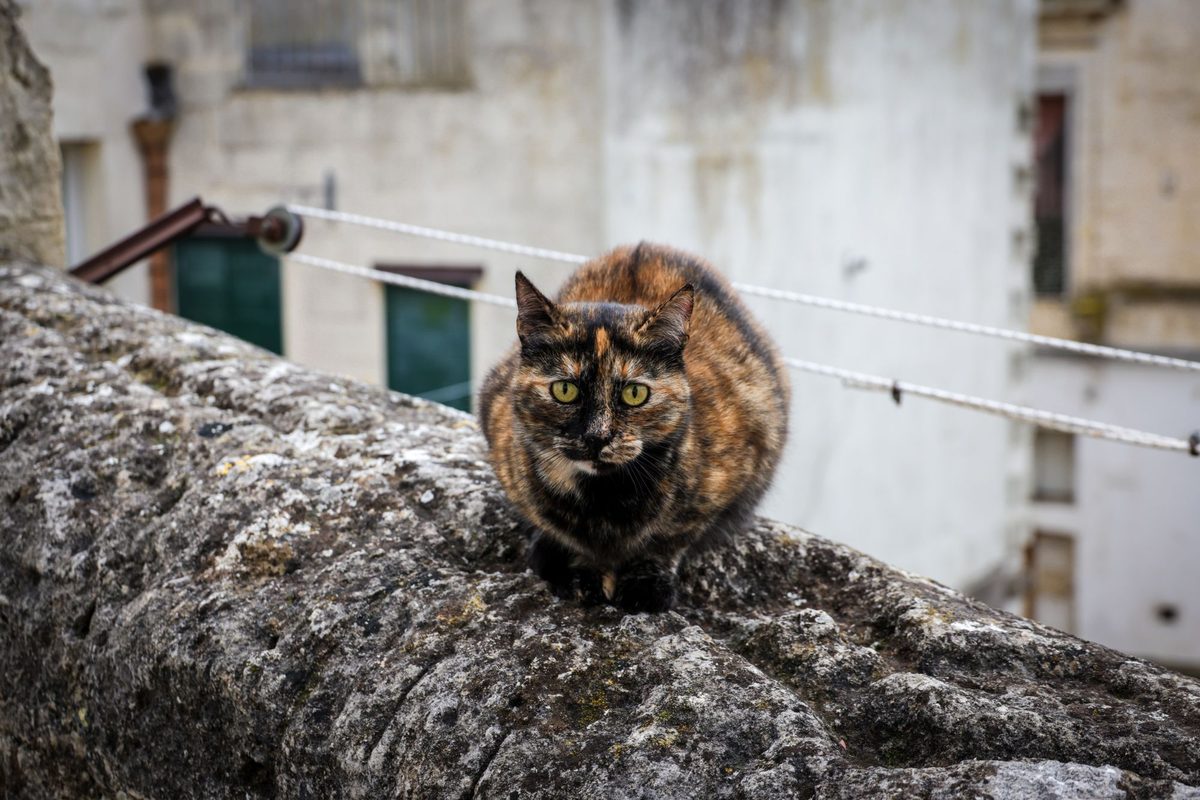
A tortoiseshell cat, or tortie, has black and red fur mixed in patches or flecks, or blue and cream in the paler dilute form. It is a coloring, not a breed: TICA's color rules, which its breeds follow, give the tortoiseshell its own color division.1 Nearly all torties are female, because the orange gene sits on the X chromosome.1 I counted 19,116 torties in public shelter records, about 1 in 13 cats with a recorded color, and they were adopted as often as other female cats at the same shelters.
Jump to: The genes, Always female?, Tortitude, 19,116 torties, Breed labels, Adoption, Names, Counting rules
What gives a tortoiseshell its patches
Every tortie carries two versions of one gene. TICA, The International Cat Association, defines a tortoiseshell as a cat with the sex-linked orange variant on one X chromosome and the ordinary version on the other. Early in the embryo, each pigment-making cell switches off one of its two X chromosomes at random, a process called lyonization. Cells that keep the orange X make red pigment and the rest make black, so the mix on each tortie is down to chance. TICA prefers an evenly patched cat with a streak of orange on the nose, called a blaze, but tells judges not to fault a cat without one.1
The Cat Fanciers' Association (CFA) describes the classic tortoiseshell as "black with patches of red or softly intermingled areas of red on both body and extremities," and its dilute partner, the blue-cream, as blue with patches of cream.2 Dilution comes from a separate gene, MLPH, that turns black into blue (grey) and red into cream. Pale orange patches on a black tortie are not cream, though: TICA says they are a lighter orange left by tabby patterning in the red areas.1 How common the dilute gene is in DNA-tested cats is on my rarest cat colors page.
Three close relatives get mixed up with torties all the time:
- Torbie. A tabby with patches of red or cream, which CFA calls a patched tabby.2 To tell one from a tortie, TICA says to look at the belly, feet, chin, muzzle and the skin around the eyes. A torbie shows the tabby's lighter brownish ground and pale face markings there, while a tortie shows deep solid color.1
- Calico. A tortie with white spotting. TICA files such cats in a separate tortie-with-white division,1 and CFA's calico has white on most of the underparts.2 The calico page sets the whole family side by side.
- Tortie point. A pointed cat, colored like a Siamese, whose points carry the tortie mix. TICA lists seal tortie point and blue tortie point among its tortie colors.1 CFA judges seal-tortie, chocolate-tortie, blue-cream and lilac-cream points in the Colorpoint Shorthair.3
Silver can sit on top of all this. In a tortoiseshell smoke, each hair is white at the base and colored at the tip, and the CFA standard says the cat "in repose appears tortoiseshell" until it moves.2
Are tortoiseshell cats always female?
Almost always. A cat needs two X chromosomes, one with orange and one without, to grow both colors, and a cat with two X chromosomes is typically female. TICA's color rules note that male tortoiseshells do occur through chromosome changes, such as an extra X (XXY, like Klinefelter syndrome in people) or chimerism, where two embryos fuse into one cat.1
The shelter files below fit that picture: fewer than 1 in 100 torties with a recorded sex were entered as male. Whether those male entries are real, and how the rate compares with published surveys, is worked through in are calico cats always female. Orange cats lean male for the same X chromosome reason, which orange cat facts counts.
Tortoiseshell cat personality: what the tortitude studies measured
Tortoiseshell cats are "frequently typecast as having too much attitude or 'tortitude,'" as a UC Berkeley news story put it.4 The idea is old. A 2016 UC Davis paper quotes an 1895 book calling the tortoiseshell "not over affectionate, and sometimes even sinister and most ill-tempered in its disposition."5 Three studies have tested coat color and personality in ways that include torties, and none of them watched a cat.
| Study | What it measured | What it did not measure |
|---|---|---|
| Delgado, Munera and Reevy, 20124 | What 189 people recruited on Craigslist believed: they rated five color groups on ten traits | Any real cat's behavior |
| Stelow, Bain and Kass, UC Davis, 20165 | How often owners said their own cat hissed, chased, bit or scratched people, in an online survey of 1,274 cats | Behavior seen by a researcher. Only 54 of the cats were tortoiseshells |
| González-Ramírez and Landero-Hernández, Mexico, 20226 | How 211 owners rated their own cat on ten traits; 32 cats fell in a tricolor group | Behavior seen by a researcher |
The 2012 survey measured belief. People rated black, white, bi-colored, tri-colored (tortoiseshell or calico) and orange cats, and "tortoiseshell cats were more likely to be depicted as both more intolerant and more trainable." The lead author, Mikel Delgado, then a psychology doctoral student at UC Berkeley, added: "To date there is little evidence that these perceived differences between differently colored cats actually exist."4
The 2016 survey measured owner reports. The UC Davis team hid its real question by not telling people that coat color was the point, posted the survey on the school's behavior service Facebook page and two cat email lists, and kept cats 1 year and older that were not outdoor-only. Its tortie group held 131 cats: 69 calicos, 54 tortoiseshells and 8 torbies. Their owners gave a mean score of 2.5 on a 0 to 20 scale of aggression toward people, against 2.0 for other female cats. Grey-and-white and black-and-white cats also scored high, which the authors had not expected.5
Split the group apart and the torties drop back. Owners reported some aggression toward people for 50 of the 69 calicos, or 72.5%, but for 26 of the 54 tortoiseshells, or 48.1%, close to the 43.5% for black cats. In that count, the tortoiseshells on their own did not differ significantly from cats of all colors. The authors call the color differences relatively small and say they could come from owners reading the scoring rules differently. They also list the limits: a self-selected sample from cat-loving websites, and behavior judged only by owners, with no observation by the researchers.5
The 2022 Mexico survey found its tricolor cats rated highest on one trait, stubborn, and found no significant personality differences between color groups. The authors suggest bigger and more even groups might have shown some.6 So the evidence for tortitude is a small gap in what owners reported, carried more by calicos than by torties, and no study has yet tied it to the genes that make the coat.
Quick quiz: how well do you know cat biology?
What is the relationship between claw scratching and interdigital gland secretion in cats?
Answer: Scratching pressure activates secretion release through paw pads. When cats scratch surfaces, their claw movements apply pressure to the paw pads, which activates the interdigital sebaceous glands and causes them to deposit their pheromone-containing secretions. This creates a combined visual and chemical message that marks territory more effectively than either method alone. Source
What is the scientific term for a species, like the cat, in which mating itself triggers the release of an egg?
Answer: Induced ovulator. Cats are 'induced ovulators,' meaning ovulation is triggered by the physical stimulus of mating rather than happening on its own each cycle. Source
What is the typical incubation period (time from infection to symptom onset) for feline herpesvirus 1 and feline calicivirus?
Answer: 2 to 10 days. Both FHV-1 and FCV have an incubation period of approximately 2 to 10 days. During this time, infected cats may shed virus before showing any signs of illness, which is why exposure to infected cats can lead to infection even if the source cat appears well. Source
How common are tortoiseshell cats? 19,116 in shelter records
Twelve public shelter datasets name a coat color for each cat: Austin, Texas, in an old and a new record system,78 Bloomington, Indiana,9 Corona, California, which publishes adoptions only,10 Edmonton, Alberta,11 Long Beach, California,12 Louisville, Kentucky,13 Midland, Texas,14 Montgomery County, Maryland,15 Norfolk, Virginia,16 Sacramento, California,17 and Sonoma County, California.18 Their records hold 19,713 stays by a tortoiseshell or torbie. Counting each cat once leaves 19,116 torties among 249,018 cats with a recorded color, or 7.7%.
| Shelter | Torties | Share of cats | Torbie | Dilute |
|---|---|---|---|---|
| Austin, 2013 to 2025 | 6,114 | 9.2% | 41.3% | 1.9% |
| Edmonton | 4,016 | 11.7% | 39.6% | 16.1% |
| Bloomington | 1,460 | 8.9% | 29.2% | 17.9% |
| Montgomery County | 1,286 | 7.0% | 18.7% | 22.6% |
| Long Beach | 1,232 | 4.6% | 6.3% | 18.0% |
| Louisville | 1,124 | 5.3% | 8.4% | 0.1% |
| Norfolk | 1,052 | 5.3% | 46.2% | 3.1% |
| Austin, 2025 to 2026 | 911 | 8.0% | 45.4% | 3.3% |
| Sacramento | 791 | 5.4% | 19.3% | 16.3% |
| Sonoma County | 722 | 6.2% | 16.8% | 18.3% |
| Corona (adoptions only) | 273 | 6.6% | 7.7% | 2.9% |
| Midland | 135 | 3.1% | 14.1% | 0.7% |
| All twelve datasets | 19,116 | 7.7% | 32.3% | 9.8% |
Edmonton recorded the most, 11.7% of its cats, and Midland the fewest, 3.1%. Part of that spread may be vocabulary. About a third of all torties were torbies, but the word torbie never appears in the Louisville or Sonoma County files and is rare in Long Beach's. There, a torbie shows up only when staff paired tortie with a tabby color.
Dilute torties are written down less than the genes predict
Six shelters write blue cream or dilute for at least 1 tortie in 7: Bloomington, Edmonton, Long Beach, Montgomery County, Sacramento and Sonoma County. There, 1,682 of 9,507 torties, or 17.7%, were dilute. Louisville writes "muted" instead, for 16.2% of its torties and for many of its calicos. The share is so close to the others that I read it as the same coat, though its files do not say so.
Because dilution has its own gene, separate from orange, and lightens both of a tortie's colors,1 a tortie should be about as likely to be dilute as a solid cat is to be blue. At those six shelters, 31.2% of plain solid cats were recorded as grey or blue rather than black, weighted to match where the torties were. So if every grey solid was a true blue and staff caught every blue-cream, about 3 in 10 torties would be dilute. They recorded about 1 in 6. Pale torties filed as plain torties would explain the gap, and so would grey tabbies filed as plain grey. These records cannot tell the two apart.
A few more details from the color field: 13.8% of torties had white recorded as well, from 40.6% in Edmonton down to none in Norfolk and Sacramento, which note only the main color. By the registry rules above, many of those cats would count as calicos or torties with white. Another 530 were tortie points, and 199 were smoke or silver torties, 178 of them in Edmonton. My smoke cat page counts every smoke coat in the same records.
Torties were a little less likely to arrive as kittens. At their first intake, 53.0% were under 1 year old, against 56.7% of other female cats at the same shelters, weighted the same way. Seniors, 10 years or older, were 3.8% against 3.7%.
Breed labels staff gave tortoiseshell cats
Eleven of the datasets also hold a breed, typed by staff from the cat's looks. Leaving out Corona, whose file gives no sex to compare with, 17,611 torties had one, and 96.7% got a domestic label: shorthair for 83.0%, medium hair for 9.8% and longhair for 3.9%. The other 573, or 3.3%, got a named breed, rarer than among other female cats at the same shelters, at 5.2%.
| Breed label | Torties | With a pointed color |
|---|---|---|
| Siamese | 294 | 264 |
| Manx | 47 | 1 |
| American Shorthair | 45 | 0 |
| Snowshoe | 41 | 40 |
| Maine Coon | 26 | 0 |
| Ragdoll | 25 | 22 |
| Persian | 16 | 1 |
| Himalayan | 15 | 13 |
| Balinese | 10 | 10 |
The Siamese label went mostly to tortie points: 264 of the 294 had a point color. CFA's Siamese comes in four point colors, seal, chocolate, blue and lilac,19 so under its rules those cats would be Colorpoint Shorthairs,3 and the flame point Siamese page explains how the red gene got into pointed cats. A breed label on a shelter record is a guess from appearance. It says nothing about a cat's parents.
Are tortoiseshell cats adopted faster?
No faster than other female cats. Eight of the datasets record how each stay ended, and I used the same stays as my black cat adoption count. Of 11,316 tortie stays, 57.5% ended in adoption. Had each shelter's torties matched all its cats, the figure would be 54.4%; had they matched its other female cats, 58.6%.
| Shelter | Tortie stays | Torties adopted | All cats adopted | Other females adopted |
|---|---|---|---|---|
| Austin, 2013 to 2025 | 5,991 | 56.8% | 54.0% | 58.2% |
| Long Beach | 1,056 | 29.0% | 29.1% | 33.0% |
| Norfolk | 1,042 | 63.0% | 60.2% | 63.1% |
| Montgomery County | 999 | 76.4% | 73.6% | 74.6% |
| Sacramento | 641 | 66.0% | 56.9% | 62.5% |
| Sonoma County | 597 | 52.9% | 47.3% | 56.2% |
| Louisville | 537 | 64.6% | 62.8% | 67.8% |
| Austin, 2025 to 2026 | 453 | 66.0% | 57.7% | 64.0% |
| All eight datasets | 11,316 | 57.5% | 54.4% | 58.6% |
Torties beat the all-cat rate in seven of the eight datasets and came within 0.1 points of it in Long Beach. Compared only with cats of the same age group at the same shelter, torties had about 17% higher odds of adoption than all other cats, but the same odds as other female cats (odds ratio 0.98, 95% range 0.94 to 1.03). Adopted torties waited a median of 27 days, the same as all adopted cats. In these files the tortie advantage is a female-cat advantage.
Names people give tortoiseshell cats
Nine datasets keep both a name and a sex for many of their cats, and 9,152 named torties are recorded as female. Torties make up 15.0% of all named female cats in these files. The top tortie names are the top names for female cats in general, led by Luna (66 torties), Bella (62) and Nala (44), and only 11.0% of female cats named Luna were torties. The names in the table lean the other way.
| Name | Tortie cats | All female cats with the name | Tortie share |
|---|---|---|---|
| Tortilla | 10 | 13 | 76.9% |
| Turtle | 12 | 20 | 60.0% |
| Marble | 16 | 31 | 51.6% |
| Tori | 13 | 26 | 50.0% |
| Reese | 12 | 26 | 46.2% |
| Hermione | 17 | 37 | 45.9% |
| Mocha | 22 | 50 | 44.0% |
| Spice | 15 | 38 | 39.5% |
| Ember | 20 | 51 | 39.2% |
| Donna | 11 | 30 | 36.7% |
| Chai | 10 | 29 | 34.5% |
| Snickers | 13 | 38 | 34.2% |
| Autumn | 25 | 81 | 30.9% |
Each count here is small, from 10 to 25 cats, so read the shares loosely. Most of the names fit three themes: plays on tortie (Tortilla, Turtle, Tori), brown and orange food and candy (Mocha, Spice, Chai, Snickers, Reese) and fire or fall colors (Ember, Autumn). Marble, Hermione and Donna fit none of them. Every name in the table was given to torties at five or more of the datasets, so no single litter explains it. Plain "Tortie" was the recorded name of 11 more cats, which my name cleaning sets aside as a color word. For more ideas, try the cat name generator or the most popular cat names count.
What I counted, and what the records miss
The shared rules for these files, and every dataset's dates, are under how the orange count was made. These points are specific to this page.
- Which cats. Every record whose color reads tortoiseshell, tortie, torbie, blue cream, dilute tortie or tortie point, plus records that pair black with orange and name no pattern. Records called calico stay out; a tortie with white stays in.
- One count per cat. A cat that came back counts once, with the color and age from its first stay. Edmonton has no IDs and Bloomington gives a new code for each intake, so a return there counts twice. Corona lists adopted cats only and gives no sex, so its 273 torties count in the coat shares only.
- The words. Torbie means the word torbie, or a tortie paired with a tabby color. Dilute means blue cream, dilute or dil; Louisville's muted is kept apart. Pointed means point or pt, and white means white anywhere in the color field.
- Comparisons. Other female cats are cats recorded as female that are not torties, torbies, calicos or orange. Each comparison takes the other group's rate at each shelter and weights it by that shelter's torties. The same-age odds compare torties with other cats inside each shelter and age group (Mantel-Haenszel); Sacramento, with no ages, counts as one group.
- Limits. Color, breed and sex are what staff saw and typed, with no gene test behind them. Shelters use different words, and Norfolk and Sacramento note only a main color. Shelter cats are not every cat, so these shares describe these records.
- Credit. Long Beach records are the City of Long Beach Animal Care Services' Animal Shelter Data under CC BY 4.0,20 which I merged with the other files and counted. Edmonton's are used under the City of Edmonton Open Data Terms of Use and Louisville's under Louisville Metro's open data terms. The others belong to the City of Austin, Texas, the City of Bloomington, the City of Corona, the City of Midland, Montgomery County, MD, the City of Norfolk, the City of Sacramento and the County of Sonoma. None of them checked or endorsed this page.
Use this data. Anyone may quote or chart these tortie numbers with a link back to this page. The shelter-by-shelter coat counts, the adoption table, the breed labels and the full name list are in tortoiseshell-cat-2026.csv.
Frequently asked questions
Are tortoiseshell cats rare?
No. About 1 in 13 shelter cats with a recorded color was a tortie, and in Edmonton's records it was closer to 1 in 9. Smoke and silver torties are the scarce kind: 199 of the 19,116, and 178 of those came from Edmonton.
Test your cat knowledge
Could you pick a torbie out of a lineup? Cat Trivia asks about coats and genes, plus behavior, breeds and history, and you can play free without signing up.
Play Cat TriviaUp next
 Cat FactsAre Calico Cats Always Female?The male calico and tortie records, and why many may be typing errors.
 Cat FactsOrange Cat Facts: Why Most Orange Cats Are MaleThe other half of every tortie, counted by sex.
 Cat FactsWhat Is the Rarest Cat Color? Amber, Russet, Albino and MoreAmber, russet and the colors DNA tests almost never find.
Christopher writes and runs Cat Trivia Games. The studies, standards and datasets behind this page are listed below, and how the site is made and corrected is on the editorial policy page. More about the author.
References
- The International Cat Association (TICA). Uniform Color Descriptions and Glossary of Terms, version D (tortoiseshell division, X inactivation, torbies, dilution and pointed tortie colors). back
- The Cat Fanciers' Association. American Shorthair show standard, revised 2024 (tortoiseshell, blue-cream, calico, smoke and patched tabby colors). back
- The Cat Fanciers' Association (CFA). Colorpoint Shorthair: breed profile and color classes. back
- UC Berkeley News, Yasmin Anwar, October 23, 2012, on Delgado, Munera and Reevy, Anthrozoös, 2012. Don't be so fast to judge a cat by its color, study warns. back
- Stelow, Bain and Kass, University of California, Davis, Journal of Applied Animal Welfare Science, 2016 (full text, UC Davis Previously Published Works). The relationship between coat color and aggressive behaviors in the domestic cat. back
- González-Ramírez and Landero-Hernández, Autonomous University of Nuevo León, Animals, 2022 (PubMed Central). Cat coat color, personality traits and the Cat-Owner Relationship Scale: a study with cat owners in Mexico. back
- City of Austin, Texas, data.austintexas.gov, public domain, read November 19, 2026. Austin Animal Center Intakes (10/01/2013 to 05/05/2025) and Austin Animal Center Outcomes (10/01/2013 to 05/05/2025). back
- City of Austin, Texas, data.austintexas.gov, no license stated on these datasets, read November 19, 2026. Austin Animal Center Intakes and Austin Animal Center Outcomes (new system). back
- City of Bloomington, Indiana, data.bloomington.in.gov, no license stated on the dataset, read November 19, 2026. Animal Shelter Animals. back
- City of Corona, Corona Animal Services, CorStat, no license stated on the dataset, read November 19, 2026. CorStat - Animal Adoptions. back
- City of Edmonton, data.edmonton.ca, under the City of Edmonton Open Data Terms of Use, read November 19, 2026. Animals Admitted to the Animal Care & Control Centre. back
- City of Long Beach Animal Care Services, data.longbeach.gov, CC BY 4.0, read November 19, 2026. Animal Shelter Data. back
- Louisville Metro Animal Services, Louisville Metro open data (LOJIC), under the Open Data Platform Terms and Use, read November 19, 2026. Louisville Metro KY - Animal Service Intake and Outcome. back
- City of Midland, Texas, ArcGIS Hub, no license stated (the city provides the data as is, with no guarantee), read November 19, 2026. Animal Intake (public view). back
- Montgomery County, MD, dataMontgomery, public domain, read November 19, 2026. OAS - Animal Shelter Pathway. back
- City of Norfolk, data.norfolk.gov, no license stated on the dataset, read November 19, 2026. Norfolk Animal Care and Adoption Center (NACC). back
- City of Sacramento, ArcGIS Hub, no license stated, read November 19, 2026. Animal Intakes and Outcomes for the Last 3 Years. back
- County of Sonoma Department of Health Services, data.sonomacounty.ca.gov, no license stated on the dataset, read November 19, 2026. Animal Shelter Intake and Outcome. back
- The Cat Fanciers' Association (CFA). Siamese: breed profile and colors. back
- Creative Commons. Attribution 4.0 International (CC BY 4.0). back
Written by Christopher Fox under our editorial policy.