 Cat Trivia Games
iOS App
Tuxedo Cat Breeds: Which Breeds Come in Black and White
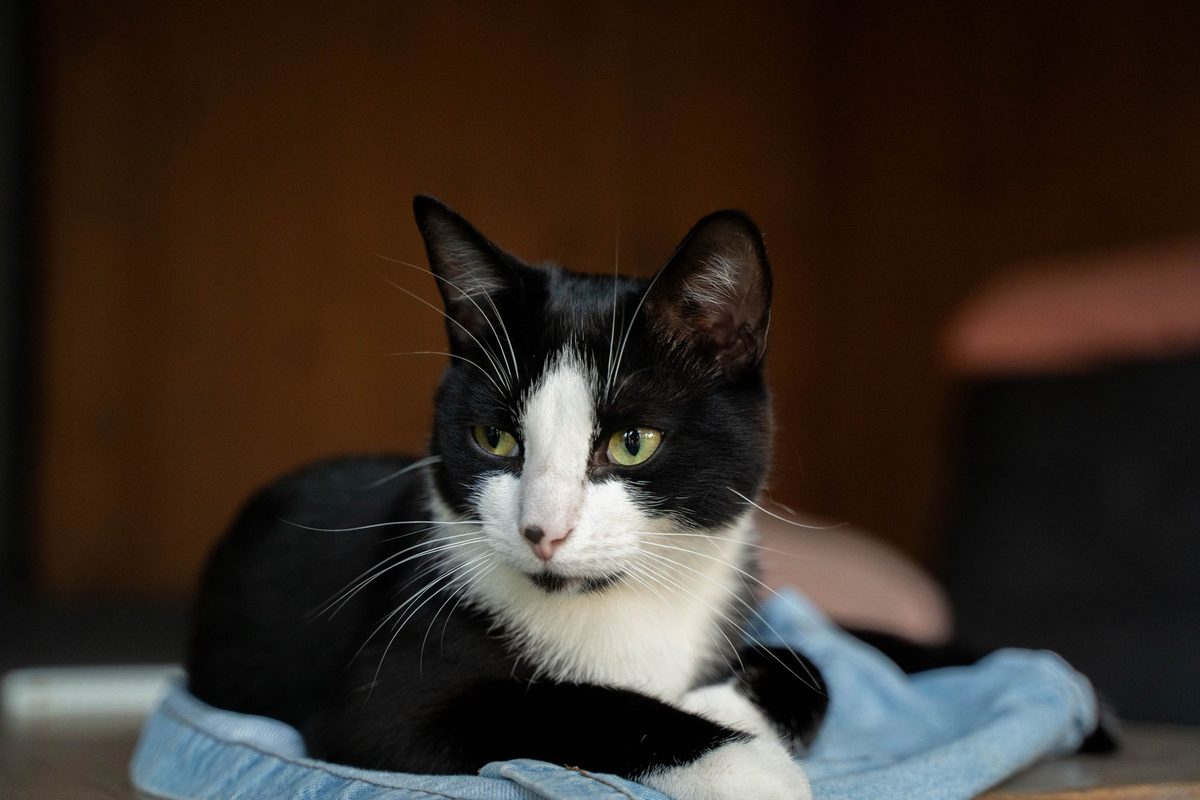
A tuxedo cat has black fur on its back and sides and white fur on its chest and belly.1 Tuxedo is a coat pattern, not a breed. Registries list it as bi-color, or as black and white.2 Below are 12 breeds whose standards accept it and six whose standards rule it out. The gene, the famous tuxedos and the "smarter" myth are in tuxedo cat facts.
What registries call a tuxedo
The word tuxedo is not in any of the registry documents cited on this page. Each registry has its own terms for a black cat with white.
- CFA uses bi-color. The American Shorthair standard describes it as "white with unbrindled portions of black." A cat that is white with color only on the head, tail and legs is a van.2
- TICA says "a black and white cat is judged in the 'traditional solid with white' division." Its color guide names four white patterns: gloved, mitted, bi-color and van.3
- FIFe writes colors as codes. Black is n. The amount of white gets a number: 01 for van, 02 for harlequin, 03 for bicolour.4 Harlequin is a FIFe term. I did not find it in the CFA standards or the TICA guide cited here.
Breeds that come in black and white
I opened the CFA standard for each breed below in November 2026 and copied how it lists black and white. The coat and size columns come from the same standards. Standards get revised, so follow the reference if the detail matters to you.
| Breed | Coat | Size in the standard | How the standard lists black and white |
|---|---|---|---|
| American Shorthair | Short and thick | "Medium to large" | Bi-color: "white with unbrindled portions of black."2 |
| British Shorthair | "Short, very dense" | "Medium to large" | "Black and white" is the first bi-color listed.6 |
| Maine Coon | Long, "heavy and shaggy" | "Medium to large" | "A combination of black and white, with or without white on face."7 |
| Norwegian Forest Cat | Long double coat | Males "large and imposing" | Solid color and white: "black and white," vans included.8 |
| Siberian | Triple coat | "Medium to medium large" | Bi-color is "solid color and white," with white "allowed in any amount." The van class names black and white.9 |
| Persian | "Long and thick" | "Medium to large" | Bi-color: "black and white."10 |
| Exotic | "Dense, plush," medium length | "Medium to large" | Bi-color: "black and white."11 |
| Manx | Shorthair and longhair | "Medium in size" | Bi-color: the solid colors, black among them, "with the addition of white."12 |
| Cornish Rex | Short, soft and wavy | "Small to medium" | Bi-color: "black and white."13 |
| Turkish Angora | Single coat, long on the tail and ruff | "Medium size" | "Black & White" is in the parti-color and bi-color class.14 |
| Japanese Bobtail | Shorthair and longhair | "Medium sized" | "Black & White" has a color class of its own.15 |
| American Curl | Shorthair and longhair | Females 5 to 8 pounds, males 7 to 10 pounds | Bi-color: "black and white."16 |
This is a sample. I kept to CFA, and to standards that name black and white in words I could quote. Other registries keep their own lists. Eight of these 12 breeds are also in my table of breeds that come in tabby.
How much white: bicolor, harlequin and van
Registries sort cats with white by how much of the coat is white. TICA and FIFe use different cutoffs, so both are shown.
| Term | Registry | What the rule says |
|---|---|---|
| Mitted | TICA | White on the paws, back legs, belly, chest and chin. The cat is "typically about 1/4 white."3 |
| Bicolour (03) | FIFe | At least half colored and no more than three quarters. White on the legs, chest, face and stomach.5 |
| Bi-color | TICA | Colored head, back and tail, with white legs, feet and underside. The cat is generally one third to two thirds white.3 |
| Harlequin (02) | FIFe | Colored patches cover "at least 1/4, but no more than 1/2" of the body.5 |
| Van (01) | FIFe | Two patches of color on the face, split by a white blaze, and one patch from the rump to the tip of the tail. Chest and belly must be white.5 |
| Van | TICA | "A predominantly white cat with colored patches." At the far end, only a colored cap and tail.3 |
| Van | CFA | White, with color "confined to the head, tail and legs." One or two small patches on the body are allowed.2 |
The dictionary tuxedo, black on top and white underneath, sits in the first three rows.1 That match is my reading. No registry rule here uses the word.
CFA standards set a floor in place of a fraction. For a British Shorthair bi-color the "preferred minimum" is "some white on the feet, legs, undersides, chest and muzzle."6 A Maine Coon must "have white on bib, belly, and all four paws."7 A small chest spot is not enough. In the Manx standard, cats "with no more white than a locket and/or button(s) do not qualify" as bi-color.12
The same gene variant can give different amounts of white. In one family of cats, three kittens inherited the identical white spotting variant from their mother and ended up with different amounts of white.24 I cover that gene in where the white comes from.
Breeds that cannot be tuxedo
A breed cannot be tuxedo when its standard accepts one color only, or disqualifies white. These six are from the CFA standards as of November 2026.
- Bombay. The coat "should be black to the roots," and "lockets or spots" disqualify.18 A Bombay is a black cat with no white at all.
- Russian Blue. The standard disqualifies "any color other than blue" and a "locket or button."19
- Chartreux. The color is "any shade of blue-gray from ash to slate." A "white locket" disqualifies.20
- Korat. The standard disqualifies "any color but silver-tipped blue" and a "white spot or locket."21
- Havana Brown. The color is "any even shade of rich, warm brown," and a "locket or button" disqualifies.22
- Siamese. A pointed cat in seal, chocolate, blue or lilac. "White toes and/or feet" disqualify.23
The Turkish Van is a special case. It comes in black and white, in the van pattern only. Color on more than 15% of the body, not counting the head and tail, disqualifies, and the standard warns against markings that make a cat "appear bi-color."17
What breed is my tuxedo cat?
Probably a domestic shorthair or domestic longhair, which means a cat with no breed. A UK study used the vet records of 7,936 cats that died in 2019. In those records 88.2% were crossbred, a label that covered domestic shorthairs, mediumhairs and longhairs as well as mixes of breeds. Only 10.3% were purebred.25
Black and white markings do not narrow it down. Coat colors and patterns are single-gene traits found across the general cat population, and breeds were built from ordinary street cats.26 A pedigree is what places a cat in a breed. A stocky shorthaired tuxedo with no papers is a domestic shorthair, however much it looks like a British Shorthair.
A DNA ancestry test can add a clue about where a cat's ancestors came from. I go through what those tests can show in what breed is my tabby cat.
Frequently asked questions
Is a tuxedo cat a breed?
No. It is a black and white coat pattern that many breeds share. FIFe's code system says the code for a color or pattern is "always the same, no matter the breed."4
What breed is a tuxedo cat?
There is no single breed. The 12 in the table above all accept black and white, and most cats of any color have no breed on record. In the UK study, 88.2% of cats were recorded as crossbred.25
Are tuxedo cats rare?
I could not find a reliable count of tuxedo cats, so I have no percentage to give. Two things I can source: black and white is written into all 12 standards in the table, and white spotting is dominant over plain color, so one copy from one parent is enough to put white on a kitten.24
Are tuxedo cats always black and white?
Not by the dictionary. The Cambridge Dictionary entry describes "black or dark fur" on the back and sides, with white underneath.1 Registries have no tuxedo class. They list blue and white, red and white, and cream and white under the same bi-color rules as black and white.10
Are tuxedo cats male or female?
Either. White spotting comes from the KIT gene on chromosome B1, which is not a sex chromosome.24
Test your breed knowledge
Cat Trivia has a full category of breed questions. It is free to play, with no account.
Play Cat TriviaUp next
 Cat FactsTuxedo Cat Facts: The Gene, Famous Tuxedos and the Smart MythWhere the white comes from, plus Socks, Simon and the first cat in space.
 Cat FactsTabby Cat Breed: The Pattern and the Breeds That Wear ItStripes, swirls and spots, and the 14 breed standards I checked for them.
 Cat FactsBlack Cat Facts, Trivia Questions and AnswersThe same black coat with no white on it.

Christopher writes and runs Cat Trivia Games. The sources for this article are listed below, and how the site is made and corrected is on the editorial policy page. More about the author.
References
- Cambridge Dictionary. Tuxedo (cat sense): definition. back
- The Cat Fanciers' Association. American Shorthair show standard, revised 2024 (bi-color and van). back
- The International Cat Association (TICA). Uniform Color Descriptions and Glossary of Terms (with white: gloved, mitted, bi-color and van patterns). back
- Fédération Internationale Féline (FIFe). FIFe EMS System (codes for colors, patterns and amount of white). back
- Fédération Internationale Féline (FIFe). Breed standards, General Part: colour varieties with white, dated January 1, 2026. back
- The Cat Fanciers' Association. British Shorthair show standard, revised 2026 (bi-color pattern colors). back
- The Cat Fanciers' Association. Maine Coon Cat show standard, revised 2025 (bi-color color class). back
- The Cat Fanciers' Association. Norwegian Forest Cat show standard, revised 2026 (calico and bi-color). back
- The Cat Fanciers' Association. Siberian show standard, revised 2024 (bi-color and van bi-color). back
- The Cat Fanciers' Association. Persian show standard, revised 2025 (calico and bi-color division). back
- The Cat Fanciers' Association. Exotic show standard, revised 2026 (bi-color). back
- The Cat Fanciers' Association. Manx show standard, revised 2026 (bi-color). back
- The Cat Fanciers' Association. Cornish Rex show standard, revised 2023 (calico and bi-colors). back
- The Cat Fanciers' Association. Turkish Angora show standard, revised 2021 (parti-color and bi-color class). back
- The Cat Fanciers' Association. Japanese Bobtail show standard, revised 2022 (color classes). back
- The Cat Fanciers' Association. American Curl show standard, revised 2018 (bi-color and van bi-color). back
- The Cat Fanciers' Association. Turkish Van show standard, revised 2009 (color and pattern). back
- The Cat Fanciers' Association. Bombay show standard, revised 1997 (color and disqualifications). back
- The Cat Fanciers' Association. Russian Blue show standard, revised 1999 (color and disqualifications). back
- The Cat Fanciers' Association. Chartreux show standard, revised 1999 (color and disqualifications). back
- The Cat Fanciers' Association. Korat show standard, revised 2006 (color and disqualifications). back
- The Cat Fanciers' Association. Havana Brown show standard (color and disqualifications). back
- The Cat Fanciers' Association. Siamese show standard, revised 2026 (colors and disqualifications). back
- David and colleagues, G3: Genes, Genomes, Genetics, 2014 (PubMed Central). Endogenous retrovirus insertion in the KIT oncogene determines White and White spotting in domestic cats. back
- Teng and colleagues, Journal of Feline Medicine and Surgery, 2024 (PubMed Central). Life tables of annual life expectancy and risk factors for mortality in cats in the UK. back
- Kurushima and colleagues, Animal Genetics, 2013 (PubMed Central). Variation of cats under domestication: genetic assignment of domestic cats to breeds and worldwide random bred populations. back
Written by Christopher Fox under our editorial policy.